

Variation during reproduction:
Organisms show similarities to parents but also small differences called variations.
-
Asexual reproduction: Very little variation (only due to minor DNA copying errors).
-
Sexual reproduction: Large variation because offspring get genes from both parents.
-
Variations help some individuals survive better and become the basis of evolution.
Exam tips for this topic:
-
Be ready to write difference between asexual and sexual variation in 2–3 lines.
-
For 3-mark answers, always mention variation → survival → evolution.
-
Keep an example ready, like heat-resistant bacteria survive a heat wave.
What are inherited traits?
Traits are characteristics that are passed from parents to offspring.
All offspring show a basic body design but also differences.
Example:
Height, eye colour, earlobe type.
Exam tips for this topic:
-
Write a short definition of trait and variation—these often come in 1-mark questions.
-
Keep examples ready: free vs. attached earlobe, tall vs. short plants.
-
Don’t call acquired traits “inherited”—they are NOT passed to next generation.
Mendel’s experiments & Laws
Characteristics selected by Mendel:
The pea plant (Pisum sativum) has a lot of different characters. Mendel chose only seven characters from among these contrasting characters.
|
Characteristics
|
Dominant
|
Recessive
|
| The length of the stem | Tall | Dwarf |
| The position of the flower | Axial | Terminal |
| The colour of the pod | Green | Yellow |
| The shape of the pod | Inflated | Constricted |
| The shape of the seed | Round | Wrinkled |
| The colour of the flower | Violet | White |
| The colour of the cotyledon | Yellow | Green |
Reason for choosing pea plant and mendels success:
-
Pea plants are naturally self-pollinated, making it easy to obtain pure breeding lines.
-
They show clear contrasting traits and have seven well-defined character pairs.
-
The plants are easy to cultivate, have a short life cycle, and allow study of multiple generations.
-
Cross-pollination is easy to control, and the hybrids are fully fertile.
-
Mendel maintained careful statistical records, helping him derive accurate numerical ratios.
Mendel’s work was not recognised initially because it was poorly publicised, used unfamiliar statistical methods, and introduced the unclear concept of “factors” for inheritance.
A genotype refers to a plant's or animal's genetic makeup or gene content.
Phenotype refers to a plant's or animal's external visible appearance.
Phenotype refers to a plant's or animal's external visible appearance.
Homozygous: An individual having two identical alleles for a trait (e.g., TT or tt).
Heterozygous: An individual having two different alleles for a trait (e.g., Tt), where the dominant allele expresses itself.
Heterozygous: An individual having two different alleles for a trait (e.g., Tt), where the dominant allele expresses itself.
a. Monohybrid cross – Law of dominance
Mendel crossed tall (\(T\)) and short (\(t\)) pea plants.
-
F1: All tall → tall is dominant.
-
F2: \(3\) tall : \(1\) short ratio → both traits were present but tall was expressed.
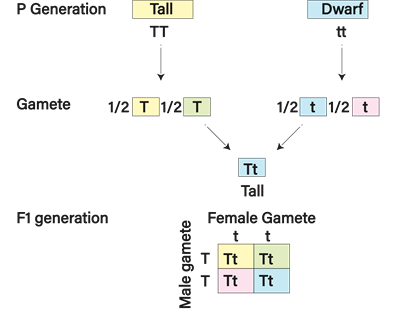
Monohybrid cross
Exam Tips
-
Always write F1 = \(100%\) dominant trait.
-
Always write F2 phenotype ratio = \(3:1\) and genotype ratio = \(1:2:1\).
-
Use a Punnett square if the question is for 3 or 5 marks—gets full marks.
b. Dihybrid cross – Law of Independent Assortment
Mendel crossed plants with two traits:
-
Seed shape: round (\(R\)) / wrinkled (\(r\))
-
Seed colour: yellow (\(Y\)) / green (\(y\))
F2 ratio: \(9:3:3:1\), showing traits assort independently.
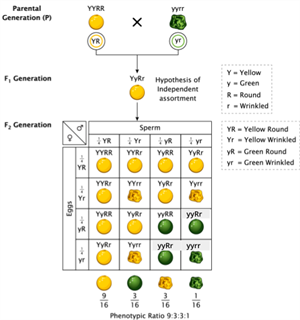
Dihybrid cross
Exam Tips
-
Memorize the \(9:3:3:1\) ratio — it is asked very often.
- F2 Genotypic ratio: \(1:2:2:4:1:2:1:2:1\)
-
Use the phrase “new combinations appear in \(F2\) (round-green, wrinkled-yellow)”.
-
Diagram of a dihybrid Punnett square can fetch 1–2 extra marks.
Dominant & Recessive traits
-
Dominant trait = expressed even if one allele is present (T).
-
Recessive trait = expressed only when both alleles are recessive (tt).
Law of segregation
An \(F1\) hybrid is created when two contrasting factors are combined. When gametes are created, the two components of the allelic pair stay together without mixing, and only one penetrates each gamete.
Exam Tips
-
Always give an example: T = tall, t = short.
-
Use key words: allele, expression, genotype, phenotype.
-
For 1-mark MCQs, remember: dominant hides recessive.
How traits get expressed
Genes are portions of DNA that code for proteins. Proteins control physical traits.
Example:
A gene may produce an enzyme that controls plant height.
Exam Tips
-
Write “genes → proteins → traits” as a flow.
-
Define gene as a segment of DNA.
-
In 3-mark questions, mention how efficient/inefficient enzyme leads to tall/short.