

Plastids:
Plastids are double-membrane organelles found in plant cells and some algae. They help in food preparation and storage.
Types of plastids:
Chloroplasts are green plastids that perform photosynthesis. Chromoplasts give colour to flowers and fruits. Leucoplasts are colourless plastids that store food.
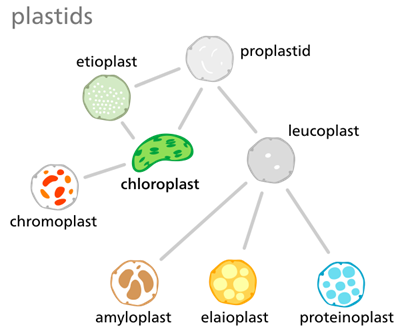
Types of plastids
Chloroplast:
Chloroplasts are green plastids containing chlorophyll and are mainly found in green parts of plants.
Chloroplast – envelope:
Each chloroplast is surrounded by an outer and inner membrane forming the envelope.
Chloroplast – stroma:
Stroma is the fluid inside the chloroplast and contains enzymes, DNA and 70S ribosomes.
Chloroplast – thylakoids and grana:
Thylakoids are flattened sacs with photosynthetic pigments. They are stacked to form grana, which are connected by stroma lamellae.
Functions of chloroplast:
Chloroplasts carry out photosynthesis and help in starch and lipid synthesis.
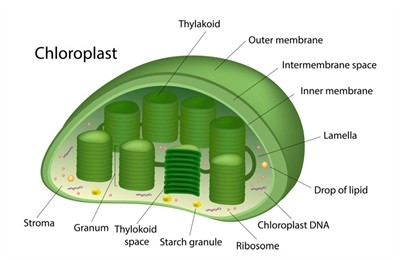
Chloroplast and its structure
Photosynthesis:
Photosynthesis is the process by which green plants make food using sunlight.
Photosynthesis – process:
Carbon dioxide and water combine in the presence of chlorophyll and light to form glucose, releasing oxygen. Photosynthesis occurs mainly in green leaves.
Photosynthetic pigments:
Photosynthetic pigments absorb light energy. Chlorophyll a is the primary pigment, while chlorophyll b and carotenoids are accessory pigments. Together they form photosystems.
Role of sunlight:
Photosynthesis occurs in two stages inside the chloroplast.
Light reaction:
The light reaction occurs in the thylakoid membranes and produces ATP and NADPH.
Dark reaction (Calvin cycle):
The dark reaction occurs in the stroma and uses ATP and NADPH to convert carbon dioxide into carbohydrates.
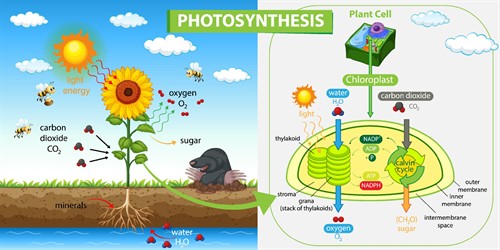
Photosynthesis
Factors affecting photosynthesis:
Photosynthesis is affected by internal factors like pigments and leaf age, and external factors such as light, carbon dioxide, temperature, water and minerals.
Mitochondria:
Mitochondria are double-membrane organelles known as the powerhouse of the cell because they produce ATP.
Mitochondria:
structure:
The outer membrane is smooth and permeable. The inner membrane forms folds called cristae, which contain oxysomes for ATP synthesis.
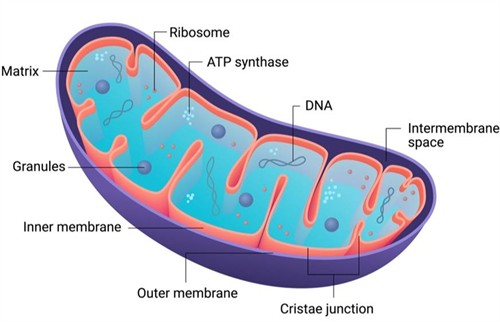
Mitochondria
Mitochondrial matrix:
The matrix contains enzymes for respiration, DNA and ribosomes.
Functions of mitochondria:
Mitochondria carry out cellular respiration, produce ATP and regulate cell metabolism.
Respiration:
Respiration is the process of releasing energy from food. Gas exchange with the environment is called external respiration, while energy release inside cells is called cellular respiration.
Aerobic respiration:
Aerobic respiration is the complete breakdown of glucose in the presence of oxygen to release carbon dioxide, water and energy.
Equation: Glucose + Oxygen → Carbon dioxide + Water + ATP
Stages of aerobic respiration:
Glycolysis:
Glucose splits into pyruvic acid in the cytoplasm.
Krebs cycle:
Pyruvic acid is oxidized in the mitochondrial matrix.
Electron transport chain:
ATP is produced on the inner mitochondrial membrane using oxygen.
Anaerobic respiration:
Anaerobic respiration occurs without oxygen and releases less energy. Glucose is converted into ethanol and carbon dioxide or lactic acid.
Respiratory quotient (RQ):
Respiratory quotient is the ratio of carbon dioxide released to oxygen consumed.
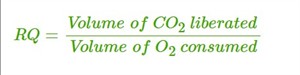
R.Q