

Chapter plan
Importance
The chapter Plant Anatomy and Plant Physiology explains the internal structure of plants and the physiological processes that help plants survive and function. Clear understanding of tissues, vascular systems, and metabolic processes is essential for scoring in both theory questions and diagrams. Overall, the chapter is conceptual, diagram-based, and scoring when studied systematically.
Expected question distribution
-
Part I (1 mark): One definition / identification question
-
Part IV (4 marks):
-
Diagram + labeling or
-
Differences between dicot and monocot structures
(Exact distribution may vary slightly in examinations.)
-
Learning objectives
-
Understand the tissue systems in plants and their role in support, protection, and transport.
-
Describe the internal structure of dicot and monocot roots, stems, and leaves with diagrams.
-
Differentiate clearly between dicot and monocot root, stem, and leaf.
-
Explain the structure and functions of plastids, chloroplast, and mitochondria.
-
Understand photosynthesis and respiration, including their stages and significance in plants.
Levels of organisation in plants
Living organisms show different levels of organisation. Atoms and molecules combine to form organelles, organelles form cells, cells form tissues, tissues form organs, and organs work together as organ systems to form an organism.
Plants also show this organisation because they are made of specialised tissues and organs. Biological organisation refers to arranging life forms based on the complexity of their cells and tissues.
Purpose of tissues in plants
Plant tissues help to:
-
Transport water, minerals, and food - xylem and phloem
-
Protect the plant body - dermal tissue
-
Perform photosynthesis and storage - ground tissue
In multicellular plants, similar cells group together to perform specific functions. Such groups of cells are called tissues.
Tissue: A group of cells with a common origin, similar structure, and same function.
Tissue system in plants
Plants need different tissues working together to perform various functions such as making food, protecting internal parts, transporting materials, preventing water loss, and providing strength and flexibility to the plant body.
A group of tissues working together for a common function forms a tissue system.
Sachs (1875) classified plant tissue systems into three types:
-
Dermal tissue system
-
Ground tissue system
-
Vascular tissue system
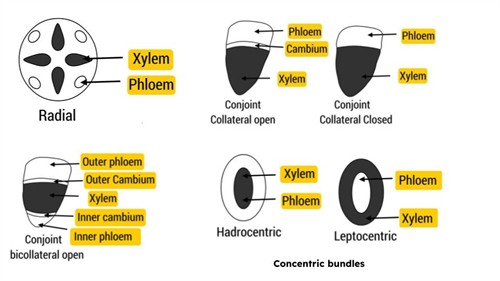
Vascular bundles
Dermal (epidermal) tissue system
This system forms the outer protective covering of the plant.
Epidermis
-
Single layer of tightly packed parenchyma cells
-
Protects inner tissues
-
Covered with cuticle (except roots) to reduce water loss
Stomata
Stomata are present on the leaf epidermis and are surrounded by guard cells containing chloroplasts. They help in gas exchange and transpiration; in dicots they are more numerous on the lower surface, while in monocots they are equally distributed on both surfaces.
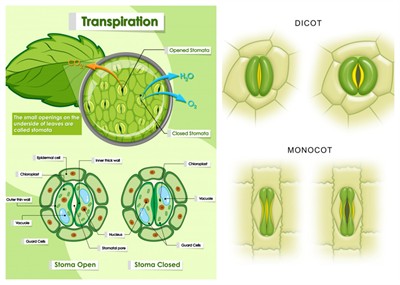
Figure left to right: (a) Depicting the process of transpiration in stomata (b) Depicting the stomata of monocot (grass) and dicot (bean) plants
Epidermal outgrowths
-
Root hairs: Absorb water and minerals
-
Trichomes: Hair-like structures on stems; reduce transpiration and provide protection
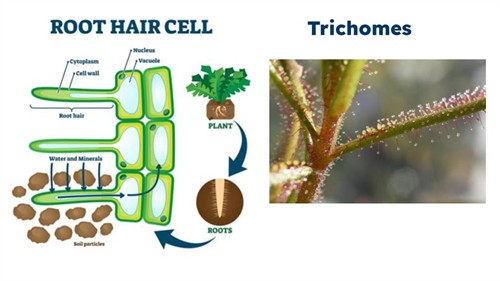
Epidermal outgrowths
Ground tissue system
- Largest tissue system
-
Found between epidermis and vascular tissues
-
Includes cortex, endodermis, pericycle, and pith
-
In leaves, forms mesophyll (photosynthesis)
Parts and functions
-
Cortex: Storage and support
-
Endodermis: Regulates movement of water and minerals
-
Pericycle: Helps in secondary growth
-
Pith: Stores and transports nutrients
Tissue system and its functions:
|
Tissue system
|
Components
|
Functions
|
| Dermal tissue system |
Epidermis and periderm
(In older stem and roots)
|
|
| Ground tissue system |
Parenchyma tissue
Collenchyma tissue
Sclerenchyma tissue
|
|
| Vascular tissue system |
Vascular tissue
Xylem tissue
Phloem tissue
|
|
Differences between dicot and monocot root:
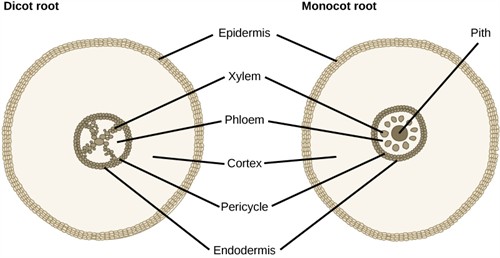
Dicot and monocot root
|
Tissues
|
Dicot root
|
Monocot root
|
| Number of xylem | Tetrarch | Polyarch |
| Cambium | Present(During secondary growth only) | Absent |
| Secondary growth | Present | Absent |
| Pith | Absent | Present |
| Conjunctive tissue | Parenchyma | Sclerenchyma |
| Example | Bean | Maize |
Differences between dicot stem and monocot stem:
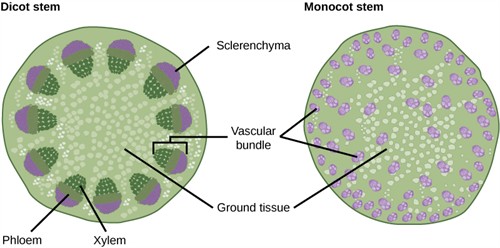
Dicot and monocot stem
| Tissues |
Dicot stem
|
Monocot stem |
| Hypodermis | Collenchymatous | Sclerenmatous |
| Ground tissue |
Differentiated into cortex, endodermis, pericycle and pith
|
Undifferentiated |
| Vascular bundles |
|
NumerousSmaller near periphery, bigger in the centreScatteredClosed (Cambium absent)Bundle sheath present |
| Secondary growth | Present | Mostly absent |
| Pith | Present | Absent |
| Medullary rays | Present |
Absent
|
Differences between of dicot and monocot leaf:
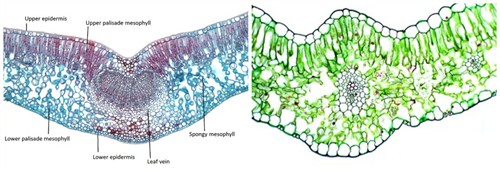
Left to right: Dicot and monocot leaf
|
Dicot leaf
|
Monocot leaf
|
|
Dorsiventral leaf
|
Isobilateral leaf |
|
Mesophyll is differentiated into palisade and spongy parenchyma
|
Mesophyll is not differentiated into palisade and spongy parenchyma |
Reference:
https://commons.wikimedia.org/wiki/File:Figure_30_03_04.jpg
https://www.flickr.com/photos/71183136@N08/6985212944
https://en.m.wikipedia.org/wiki/File:Dicot_leaf_L.jpg
https://commons.wikimedia.org/wiki/File:Figure_30_02_06.jpg