

All living organisms need a continuous supply of oxygen, nutrients, water and hormones to perform life activities. In unicellular organisms, transport occurs by diffusion and osmosis, but in multicellular organisms this is insufficient due to large body size. Hence, a specialised system called the circulatory system is required.
The circulatory system is defined as the system that transports substances like oxygen, nutrients and wastes throughout the body.
In animals, the circulatory and excretory systems together form the transportation system.
Blood and its composition:
Blood is a red-coloured fluid connective tissue with a slightly alkaline pH of \(7.4\). It acts as the main transport medium and helps in defence, temperature regulation and maintenance of pH. Blood is composed of plasma and formed elements.
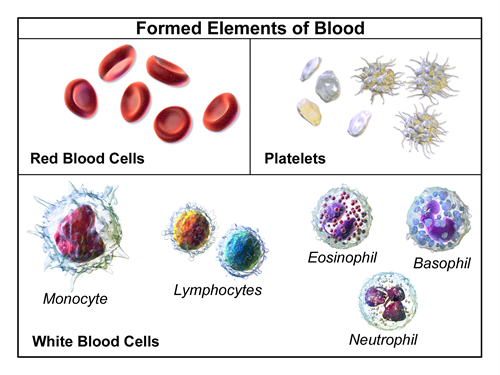
The components of blood
Plasma is the pale yellow liquid portion of blood that forms about 55% of its volume and contains water, proteins, glucose, hormones, enzymes and wastes.
Formed elements constitute about 45% of blood and include red blood corpuscles (RBCs), white blood corpuscles (WBCs) and platelets.
Red blood corpuscles and platelets:
Red blood corpuscles (RBCs) are the most numerous blood cells and are produced in the bone marrow.
RBCs contain haemoglobin, a respiratory pigment that transports oxygen from lungs to tissues. The life span of RBCs is about \(120\) days. A decrease in RBC count is called anaemia.
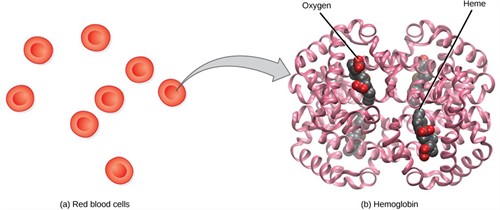
Structure of haemoglobin carrying oxygen
Platelets are small, colourless, non-nucleated cell fragments with a lifespan of \(8\)–\(10\) days. They play a vital role in blood clotting, preventing excessive blood loss.
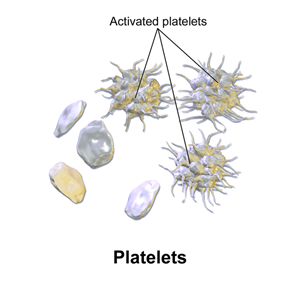
Platelets
A decrease in platelet count is known as thrombocytopenia.
White blood corpuscles:
White blood corpuscles (WBCs) are colourless, nucleated cells that help in the defence mechanism of the body. They show amoeboid movement and are formed in bone marrow and lymphoid organs. WBCs are classified into granulocytes and agranulocytes.
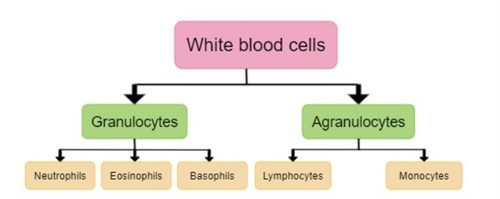
Types of WBC's
Neutrophils are phagocytic and increase during infection, eosinophils increase during allergies and parasitic infections, and basophils release histamine and heparin during inflammation.
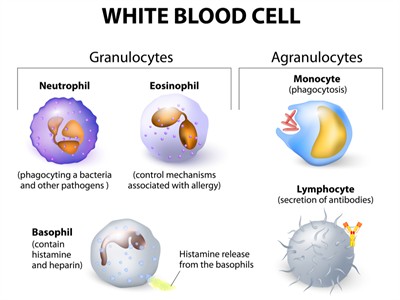
Types of white blood cells
Lymphocytes produce antibodies and provide immunity, while monocytes engulf pathogens.
An increase in WBC count is called leucocytosis, and a decrease is called leukopenia.
Blood vessels:
Blood vessels are tubes that transport blood throughout the body.
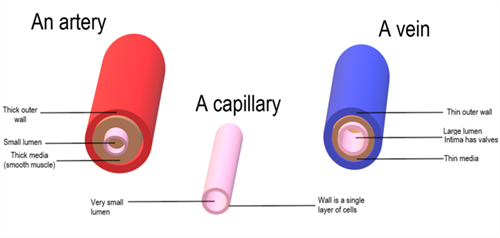
Internal structure of artery and vein
Capillaries are the smallest blood vessels with thin walls that allow the exchange of gases, nutrients and wastes between blood and tissues.
Structure of the human heart:
The human heart is a hollow, muscular pumping organ located between the lungs in the thoracic cavity. It is covered by a double-walled pericardium containing pericardial fluid that reduces friction.
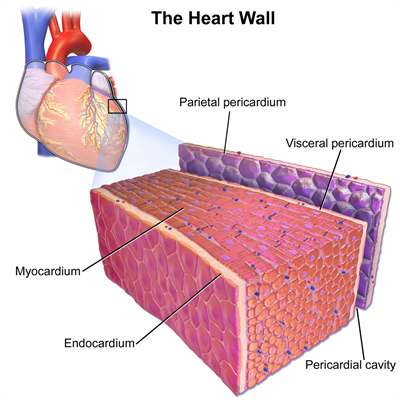
Internal structure of the heart wall
The heart has four chambers, namely right atrium, right ventricle, left atrium and left ventricle.
A muscular wall called the septum separates the chambers and prevents mixing of oxygenated and deoxygenated blood.
Circulation of blood and double circulation:
Blood circulation follows a definite pathway through the heart, lungs and body. Deoxygenated blood enters the right atrium, moves to the right ventricle and is pumped to the lungs through the pulmonary artery for oxygenation.
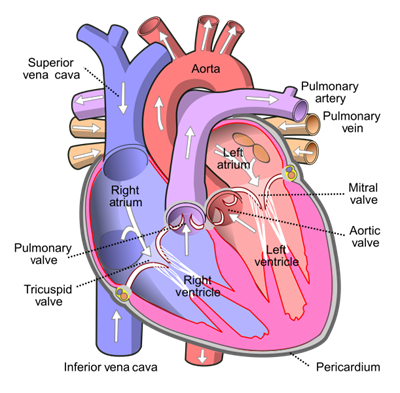
Human heart
Oxygenated blood returns to the left atrium through pulmonary veins, enters the left ventricle and is pumped to the body through the aorta.
Since blood passes through the heart twice in one complete cycle, it is called double circulation, which prevents mixing of blood and ensures efficient oxygen supply.
Heartbeat, cardiac cycle and pulse:
The contraction of the heart is called systole, and relaxation is called diastole.
One complete sequence of systole and diastole forms a heartbeat.
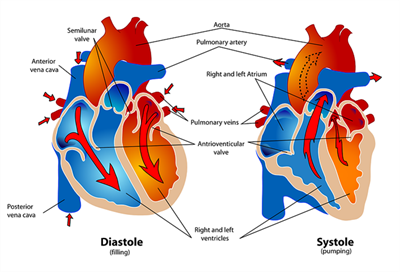
Systole and diastole
The human heart is myogenic, and the heartbeat is initiated by the sinoatrial (SA) node, which acts as the pacemaker.
One complete cardiac cycle lasts about \(0.8\) seconds and produces two heart sounds, LUBB and DUPP, due to valve closure.
Pulse is defined as the rhythmic expansion of arteries caused by the pumping of blood and is equal to the heart rate.
Blood pressure:
Blood pressure is the force exerted by blood against the walls of arteries. It is expressed as systolic pressure over diastolic pressure, with a normal value of \(120/80\) mmHg.
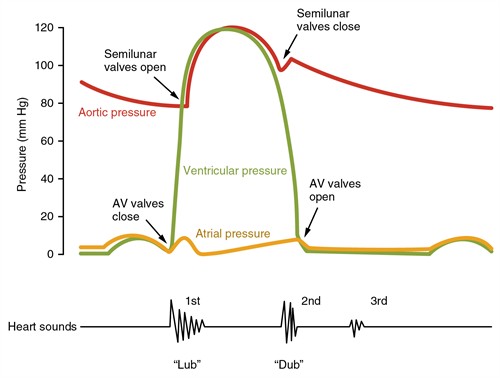
Sounds of heart
An increase in blood pressure is called hypertension, while a decrease is called hypotension. Blood pressure is measured using a sphygmomanometer.
Blood groups and lymph:
Human blood is classified into A, B, AB and O blood groups based on the presence of antigens and antibodies.
People with blood group AB are called universal recipients, and those with blood group \(O\) are called universal donors.
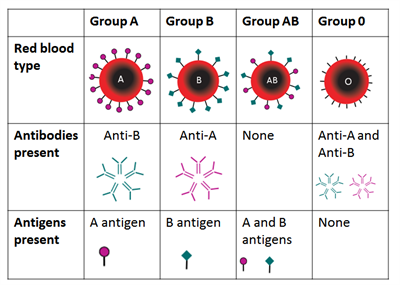
Antigen and antibodies present in the different blood groups
The lymphatic system consists of lymph, lymph vessels and lymph nodes. Lymph is a colourless tissue fluid that helps in immunity, fat absorption and drainage of excess tissue fluid. The spleen is the largest lymphoid organ.