

Multicellular organisms are made up of millions of cells, and each cell requires a continuous supply of water, nutrients, oxygen, and energy to survive. Energy is released by the breakdown of glucose and is used to carry out vital life processes. To ensure this continuous supply and removal of wastes, all organisms require an efficient transport system.
Transport in plants:
Plants do not possess a circulatory system like animals. Instead, they depend on specialized vascular tissues for transport.
Xylem is the tissue that transports water and mineral salts absorbed by the roots to all aerial parts of the plant. Phloem is the tissue that transports food prepared in the leaves to different parts of the plant.
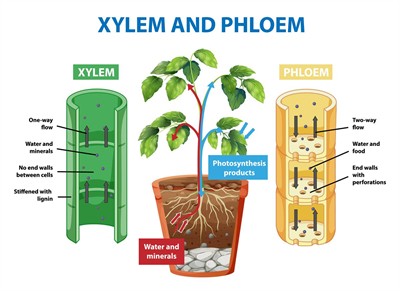
xylem and phloem
The bulk movement of substances through vascular tissues is called translocation.
Absorption and movement of water in plants:
Water is absorbed from the soil by root hairs through osmosis, which is the movement of water molecules from a region of higher concentration to a region of lower concentration through a semi-permeable membrane.
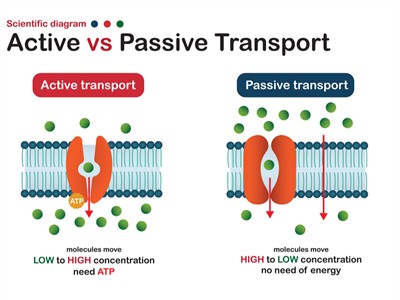
Active transport and passive transport
Within the root, water moves through two pathways.
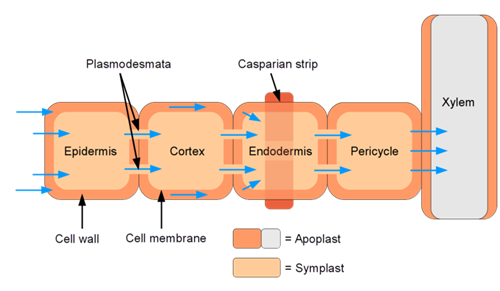
Apoplastic and symplastic pathway
The apoplast pathway involves the movement of water through cell walls and intercellular spaces without crossing the cell membrane.
The symplast pathway involves the movement of water through the cytoplasm of cells via plasmodesmata and is comparatively slower (frequently asked comparison point).
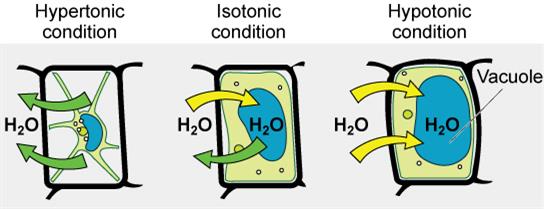
Types of solutions
Transpiration and ascent of sap:
Transpiration is defined as the loss of water in the form of vapour from the aerial parts of the plant, mainly through stomata.
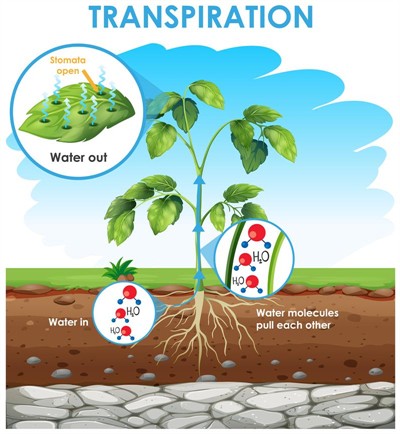
Transpiration
The upward movement of water and minerals from roots to leaves is called ascent of sap.
Transport of minerals:
Minerals are absorbed from the soil mostly by active transport, as mineral ions cannot freely cross the cell membrane and are usually present in lower concentration in the soil.
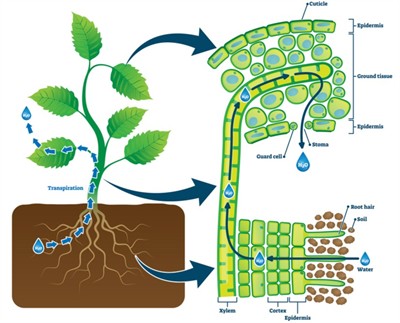
The upward pull of water from the roots
Active transport requires energy in the form of ATP. Once absorbed, minerals are transported along with water through the xylem.
Translocation of food in plants:
The food prepared in the leaves during photosynthesis is transported through the phloem.
Phloem transport is bidirectional, whereas xylem transport is unidirectional (common 1–2 mark question).
According to the pressure flow hypothesis, sugars move from the source to the sink due to pressure differences created by active loading and unloading of sucrose.
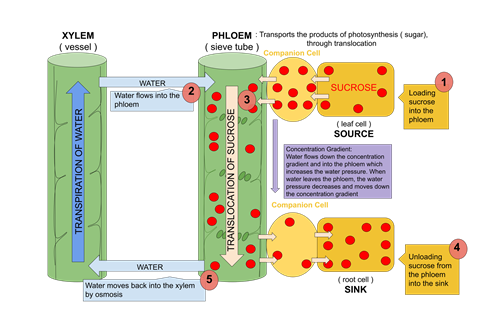
Translocation of sugars