Human Eye
The human eye is a very important and sensitive organ that helps us see the world around us. It works like a natural camera by receiving light, forming images, and sending signals to the brain. Understanding its structure and common defects helps us know how vision works and how it can be corrected.
 
Structure of the human eye:
 
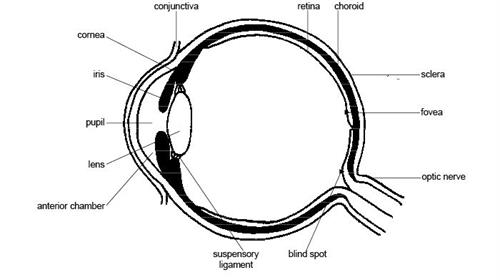
The eyeball is roughly spherical with a diameter of about \(2.3\) \(cm\). It is protected by a tough outer layer called the sclera.
 
AnatomyandphysiologyofanimalsStructureoftheeye.jpg
Structure of the eye
 
Important Parts of the Eye
  • Cornea – The thin, transparent front layer of the eye. It is the main refracting surface that bends incoming light.
  • Iris – The coloured part of the eye (blue, brown, green). It controls the amount of light entering the eye like a camera aperture.
  • Pupil – The opening at the centre of the iris through which light enters the eye.
  • Retina – The sensitive inner layer where a real and inverted image is formed.
  • Eye Lens – A convex lens that further converges light to form a sharp image.
  • Ciliary Muscles – These muscles hold the lens and change its focal length depending on whether objects are near or far.
Working of the Eye:
Light first enters through the cornea, then passes through the pupil. The convex eye lens converges the light rays and forms a real and inverted image on the retina. This image is sent to the brain through the optic nerve, and the brain interprets it as an erect image.
 
Power of accomodation:
The power of accommodation is the ability of the eye lens to adjust its focal length so that we can see both nearby and distant objects clearly.
This ability is achieved with the help of the ciliary muscles, which change the curvature of the eye lens. When we look at distant objects, the ciliary muscles relax and the lens becomes thinner, increasing its focal length. When we look at nearby objects, the muscles contract and the lens becomes thicker, decreasing its focal length. This continuous adjustment allows the image to be focused sharply on the retina.
 
Persistance of Vision:
If two light signals reach the eye within \(\frac{1}{16}\) second, the eye cannot distinguish them separately. This effect is called persistence of vision.
Near Point and Far Point of the Eye:
  • Near Point – The minimum distance to see clearly without strain. For a normal eye, it is \(25\) \(cm\).
  • Far Point – The maximum distance up to which objects can be seen clearly. For a normal eye, it is infinity.
A normal eye can clearly see objects between \(25\) \(cm\) and infinity.
 
Defects in eye
A normal human eye can clearly see objects from the near point (\(25\) \(cm\)) to the far point (infinity). However, due to factors such as ageing, changes in the shape of the eyeball, or loss of flexibility of the eye lens, the eye may lose its power of accommodation. This results in defects of vision, where objects at certain distances appear blurred. Common defects of the eye include
  • Myopia
  • Hypermetropia
  • Presbyopia, and
  • Astigmatism
Myopia:
 
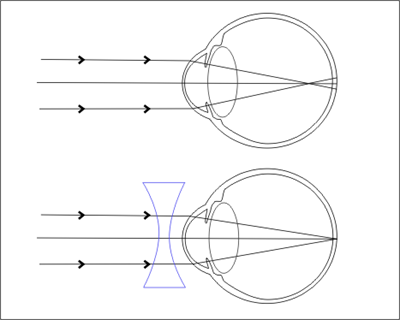
Myopia, also called short sightedness, is a defect of vision in which a person can see nearby objects clearly but distant objects appear blurred. This defect occurs due to the lengthening of the eyeball or because the focal length of the eye lens is reduced, which increases the distance between the eye lens and the retina. As a result, the image of distant objects is formed in front of the retina instead of on it, causing unclear distant vision. 
 
This defect can be corrected using a concave lens. The concave lens diverges the incoming light rays from distant objects so that, after refraction by the eye lens, the rays focus exactly on the retina.
 
Myopia.png
Myopia
 
The formula for correcting myopia is also given in the uploaded content. It is:
 
\(f=-x\)
  • \(f\) = focal length of the concave lens used
  • \(x\) = far point of the myopic eye (maximum distance up to which the person can see clearly)
A more general formula is:
 
\(f=\frac{xy}{x-y}\)
  • = distance up to which the person can see clearly
  • = distance up to which the person wants to see clearly
These formulas help in calculating the focal length of the concave lens required to correct myopia.
 
Hypermetropia:
 
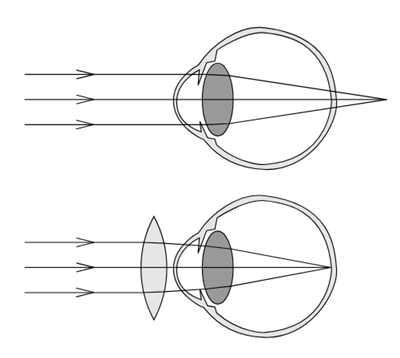
Hypermetropia, also called long sightedness, is a defect of vision in which a person can see distant objects clearly but cannot see nearby objects clearly. This defect occurs due to the shortening of the eyeball or an increase in the focal length of the eye lens. As a result, the image of nearby objects is formed behind the retina, making close objects appear blurred.
 
This defect can be corrected using a convex lens. The convex lens converges the incoming light rays so that they focus exactly on the retina, enabling clear vision for nearby objects.
 
Hypermetropia.PNG
Hypermetropia
 
The focal length of the convex lens required to correct hypermetropia is given by:
 
\(f=\frac{dD}{d-D}\)
where
  • = focal length of the convex lens
  • = defective near point of the person
  • = normal near point (\(25\) \(cm\))
Presbyopia:
 
Presbyopia is an age-related defect of vision in which a person finds it difficult to see nearby objects clearly. It occurs because the ciliary muscles become weak and the eye lens loses its flexibility, reducing the power of accommodation. As a result, the eye cannot adjust its focal length effectively for near vision. This defect is corrected using bifocal lenses, which have a convex part for near vision and a concave part for distant vision.
 
Astigmatism:
 
Astigmatism is a defect of vision in which the eye cannot see horizontal and vertical lines clearly at the same time. It occurs due to the irregular curvature of the cornea or eye lens, which prevents light rays from focusing at a single point on the retina. This leads to blurred or distorted vision. Astigmatism is corrected using cylindrical lenses, which help focus light properly on the retina.