

Microscope
Microscopes are optical instruments used to observe very small objects that cannot be seen clearly with the naked eye. They work by using lenses to produce enlarged images, allowing us to study fine details of tiny objects such as cells, insects, and small mechanical parts.
Simple Microscope:
Construction
A simple microscope consists of a single convex lens of short focal length mounted in a frame. The lens is held close to the observer’s eye, and the object is placed within the principal focus of the lens (\(u< f\)). This arrangement enables the lens to produce a magnified view of very small objects.
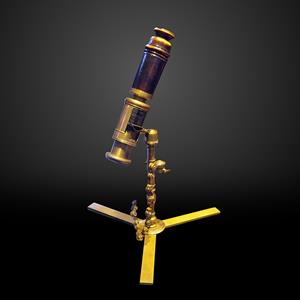
Simple Microscope
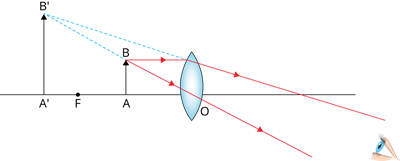
Image Formation in Simple Microscope
Working
When the object is placed within the principal focus of the convex lens, it forms an erect, virtual and enlarged image on the same side of the object. The image is usually formed at the least distance of distinct vision (about \(25\) \(cm\)), allowing the observer to see the object clearly with magnification.
Uses
A simple microscope is used by watch repairers and jewellers to see tiny parts clearly. It is also used to read small letters, to observe parts of flowers and insects, and to examine fingerprints in forensic science.
Compound Microscope:
Construction
A compound microscope consists of two convex lenses fixed in a narrow adjustable tube. The lens placed near the object is called the objective lens, which has a short focal length. The lens placed near the observer’s eye is called the eyepiece or eye lens, which has a comparatively longer focal length and larger aperture. This arrangement allows higher magnification than a simple microscope.
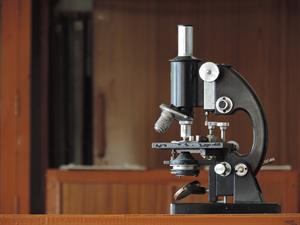
Compound Microscope
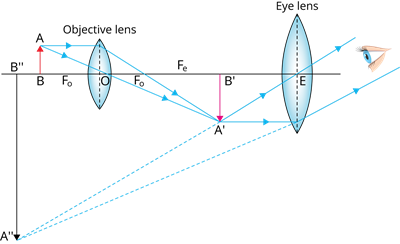
Image Formation in Compound Microscope
Working
The object is placed just beyond the focal length of the objective lens (\(u> f_{0}\)). The objective lens forms a real, inverted and magnified image of the object. This image then acts as the object for the eyepiece. The eyepiece further magnifies it and produces a virtual, enlarged and erect image on the same side as the object, which can be seen clearly by the observer. Thus, the compound microscope provides much greater magnification, about \(50\) to \(200\) times more than a simple microscope.
Uses
A compound microscope is used to observe very tiny objects such as cells, microorganisms, and minute biological specimens. It is widely used in biology laboratories, medical research, and scientific investigations where high magnification is required.
Telescope
A telescope is an optical instrument used to view distant objects clearly, especially those that cannot be seen distinctly with the naked eye. It helps us observe celestial bodies like stars, planets, and galaxies by producing magnified images.
The first telescope was invented by Johann Lippershey in 1608. Later, Galileo Galilei used a telescope to observe the satellites of Jupiter and the rings of Saturn. Johannes Kepler improved the design in 1611, leading to a model similar to the modern astronomical telescope.
Types of telescopes:
Based on optical property, telescopes are classified into
- Refracting telescopes which use lenses
- Reflecting telescopes which use parabolic mirrors
Astronomical Telescope:
An astronomical telescope is used to observe heavenly bodies such as stars, planets, galaxies, and satellites. It produces a magnified image of distant celestial objects, but the final image formed is inverted. Since orientation does not matter for celestial observations, this inversion does not affect its usefulness. Hence, it is mainly used in astronomy for studying distant objects in space.
Terrestrial Telescopes:
A terrestrial telescope is used to observe objects on the Earth’s surface. Unlike the astronomical telescope, it provides an erect image, which makes it suitable for viewing landscapes and distant terrestrial objects clearly. The main difference between astronomical and terrestrial telescopes lies in the orientation of the final image.
Advantages of Telescopes:
-
Provides an elaborate and clear view of distant celestial objects like stars, planets, and galaxies.
-
Allows observation of objects even in low intensity light conditions.
-
A camera can be attached to capture photographs of celestial bodies.
Disadvantages of Telescopes:
-
Requires frequent maintenance for proper functioning.
-
It is not easily portable, making it difficult to carry and use everywhere.