

Importance:
The chapter on "Carbon and its compounds" is assigned a weightage of \(6\) marks, and focuses on the classification, bonding, and reactions of carbon-based compounds used in daily life. Understanding this chapter strengthens exam performance and builds a foundation for organic chemistry and real-life applications like fuels, soaps, and medicines.
Question distribution:
- Section A (\(1\) mark) - One question
- Section D (\(5\) mark) - One question
(Note: The exact mark distribution may vary slightly across examinations.)
Learning objectives:
-
Recognising the versatility of carbon: Recognise how carbon’s ability to form four covalent bonds leads to a wide variety of organic compounds, such as hydrocarbons, alcohols, acids, etc.
-
Classification of organic compounds: Learn to classify compounds based on the type of carbon chain, atoms present (heteroatoms), and functional groups, enhancing the ability to identify and differentiate organic molecules.
-
Mastering IUPAC nomenclature: Understand the systematic naming of organic compounds based on IUPAC rules, including hydrocarbons and functionalised compounds, improving the precision of chemical communication.
-
Understanding isomerism and allotropy: Develop an understanding of isomerism and allotropy, which are crucial in predicting the properties and reactivity of compounds.
-
Analysing the chemical reactions of organic compounds: Learn and analyse the different reaction types, such as combustion, oxidation, substitution, and addition, and their relevance in both lab and industrial contexts.
-
Relating the uses of organic compounds in daily life: Relate how compounds like ethanol, ethanoic acid, soaps, and detergents play an essential role in our everyday lives, from cleaning products to food preservation
Organic (Covalent) compounds:
All carbon compounds are made up of covalent bonds. These are the compounds that are referred to as organic compounds. Everything in this world has a unique characteristics, and organic compounds are no exception. Some of them are as follows:
- Organic compounds have a complex structure and a high molecular weight.
- Organic compounds are mostly insoluble in water but soluble in organic solvents like ether, carbon tetrachloride, toluene, etc.
- Organic compounds are highly inflammable.
- When compared to inorganic compounds, organic compounds have lower melting and boiling points.
- Organic compounds are volatile in nature.
Classification of organic compounds:
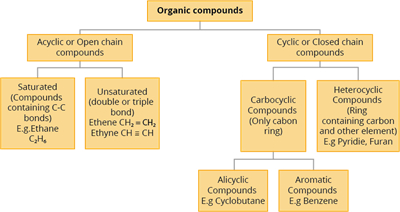
Classification of organic compounds
Classification of hydrocarbons:
Hydrocarbons are organic compounds that are made up of only carbon and hydrogen atoms.
|
Number
of
carbon atoms
|
Alkane
(\(C_nH_{2n + 2}\))
|
Alkene
(\(C_nH_{2n}\))
|
Alkyne
(\(C_nH_{2n – 2}\)).
|
|
\(1\)
|
Methane
(\(CH_4\))
|
-
|
-
|
|
\(2\)
|
Ethane
(\(C_2H_6\))
|
Ethene
(\(C_2H_4\))
|
Ethyne
(\(C_2H_2\))
|
|
\(3\)
|
Propane
(\(C_3H_8\))
|
Propene
(\(C_3H_6\))
|
Propyne
(\(C_3H_4\))
|
|
\(4\)
|
Butane
(\(C_4H_{10}\))
|
Butene
(\(C_4H_8\))
|
Butyne
(\(C_4H_6\))
|
|
\(5\)
|
Pentane
(\(C_5H_{12}\))
|
Pentene
(\(C_5H_{10}\))
|
Pentyne
(\(C_5H_8\))
|
Note: Methene and Methyne do not exist because they have only one carbon atom. These compounds cannot form multiple bonds, as hydrogen can share only one electron.
Special features of carbon:
- Isomerism: Same molecular formula but different structural arrangements. Eg: \(C_2H_6O\) ((ethanol, dimethyl ether))
- Allotropy: Same element exists in different physical forms. Eg: Diamond, Graphite, Fullerene
- Catenation: Ability of carbon atoms to bond with themselves forming chains and rings.
- Tetravalency: Carbon has four valence electrons and forms four covalent bonds.
Bromine water test: Used to detect unsaturation.
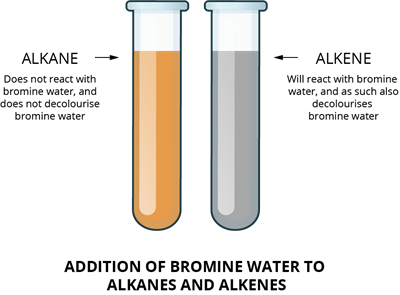
Test for unsaturation
PYQ - Carbon compounds, Isomers
Functional group:
A functional group is an atom or group of atoms in a molecule that determines its chemical properties.
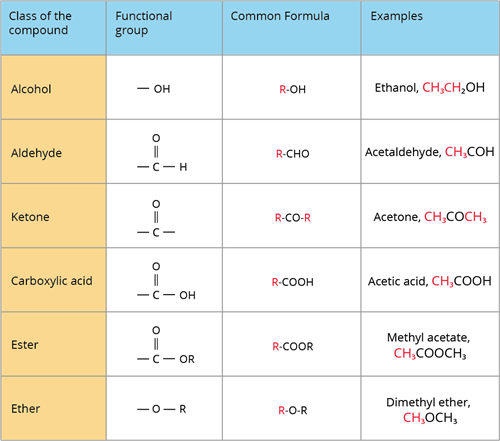
Classes of organic compounds based on functional group
Homologous series:
A homologous series is a group or class of organic compounds that have the same general formula and similar chemical properties but differ by a −\(CH_2\) group and thus by \(14 amu\) in molecular mass.
Consider the members of the alkanes listed in the below table. The following are their condensed structural formulas:
|
Name
|
Molecular
formula
|
| Methane | \(CH_4\) |
| Ethane | \(CH_3CH_3\) |
| Propane | \(CH_3CH_2CH_3\) |
| Butane | \(CH_3(CH_2)_2CH_3\) |
| Pentane |
\(CH_3(CH_2)_3CH_3\)
|
If you look at the preceding series, each successive member has one more methylene (\(CH_2\)) group than the preceding member, which is why they are called homologs.
PYQ - Homologous series
Nomenclature of organic compounds:
Therefore, the International Union of Pure and Applied Chemistry (IUPAC) developed a standard nomenclature system, enabling scientists worldwide to communicate clearly using a compound's structure-based name.
Components of an IUPAC name:
Organic compounds on naming with IUPAC consist of \(3\) parts:
1. Root word: It specifies the number of carbon atoms in the compound's parent chain as well as the pattern of their arrangement.
Root words of hydrocarbons:
|
Number
of
carbon atoms
|
Root word
|
|
\(1\)
|
Meth-
|
|
\(2\)
|
Eth-
|
|
\(3\)
|
Prop-
|
|
\(4\)
|
But-
|
|
\(5\)
|
Pent-
|
|
\(6\)
|
Hex-
|
|
\(7\)
|
Hept-
|
|
\(8\)
|
Oct-
|
|
\(9\)
|
Non-
|
|
\(10\)
|
Dec-
|
2. Prefix: It represents the substituents or branches in the parent chain.
Prefix for IUPAC Name:
|
Substituent
|
Prefix used
|
|
\(-F\)
|
Fluoro
|
|
\(-Cl\)
|
Chloro
|
|
\(-Br\)
|
Bromo
|
|
\(-I\)
|
Iodo
|
|
\(-NH_2\)
|
Amino
|
|
\(-CH_3\)
|
Methyl
|
|
\(-CH_2CH_3\)
|
Ethyl
|
3. Suffix: It is further divided into primary and secondary suffix.
- Primary suffix: If all of the bonds between the parent chain's carbon atoms are single, the suffix 'ane' must be used and the suffixes ‘ene' and ‘yne' are used for compounds with double and triple bonds, respectively.
- Seconday suffix: The compound's functional group is described by the secondary suffix.
|
Class of the compound
|
Functional group
|
Suffix used
|
|
Alcohol
|
\(-OH\)
|
-ol
|
|
Aldehyde
|
\(-CHO\)
|
-al
|
|
Ketone
|
\(-C=O\)
|
-one
|
|
Carboxylic acid
|
\(-COOH\)
|
-oic acid
|
Let us now see the IUPAC rules for naming organic compounds:
- Find the longest chain of carbon atoms to determine the parent name (root word).
- Start counting the carbon atoms in the parent chain at the closest end of the substituent or functional group. These are known as locant numbers. If both a functional group and a substituent are present, the functional group takes precedence.
- In the case of alkenes and alkynes, find the double or triple bond and use its locant number followed by a dash and a primary suffix.
- If the compound contains a functional group, find it and use the locant number followed by a dash and a secondary suffix.
- When the primary and secondary suffixes are combined, the primary suffix's terminal 'e' is removed.
- Identify the substituent using a number followed by a dash and a prefix to specify its location and identity.
Let us try to name the linear and substituted hydrocarbons in a systematic manner using IUPAC rules:

Step 1: There is a seven-membered carbon chain; hence, the root word is ‘Hept’.
Step 2: There is a substituent. So, the carbon chain is numbered from the left end, which is closest to the substituent.
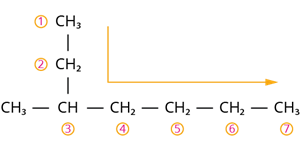
The correct way of numbering the carbon atoms
Step 3: All are single bonds between the carbon atoms, and thus the suffix is ‘ane’.
Step 4: The substituent is a methyl group compound located at the third carbon atom. So, its locant number is \(3\). Thus, the prefix is ‘\(3-Methyl\)’.
Hence, the name of the given compound is \(\text{3-Methyl + hept + ane = 3-Methyl heptane}\).
The below are some of the IUPAC names of various classes of compound:
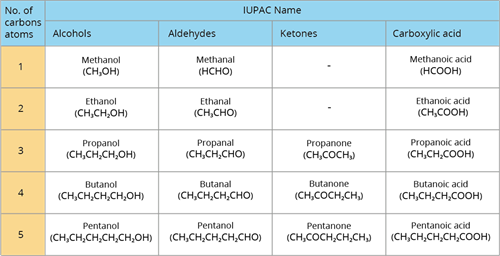
IUPAC names of various classes of compounds
PYQ - IUPAC