

Desirable change:
Various beneficial changes take place in our everyday lives. A desirable change brings us benefits, advantages, or value. We strive for these changes since they enhance our lives in various ways. A change that we appreciate and that gives us positive outcomes is known as a desirable change.
The changes that are beneficial for us and the environment are known as desirable changes.

Desirable changes
Example:
Preparation of curd, manure from cow dung and dead plants, ripening of fruits, seasonal changes, germination of seeds, baking of cake and cooking food
Undesirable change:
An undesirable change refers to a shift that is unhelpful, unwanted, harmful or potentially damaging. These are the changes we prefer to avoid, as they can cause damage, ruin things, or create issues in everyday life.
The changes that are harmful to us and the environment are known as undesirable changes.

Undesirable changes
Example:
The burning of a factory, rotting of foodstuff, volcanic eruption, flood, earthquake and rusting of iron articles
Note:
i. A change may be beneficial at one moment but unfavourable at another. The burning of fuel (such as wood or coal) to generate heat is the desired change. When a house or a factory is burnt, it causes an undesired change.
ii. For some, a change may be beneficial, but it may be destructive for others. Cutting trees may be desirable for those who require wood, but it is undesirable for animals and the environment, as it disrupts the natural balance.
Have you ever experinced hiking in the mountains or hills and noticed a pile of gravel, sand, or broken rocks at the base of the slopes? These accumulations are known as sediments.
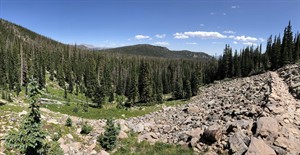
Sediments of broken rocks
They are the product of a slow natural process that has been going on for thousands or even millions of years; they did not form all at once. It occurs gradually over a period. Some slow natural changes are as follows:
- Weathering of rocks
- Soil erosion
In this theory, we will be discussing about the slow natural changes.
1. Weathering of rocks:
Imagine a vast, huge rock on a mountain. Over the years, that rock endures extreme conditions, including the hot sun during the day, cold nights, rain, wind, and even plants attempting to grow in its cracks. These natural elements slowly break the rock over time.
The two main ways of weathering of rocks are,
i. Physical change:
At times, the changes are physical. Imagine rainwater penetrating small cracks in the rock. When temperatures drop and that water freezes, it expands like the ice in a tray. This expansion creates pressure on the rock, causing the cracks to widen and slowly break the rock.
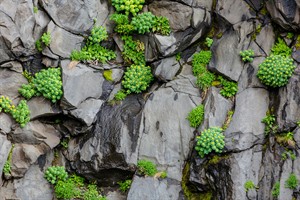
Growth of plants on rocks
Even the roots of plants can infiltrate these cracks, and as they thicken, they push the rock apart even more. Over many years, these processes can break large rocks down into pebbles and sand.
ii. Chemical change:
In some cases, the changes are chemical in nature. Rainwater is not simply pure water; it can contain small quantities of acids or various chemicals. When this water comes into contact with specific rocks, it interacts with the minerals present in the rocks.
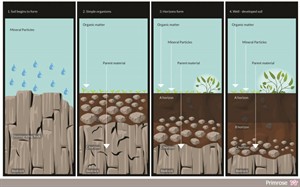
Weathering of rocks
Basalt is a type of rock that contains iron. When exposed to air and moisture, it undergoes rusting, appearing as a red-brown coating.
2. Soil erosion:
Have you ever gathered a handful of soft, fine sand from a riverbank or discovered smooth stones in a lake? Have you considered the origins of all this loose material?
It all begins high in the hills and mountains, where rocks and soil are exposed to natural elements. When the wind blows or rain pours, these natural forces gradually disintegrate large rocks and soil into smaller fragments.
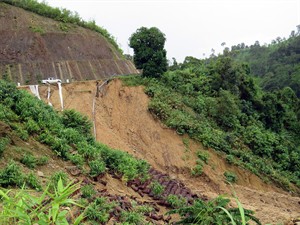
Landslide
As rainwater runs downhill, it carries small rocks, soil, and even pebbles along with it. A similar process occurs when strong winds blow across dry land. This process is known as erosion; it is a slow process.
Natural forces carry soil and small rocks from one spot to another. For instance, during a landslide, large quantities of rock and soil can slide down together. That’s a striking illustration of physical soil erosion in action and irreversible.
Reference:
https://commons.wikimedia.org/wiki/File:Landslide_between_Ye_and_Dawei.jpg
https://pixnio.com/media/aspen-forest-forest-trail-rocks-stones
https://www.pexels.com/photo/barren-rocks-and-plants-17461981/