

All the materials do not have the same density. Depending on the material, density varies.
Materials with a higher density are denser, while those with a lower density are rarer.
Relationship between the density, mass and volume:
We can determine the mass and volume of an object using the density formula.
Density of substances at room temperature:
The table below shows the different materials, their nature, and their densities.
|
Nature
|
Material
|
Density in
\(kg/ m^3\)
|
|
Gas
|
Air
|
\(≈1.2\)
|
|
Liquid
|
Kerosene
|
\(800\)
|
|
Liquid
|
Water
|
\(1,000\)
|
|
Liquid
|
Mercury
|
\(13,600\)
|
|
Solid
|
Aluminium
|
\(2700\)
|
|
Solid
|
Iron
|
\(7,800\)
|
|
Solid
|
Copper
|
\(8,900\)
|
|
Solid
|
Silver
|
\(10,500\)
|
|
Solid
|
Gold
|
\(19,300\)
|
Conversion factors for density:
i. Basic conversion:
- \(1\ g/cm^3 = 1000\ kg/m^3\)
- \(1\ kg/m^3 = 0.001\ g/cm^3\)
ii. Other equivalences:
Volume conversion - \(1\ mL = 1\ cm^3\)
- \(1\ g/mL = 1\ g/cm^3\)
- \(1\ g/mL = 1000\ kg/m^3\)
Litre to millilitre - \(1\ L = 1000\ mL\)
- \(1\ g/1 L = 1\ g/ 1000\ mL\)
- \(1\ g/ 1000\ mL = 0.001\ g/cm^3\)
At room temperature, the mass of \(1\ mL\) of water is approximately equal to \(1\ g\). The volume of water is measured in \(mL\) and its mass is measured in \(g\). Therefore,
- \(10\ mL ≈ 10 g\)
- \(100\ mL ≈ 100 g\)
If the mass of a gold bar is \(193\ g\) and its volume is \(10\ cm^3\), its density is \(19.3\ g/cm^3\). Thus, a gold bar is \(19.3\) times denser than water. Gold is one of the densest common metals, with a density of \(19.3\ g/cm^3\)
Relative density:
Relative density of a substance with respect to water is,
The relative density of a substance is the ratio of the density of the substance to the density of water at the specific temperature (\(4\ °C\)). Relative density is also known as specific gravity.
Water is specifically taken at a temperature of \(4\ °C\), because its density is maximum \(1\ g/cm^3\) at this temperature. It is a dimensionless quantity, hence it has no unit.
Determination of density:
The density of an object can be determined by measuring its mass and volume.
Mass is defined as the measure of the amount of matter present in any object or substance. The SI unit of mass is \(kilogram\) (\(kg\))
Usually, for measuring mass, the units of a \(kilogram\) are preferred over the \(gram\) units. Heavyweights are measured in \(tonne\) or \(metric\ tonne\).
\(1\) \(gram\) (\(g\)) \(= 1000\) \(milligram\) (\(mg\))
\(1\) \(kilogram\) (\(kg\)) \(= 1000\) \(gram\) (\(g\))
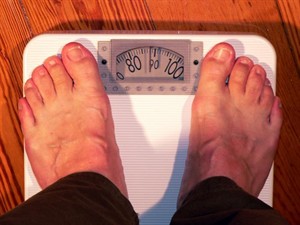
Weight scale
In contrast, weight is the gravitational force experienced by the mass of an object. The SI unit of weight is Newton (\(N\)). The mass of an object is a constant value and does not vary with any change in gravity or place. Whereas the value of weight changes depending on the gravitational pull or location.
An instrument used to measure the mass of an object is called a balance. Mass is measured using different instruments such as a weight scale, a balance scale, a spring balance, and an electronic balance.
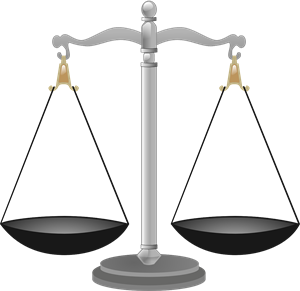
Balance scale
Activity: To measure the mass with a digital balance
Step 1: Switch on the digital weighing balance.
Step 2: Observe the initial reading; the balance should display zero as the initial value.
Step 3: If the reading is not zero, press the tare button to reset it to zero.
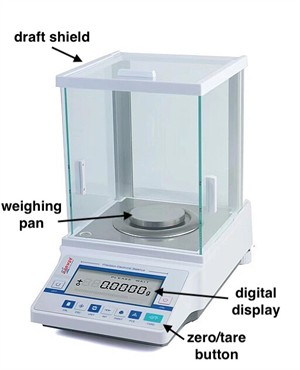
Digital balance
Step 4: Place a dry, clean watch glass, and press the tare button to reset it to zero. This process ignores the mass of the watch glass.
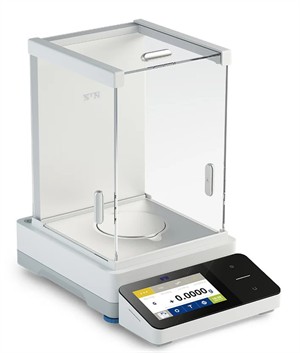
Tare after placing a watch glass
Step 5: Now place a solid object, an iron nail and note the reading, which gives the mass of the iron nail.
The mass of the liquid is measured by replacing the watch glass with a beaker and pouring the desired liquid into the beaker. Then note the reading to determine the mass of the liquid.
Reference:
https://upload.wikimedia.org/wikipedia/commons/c/c0/Notated_Analytical_Balance.jpg
https://www.stninstruments.com/products/analytical-balance-60g-0-1mg-non-sc