

Answer the following question:
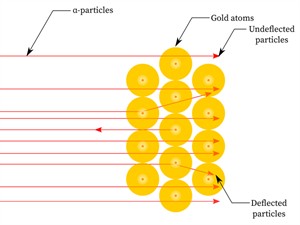
A group of students performed Rutherford's Gold Foil Experiment in the laboratory. According to Thomson's model, they expected every alpha (α) particle to pass through the gold foil because the positive charge was believed to be spread uniformly throughout the atom.
However, the observations surprised them.
- Most α-particles passed straight through the foil.
- Some α-particles were deflected through small angles.
- A very few α-particles bounced back.
1. Which conclusion can be drawn from the particles that bounced back?
2. Why was gold foil chosen for this experiment?
3. The diameter of an atom is \(10^{
−10}\)
m, while the nucleus is only \(10^
{−15}\)
m. What does this comparison indicate?
4. If Thomson's model had been correct, which observation would most likely have been seen?