

A designer is developing a fountain feature for a garden. The water stream follows a parabolic path that opens downward.
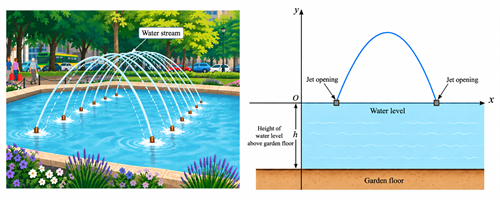
For one particular jet, the height of the water above the water surface is given by
\(p(x)=-x^2+10x-24\)
where \(x\) is the horizontal distance in metres from a reference point and \(p(x)\) is in metres.
The water stream meets the water surface where \(p(x)=0\). The water surface itself lies \(0.1\text{ m}\) above the garden floor, resting on the supporting fountain rods.
Let \(\alpha\) and \(\beta\), with \(\alpha<\beta\), be the zeroes of \(p(x)\).
Based on the above information, answer the following:
1. Without solving for \(\alpha\) and \(\beta\) separately, find the horizontal width of the arc of water.
2. Find the horizontal position at which the stream reaches its greatest height, and find that greatest height above the water surface.
3. Find \(H\), the maximum height of the stream measured from the garden floor.
4. A second jet is to meet the water surface at the same two points, but must reach a maximum height of \(3\text{ m}\) above the water surface. Determine