

Establish that \(\frac{BY}{DY}\) \(=\) \(\frac{AC}{BC}\) if \(DB \perp BC\), \(DY \perp AB\) and \(AC \perp BC\).
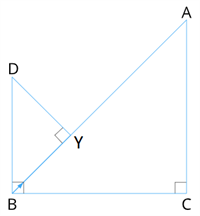
Proof:
Let \(\angle BAC\) be marked as \(\angle 1\), \(\angle ABC\) be marked as \(\angle 2\), and \(\angle DYB\) be marked as \(\angle 3\).
By angle sum property of a triangle, "The sum of all three angles in a triangle is \(180^\circ\)."
In \(\triangle ABC\), \(\angle 1 + \angle 2 + \angle C = 180^\circ\)
\(\angle 1 + \angle 2 + 90^\circ = 180^\circ\)
\(\longrightarrow (1)\)
\(\longrightarrow (2)\)
On comparing \((1)\) and \((2)\), we get:
Let us now consider \(\triangle ABC\) and \(\triangle BDY\).
We already have proved that \(\angle 1 = \angle 3\).
Also, [Given]
By AA similarity criterion, "If two angles of one triangle are respectively equal to two angles of another triangle, then the two triangles are similar."
Therefore, .
Thus, \(\frac{BY}{DY}\) \(=\) \(\frac{AC}{BC}\).
Answer variants: