

In given figure, \(l\) is parallel to \(m\) and line segments \(PQ\),\(RS\) and \(EF\) concurrent at point \(O\). Jusity that \(\frac{PE}{QF} = \frac{PR}{QS} = \frac{RE}{FS}\).
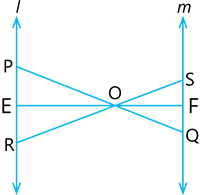
In \(\Delta POR\) and \(\Delta QOS\),
\(\angle POR = \angle QOS\) (vertically opposite angles)
\(\angle OPR = \angle OQS\) (alternate angles)
Therefore, \(\Delta POR \sim \Delta QOS\) (by \(AA\) similarity criterion)
\(\frac{PO}{OQ} = \frac{PR}{QS} =\) - - - - (i)
In \(\Delta POE\) and \(\Delta QOF\),
\(\angle POE = \angle QOF\) (vertically opposite angles)
\(\angle OPE = \angle OQF\) (alternate angles)
Therefore, \(\Delta POE \sim \Delta QOF\) (by \(AA\) similarity criterion)
\(\frac{PO}{OQ} = \frac{PE}{QF} = \) - - - - (ii)
In \(\Delta OER\) and \(\Delta OFS\),
\(\angle EOR = \angle FOS\) (vertically opposite angles)
\(\angle ORE = \angle OSF\) (alternate angles)
Therefore, \(\Delta OER \sim \Delta OFS\) (by \(AA\) similarity criterion)
\(\frac{OE}{OF} = \frac{OR}{OS} =\) - - - - (iii)
From equation, we get the result.