

Empirical probability or experimental probability is defined as the number of times an event has occurred to the total number of times an experiment is performed.
Let us consider an example.
On throwing a die of \(6\) faces \(100\) times, the frequencies of the outcomes are as follows:
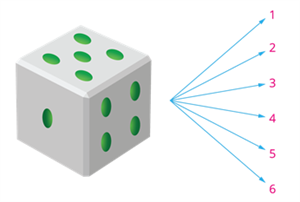
Face \(1 = 18\), Face \(2 = 10\), Face \(3 = 37\), Face \(4 = 5\), Face \(5 = 13\), Face \(6 = 17\).
Based on this experiment, the empirical probability of face \(1\) is \(\frac{18}{100}\) i.e. \(0.18\)
Similarly, the empirical probability of face \(2\) is \(\frac{10}{100} = 0.1\).
The empirical probability of face \(3\) is \(0.37\), face \(4\) is \(0.05\), face \(5\) is \(0.13\) and face \(6\) is \(0.17\).
Similarly, consider an another scenario of tossing a coin.
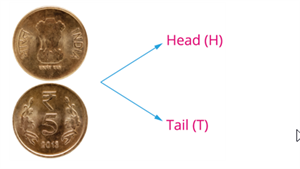
Either we get a head, or a tail is equally likely to appear. In other words, we can say the probabilities of both events are equal.
That is, P(getting a head) \(= \frac{1}{2}\)
P(getting a tail) \(= \frac{1}{2}\)
Important!
The empirical or experimental probability \(P(E)\) of an event \(E\) is defined as:
\(P(E) = \frac{\text{Number of trials in which the event happened}}{\text{Total number of trials}}\)
The theoretical probability or classical probability of an event \(E\) is defined as:
\(P(E) = \frac{\text{Number of outcomes favourable to E}}{\text{Number of all possible outcomes of the experiment}}\)
Note that \(0 \leq P(E) \leq 1\)