1. Construction of triangle when \(3\) sides are known
Let us construct a triangle whose sides are \(5 \ cm\), \(7 \ cm\) and \(4 \ cm\).
Construction:
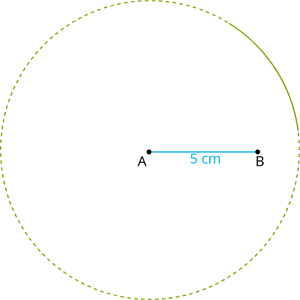
Step 1: Let us construct the base \(AB\) of any length. Let us choose \(AB = 5 \ cm\).

Step 2: With \(A\) as centre, draw an arc of radius \(7 \ cm\).
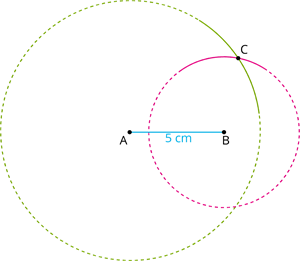
Step 3: With \(B\) as centre, draw an arc of radius \(4 \ cm\) which cuts the previous arc at \(C\).
Step 4: Join \(AC\) and \(BC\).
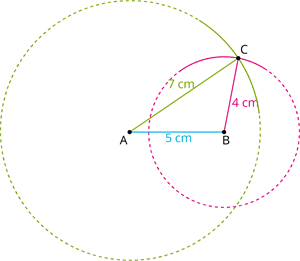
Thus, \(ABC\) is the required triangle.
2. Construction of a triangle when \(2\) sides and the included angle
Let us construct a triangle \(ABC\) with measurements \(AB = 4 \ cm\), \(BC = 6 \ cm\) and \(\angle ABC = 120^{\circ}\).
Construction:
Step 1: Draw a base line segment \(BC = 6 \ cm\).

Step 2: Using a protractor, construct \(\angle B = 120^{\circ}\) by drawing the other arm of the triangle.
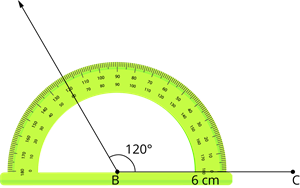
Step 3: With \(B\) as the centre and \(4 \ cm\) as the radius, draw an arc which cuts the arm at \(A\).
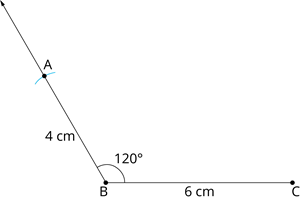
Step 4: Join \(AC\).
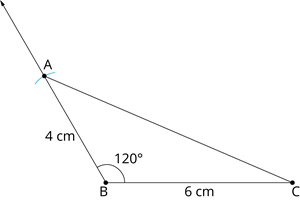
Thus, \(ABC\) is the required triangle.
3. Construction when \(2\) angles and the included side
Construct a triangle \(ABC\) with measurements \(AB = 8 \ cm\), \(\angle CAB = 60^{\circ}\) and \(\angle ABC = 40^{\circ}\).
Construction:
Step 1: Draw a base line segment \(AB = 8 \ cm\).

Step 2: Place the protractor at \(A\) and construct \(\angle XAB = 60^{\circ}\).
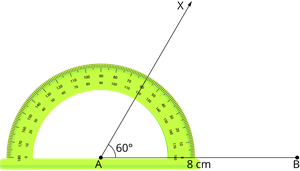
Step 3: Place the protractor at \(B\) and construct \(\angle YBA = 40^{\circ}\).
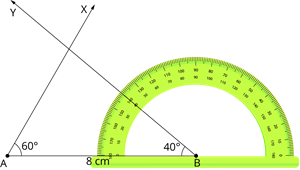
Step 4: Mark the intersection point of the two arms as the vertex \(C\).
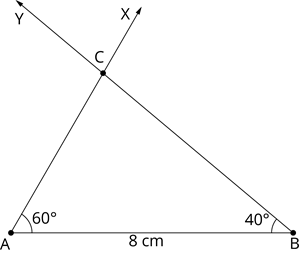
Thus, \(ABC\) is the required triangle.
Altitude of a triangle:
The perpendicular line segment drawn from the vertex of a triangle to its opposite side is called the altitude of a triangle.
4. Construction of altitude of a triangle
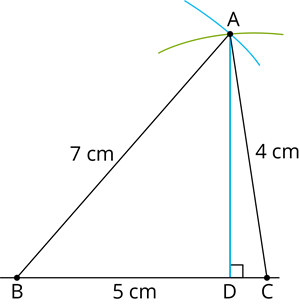
Let us construct a triangle \(ABC\) with \(BC = 5 \ cm\), \(AB = 7 \ cm\) and \(AC = 4 \ cm\). Construct an altitude from \(A\) to \(BC\).
Construction:
Step 1: Construct a base line segment \(BC = 5 \ cm\).

Step 2: With \(B\) as centre and \(7 \ cm\) as radius, draw an arc.
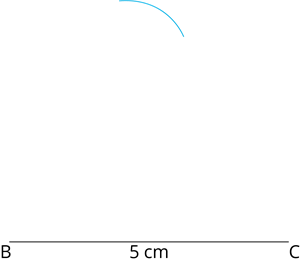
Step 3: With \(C\) as centre and \(4 \ cm\) as radius, draw an arc which cuts the previous arc at \(A\).
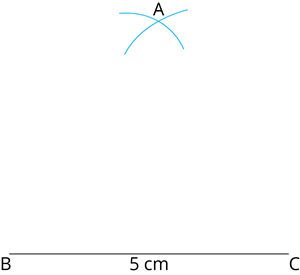
Step 4: Join \(AB\) and \(AC\).
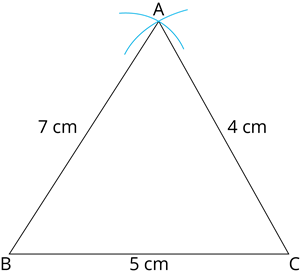
Step 5: Keep the ruler aligned to the base. Place the set square on the ruler as shown, such that one of the edges of the right angle touches the ruler.
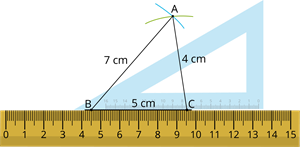
Step 6: Slide the set square along the ruler till the vertical edge of the set square touches the vertex \(A\).
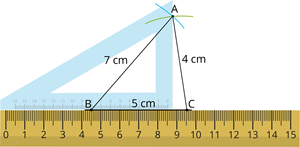
Step 7: Draw the altitude to \(BC\) through \(A\) using the vertical edge of the set square.
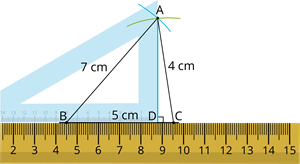
Step 8: \(AD\) is the altitude of the triangle \(ABC\).