

What is a triangle?
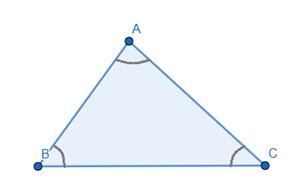
A triangle is the most basic closed shape, formed when three lines intersect. It consists of:
- Three vertices(Corner points): \(A\), \(B\) and \(C\).
- Three sides(line segments): Line segments joining three pairs of vertices. \(AB\), \(BC\) and \(CA\).
- Three angles formed at the vertices are \(\angle A\), \(\angle B\) and \(\angle C\). It can also be written as \(\angle BAC\), \(\angle ABC\) and \(\angle ACB\).
A triangle is denoted by the symbol \(\triangle\). A triangle is named using its three vertices, e.g. \(\triangle ABC\). The vertices can be written in any order(\(\triangle ABC = \triangle BAC = \triangle BCA\), .....)
Types of triangles
Triangles can be classified based on their sides and angles.
(A) Classification of triangles based on their sides:
1. Equilateral triangle:
An equilateral triangle is a triangle in which all three sides are equal in length.
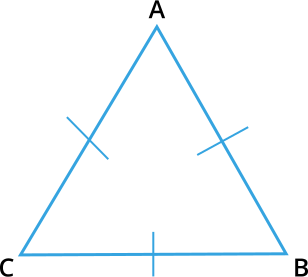
Here, the sides \(AB = BC = CA\).
2. Isosceles triangle:
A triangle with exactly two sides equal is called an isosceles triangle.
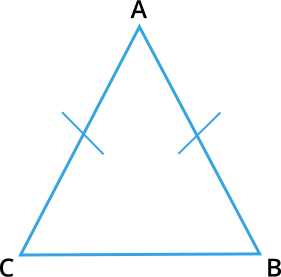
Here, \(AB = AC\).
3. Scalene triangle:
A triangle in which all three sides are of unequal measure is called a scalene triangle.
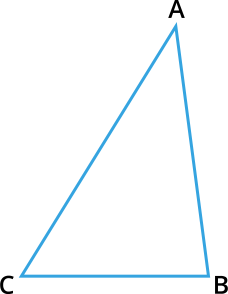
(B) Classification of triangles based on their angles:
| Type | Definition |
| Acute-angled triangle | All three angles in a triangle are less than \(90^{\circ}\). |
| Right-angled triangle | One angle is exactly \(90^{\circ}\). |
| Obtuse-angled triangle | One angle is greater than \(90^{\circ}\). |
Triangle inequality
The triangle inequality is a fundamental geometric property used to determine whether a triangle can exist given three specific side lengths.
A set of three lengths satisfies the triangle inequality if each length is smaller than the sum of the other two lengths.
How to Test for Existence
Identify the longest length and check if it is less than the sum of the two smaller lengths.
Example:
A set of lengths \(9,12,15\) satisfies the triangle inequality because \(15<9+12\).
Conversely, the set \(10,15,30\) does not, because \(30>10+15\).
Circle intersection test:
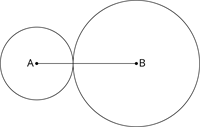
Case 1: Circles touch each other: The sum of the two smaller lengths equals the longest length. The circles meet at a single point on the base, so no triangle is formed.
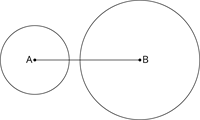
Case 2: Circles do not intersect: The sum of the two smaller lengths is less than the longest length. The arcs will never meet, making a triangle impossible.
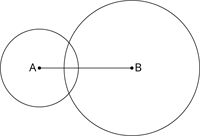
Case 3: Circles intersect internally: The sum of the two smaller lengths is greater than the longest length. The circles intersect at two points, providing the third vertex needed to form a triangle.
Important!
Suppose \(a\), \(b\) and \(c\) are the sides of a triangle with \(a\) and \(b\) are known sides and \(c\) is unknown. Let's use the triangle inequality to find the third side \(c\). As the sum of two sides\((a+b)\) of a triangle is always greater than the third side\((c)\), and the difference of two sides\((a−b)\) of a triangle is always lesser than the third side\((c)\), the length of the third side\((c)\) must lie between difference\((a−b)\) and sum\((a+b)\).
That is, \(|a−b|< c < (a+b)\).
Angle sum property of triangles
The sum of the three angles of any triangle is \(180°\).