Common multiple
A multiple (product), which is common to two or more numbers is called a common multiple.
Example:
1. Find the first common multiple of the numbers \(8\), \(9\) and \(12\).
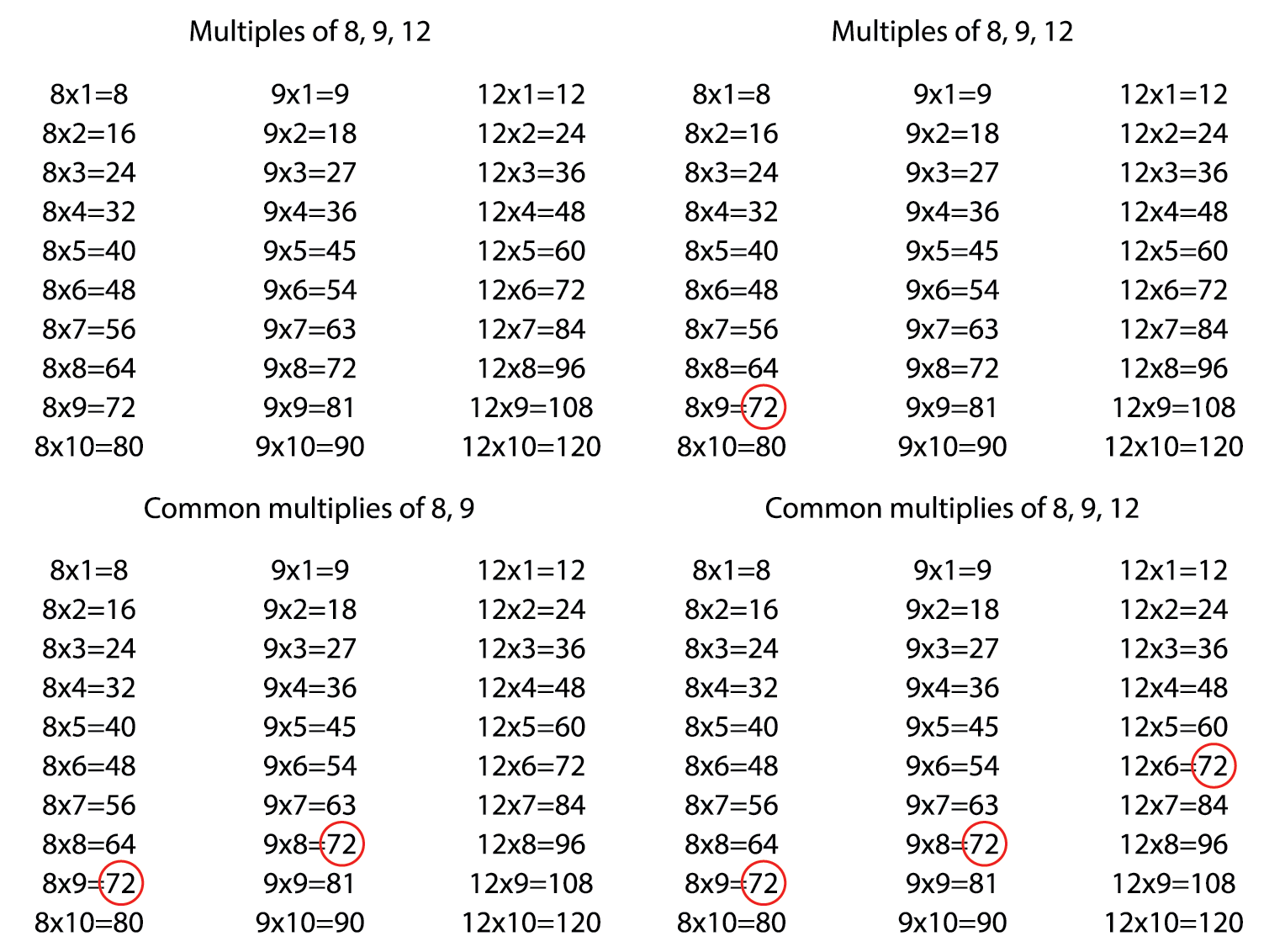
The first common multiple of \(8\), \(9\) and \(12\) is \(72\).
2. List the first four common multiples of \(3\) and \(6\).

The first four common multiples of \(3\) and \(6\) are \(6\), \(12\), \(18\) and \(24\).
Lowest Common Multiple (LCM)
The Lowest Common Multiple (LCM) of two or more given numbers is the lowest (or smallest or least) of their common multiples.
Example
1. Find the lowest common multiple of the numbers \(8\) and \(12\).
Solution:
Multiples of \(8\) \(=\) \(8\), \(16\), \(24\), \(32\), \(40\), \(48\), \(56\), \(64\), \(72\), \(80\), ...
Multiples of \(12\) \(=\) \(12\), \(24\), \(36\), \(48\), \(60\), \(72\), \(84\), …
The common multiples of \(8\) and \(12\) are \(24\), \(48\), \(72\), ...
The lowest common multiple of \(8\) and \(12\) is \(24\).
2. A doctor advises a patient to take a tablet every \(4\) hours and a syrup every \(6\) hours. If he takes the medicine and syrup now, when will the patient take both at the same time?
Solution:
Medicine should be taken for every \(4\) hours.
Syrup should be taken for every \(6\) hours.
We need to find when the patient will take both medicine and syrup at the same time. This indicates that we need to calculate the LCM.
Multiples of \(4\) \(=\) \(4\), \(8\), \(12\), \(16\), …
Multiples of \(6\) \(=\) \(6\), \(12\), \(18\), ..
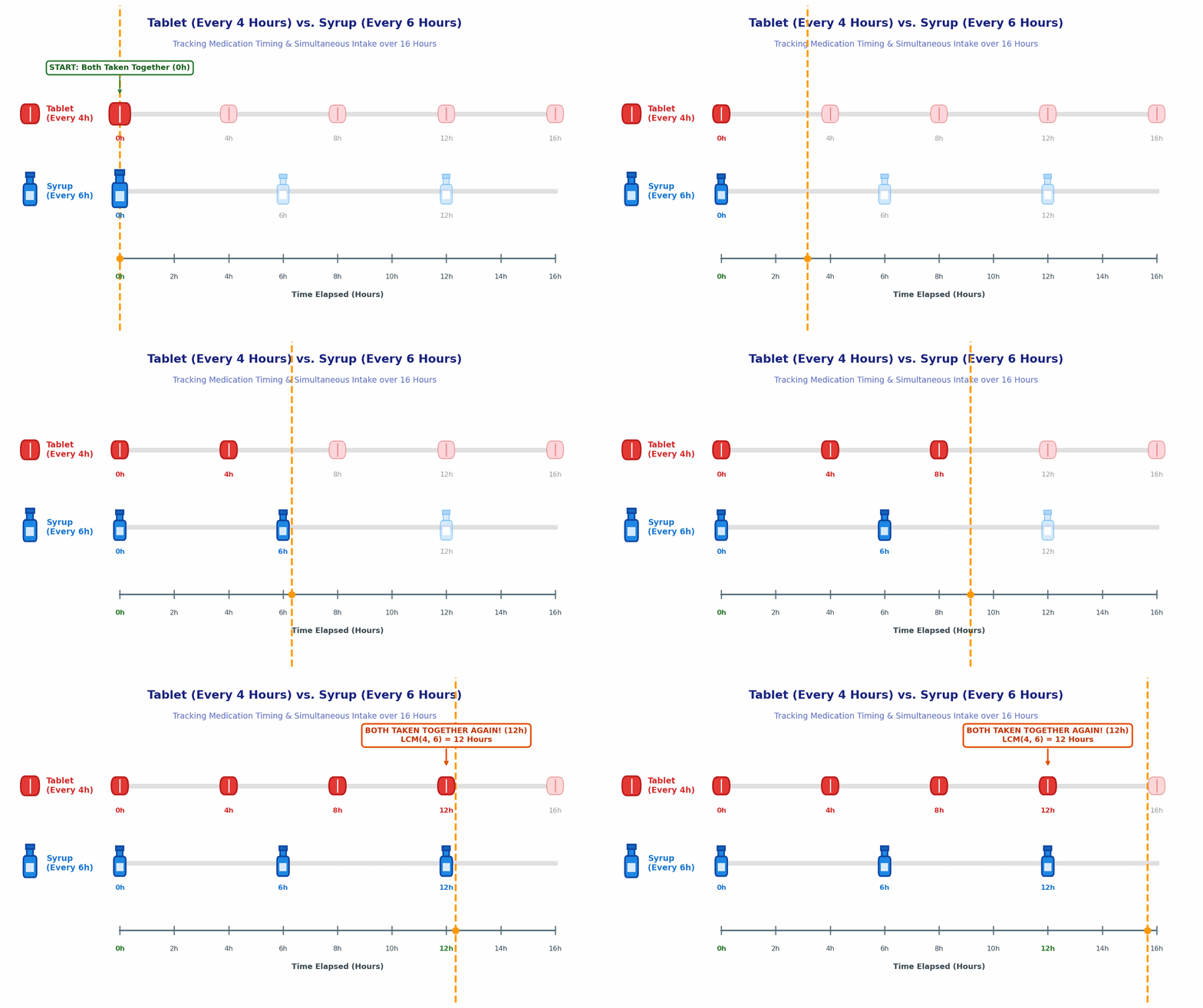
LCM of \(4\) and \(6\) \(=\) \(12\)
Therefore, the patient will take both medicines at the same time after \(12\) hours.
Existence of a Largest Common Multiple
What about the largest common multiple? Does such a number exist?
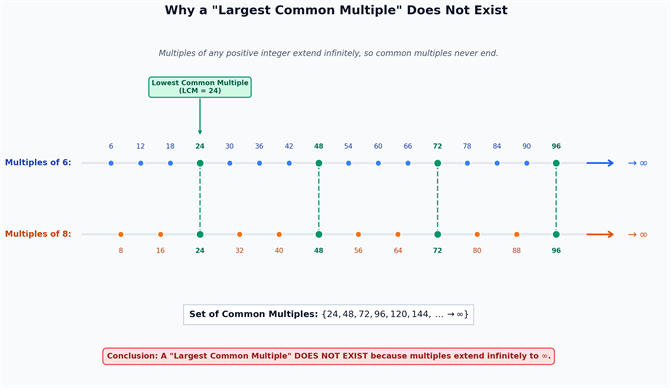
No, a largest common multiple does not exist. Multiples of any positive natural number extend infinitely (e.g., multiples of \(6\) are \(6\), \(12\), \(18\), \(24\), ... to infinity). Consequently, the set of common multiples of \(6\) and \(8\) ({\(24\), \(48\), \(72\), \(96\), \(120\), ...}) is also infinite. Hence, there is no single largest common multiple.
The picture below gives a clear idea of the largest common multiple.