

Finding LCM through Prime factorisation:
Listing multiples works well for small numbers; but it becomes slow and tedious for larger ones. Prime factorisation provides a direct, reliable, and systematic procedure.
Step-by-Step Procedure for LCM through Prime Factorisation.
Step 1: Write out the prime factorisation of each given number.
Step 2: Identify all the distinct prime numbers that appear in any of the factorisations.
Step 3: For each distinct prime factor, pick the maximum number of occurrences across all the given numbers.
Step 4: Multiply these prime factors together. The product is the LCM.
Example
Find the LCM of \(4\), \(8\) and \(12\).
Step 1: Find the Prime Factorisation of Each Number
Prime factorisation of 4:
\begin{array}{r|l} 2 & 4 \\ \hline 2 & 2 \\ \hline & 1 \end{array}
Prime factorisation of 8:
\begin{array}{r|l} 2 & 8 \\ \hline 2 & 4 \\ \hline 2 & 2 \\ \hline & 1 \end{array}
Prime factorisation of 12:
\begin{array}{r|l} 2 & 12 \\ \hline 2 & 6 \\ \hline 3 & 3 \\ \hline & 1 \end{array}
Hence Prime factoristaion
\(4 = 2 \times 2\)
\(8 = 2 \times 2 \times 2\)
\(12 = 2 \times 2 \times 3\)
Step 2: Identify All Distinct Prime Factors
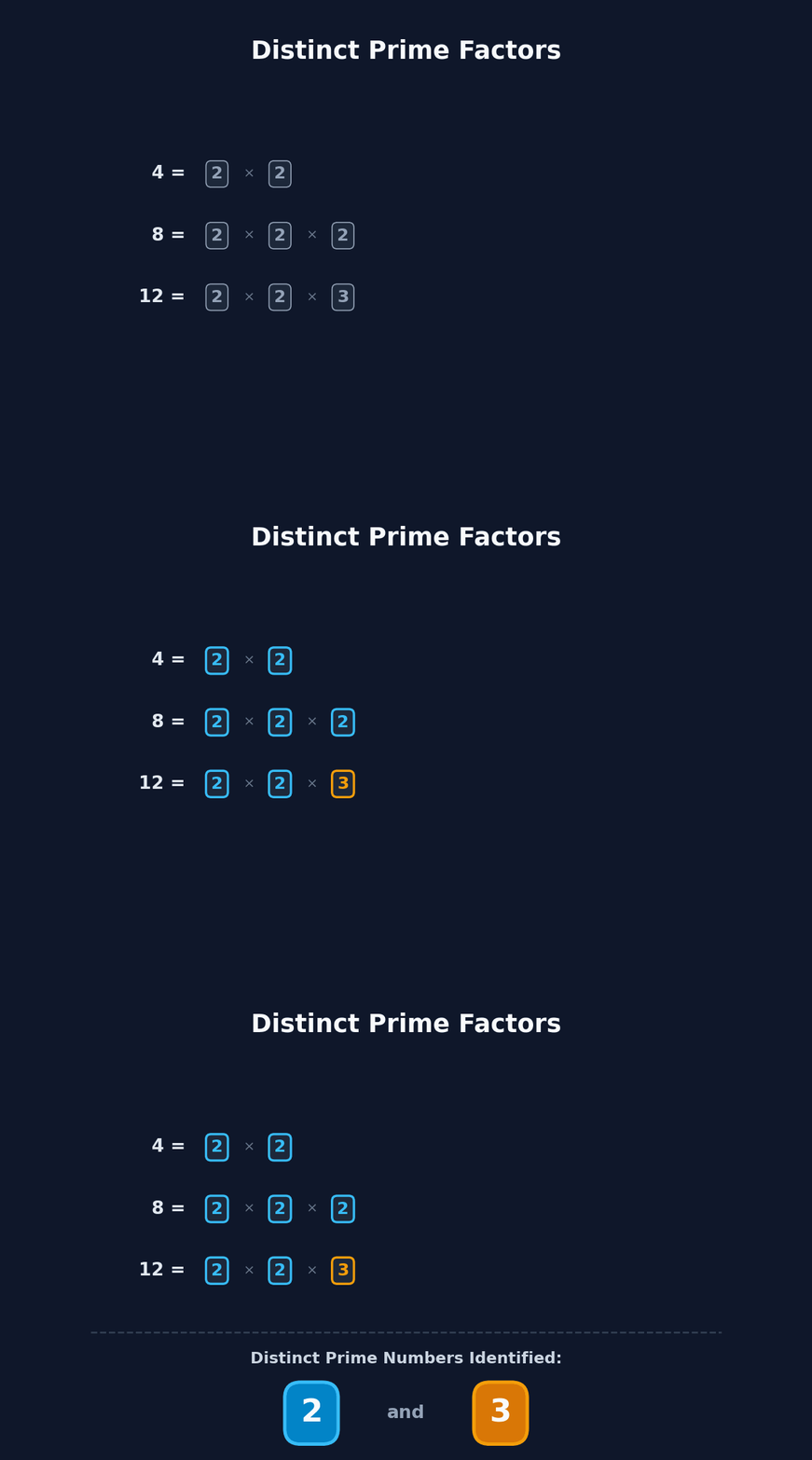
\(2\) and \(3\) are the distinct prime numbers.
Step 3: Find the Maximum Occurrence of Each Prime Factor
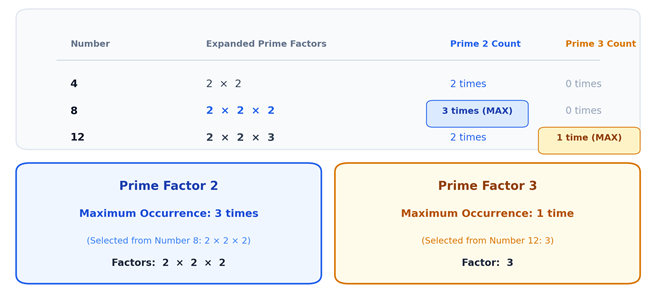
Prime \(2\): Maximum occurrence is \(3\) times (from \(8\)).
Prime \(3\): Maximum occurrence is \(1\) time (from \(12\)).
Step 4: Calculate the LCM
Multiply each prime factor, taking its maximum occurrence.
LCM of (\(4\), \(8\), \(12\)) = \((2 \times 2 \times 2)\) \(\times\) \((3)\) = \(24\)
Hence, LCM of \(4\), \(8\) and \(12\) is \(24\).