

Non-Included Side
A non-included side is a side that does not lie directly between the two specific angles. Instead, it lies opposite to one of the angles.
Example
Consider a triangle \(\Delta ABC\).
If we are given angles \(\angle B\) and \(\angle C\):
The side \(AB\) is opposite to \(\angle C\). Therefore, \(AB\) is a non-included side for the pair \({\angle B, \angle C}\).
The side \(AC\) is opposite to \(\angle B\). Therefore, \(AC\) is a non-included side for the pair \({\angle B,\angle C}\).
The diagrammatic representation is as follows:
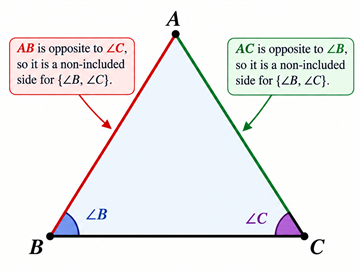
Measuring Two Angles and a Non-Included Side
When two angles are given and the given side is a non-included, we refer to this as the AAS Condition. Since the sum of angles in any triangle is always \(180^\circ\), if we know two angles, the third angle is uniquely determined:
Third Angle = \(180^\circ\) - (Sum of the two known angles)
By calculating the third angle, we can identify the side included between two known angles,
thereby converting the AAS case into an ASA case. Therefore, AAS also guarantees congruence, but it is mathematically an extension of ASA.
AAS (Angle-Angle-Side) Congruence Condition:
If two angles and a non-included side of one triangle are equal to the corresponding two angles and non-included side of another triangle, then the two triangles are congruent.
If two angles and a non-included side of one triangle are equal to the corresponding two angles and non-included side of another triangle, then the two triangles are congruent.
Example
Consider two triangles \(\Delta PQR\) and \(\Delta STU\) with the following measurements:
\(\angle P = \angle S = 40^\circ\), \(\angle R = \angle U = 65^\circ\), and \(QR = TU = 8 \ cm\).
Are the two triangles congruent?
Solution
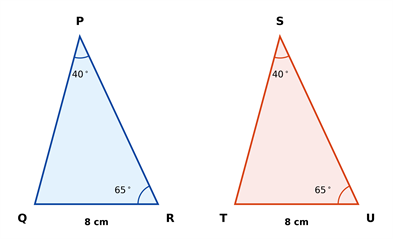
Given:
In \(\triangle PQR\) and \(\triangle STU\),
\(\angle P = \angle S = 40^\circ\)
\(\angle R = \angle U = 65^\circ\)
\(QR = TU = 8 \ cm\)
\(\angle P = \angle S = 40^\circ\)
\(\angle R = \angle U = 65^\circ\)
\(QR = TU = 8 \ cm\)
The side \(QR\) is a non-included side for the two given angles \(\angle P\) and \(\angle R\).
Similarly, the side \(TU\) is a non-included side for the two given angles \(\angle S\) and \(\angle R\).
Now, to find the included side, we have to find the third angle.
Finding the third angle
The sum of the angles of a triangle is \(180^\circ\).
For \(\triangle PQR\):
To find \(\angle Q\)
\(\angle P + \angle Q + \angle R = 180^\circ\)
\(40^\circ + \angle Q + 65^\circ = 180^\circ\)
\(\angle P + \angle Q + \angle R = 180^\circ\)
\(40^\circ + \angle Q + 65^\circ = 180^\circ\)
\(\angle Q + 105^\circ = 180^\circ\)
\(\angle Q = 180^\circ - 105^\circ\)
\(\angle Q = 75^\circ\)
For \(\triangle STU\):
\(\angle Q = 180^\circ - 105^\circ\)
\(\angle Q = 75^\circ\)
For \(\triangle STU\):
To find \(\angle T\)
\(\angle S + \angle T + \angle U = 180^\circ\)
\(\angle S + \angle T + \angle U = 180^\circ\)
\(40^\circ + \angle T + 65^\circ = 180^\circ\)
\(\angle T + 105^\circ = 180^\circ\)
\(\angle T = 180^\circ - 105^\circ\)
\(\angle T = 75^\circ\)
\(\angle T = 180^\circ - 105^\circ\)
\(\angle T = 75^\circ\)
Since the sums must equal \(180^\circ\), the third angles are automatically equal:
Therefore, \(\angle Q = \angle T = 75^\circ\)
Finding the included side
Now we have:
\(\angle Q = \angle T = 75^\circ\)
\(\angle R = \angle U = 65^\circ\)
\(\angle Q = \angle T = 75^\circ\)
\(\angle R = \angle U = 65^\circ\)
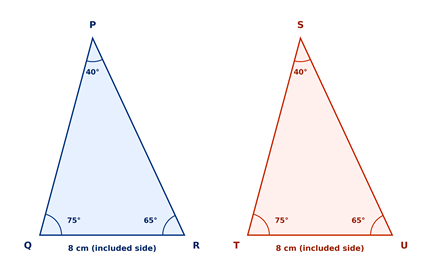
In \(\Delta PQR\), the side \(QR\) lies between the two angles \(\angle Q\) and \(\angle R\).
Therefore, \(QR\) is the included side.
Similarly, in \(\Delta STU\), the side \(TU\) lies between the two angles \(\angle T\) and \(\angle U)\.
Similarly, in \(\Delta STU\), the side \(TU\) lies between the two angles \(\angle T\) and \(\angle U)\.
Therefore, \(TU\) is the included side.
Identifying the congruence condition
Thus,
\(\angle Q = \angle T\)
\(QR = TU\) (included side)
\(\angle R = \angle U\)
\(\angle R = \angle U\)
Let's recall the concept of ASA (Angle Side Angle)congruence condition.
When two angles and the included side of two triangles are equal, the two triangles are congruent. This is referred to as the ASA (Angle Side Angle) congruence condition.
Therefore, by the ASA (Angle Side Angle) congruence condition, the two triangles are congruent.
Understanding the order of the letters
The order in the congruence statement is important.
We have the correspondence:
\(Q \leftrightarrow T\) (Since \(\angle Q = \angle T\))
\(R \leftrightarrow U\) (Since \(\angle R = \angle U\))
Therefore, the remaining vertices must correspond:
\(P \leftrightarrow S\)
Hence \(\triangle PQR \cong \triangle STU\) by ASA (Angle Side Angle) congruence condition.
\(P \leftrightarrow S\)
Hence \(\triangle PQR \cong \triangle STU\) by ASA (Angle Side Angle) congruence condition.
Thus, measuring two angles and a non-included side (AAS) is always sufficient to establish congruence.
Why AAS Works but SSA Fails
Students often confuse AAS (two angles and a non-included side) with SSA (two sides and a non-included angle). Understanding why AAS always guarantees congruence while SSA does not is important.
| Criterion | Given Parts | Guarantees Congruence? | Key Mathematical Reason |
| ASA | 2 Angles + Included Side | Yes | Fixes exact baseline length and ray directions. |
| AAS | 2 Angles + Non-Included Side | YES | Third angle is fixed by 180° sum, reducing case to ASA. |
| SSA | 2 Sides + Non-Included Angle | NO |
Circular arc can intersect side line at 2 distinct points forming
non-congruent triangles.
|
| AAA | 3 Angles | NO |
Guarantees same shape, but not same size.
|