

Measuring Two Sides in a Right Triangle
In triangle geometry, when two sides and an angle are given, the position of the angle relative to the sides determines whether a unique triangle can be constructed. When the given angle is included between the two sides, the SAS (Side-Angle-Side) condition guarantees that all constructed triangles are congruent.
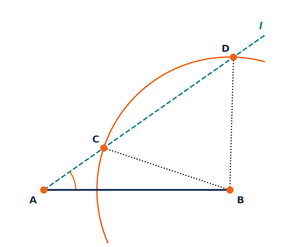
However, when two sides and a non-included angle are specified, we enter the SSA (Side-Side-Angle) case. In general acute or obtuse triangles, SSA does not guarantee congruence because an arc struck from one vertex can intersect the ray of the angle at two distinct points, creating two completely non-congruent triangles (e.g., \(\Delta ABC\) and \(\Delta ABD\) with identical side lengths and non-included angle).
When the fixed non-included angle is a right angle \((90^\circ)\), the general SSA ambiguity disappears completely. This special case is known as the RHS (Right Hypotenuse Side) Congruence Condition.
Important!
- Right Angle: An interior angle measuring exactly 90°.
- Hypotenuse: In a right-angled triangle, the side opposite to the right angle is called the hypotenuse. It is always the longest side of the right triangle.
- Leg / Side: Either of the remaining two perpendicular sides forming the right angle
Consider right-angled triangles \(\Delta DEF\) and \(\Delta PQR\) where:
\(EF = QR = 6 \ cm\), \(\angle E = \angle Q = 90^\circ\) and \(DF = PR = 10 \ cm\).
Are the two right-angled triangles congruent?
Planning the construction is easier with a rough diagram.
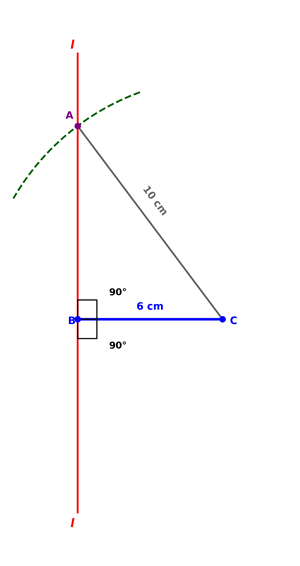
The measurements of \(\Delta ABC\) are \(BC = 6 \ cm\), \(AC = 10 \ cm\) and \(\angle B = 90^\circ\).
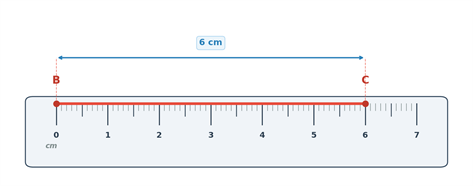
Step 1 (Base Line): Draw a base line segment of length \(BC = 6 \ cm\).
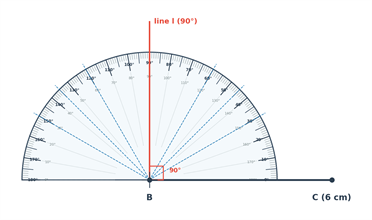
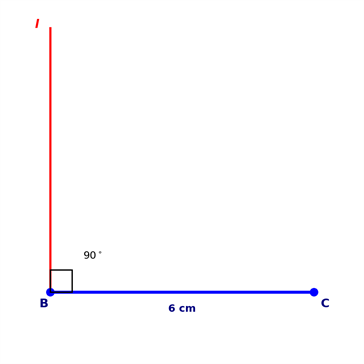
Step 2 (Perpendicular Line): At vertex \(B\), construct a line \(l\) perpendicular to \(BC\) (making \(\angle B = 90^\circ\)).
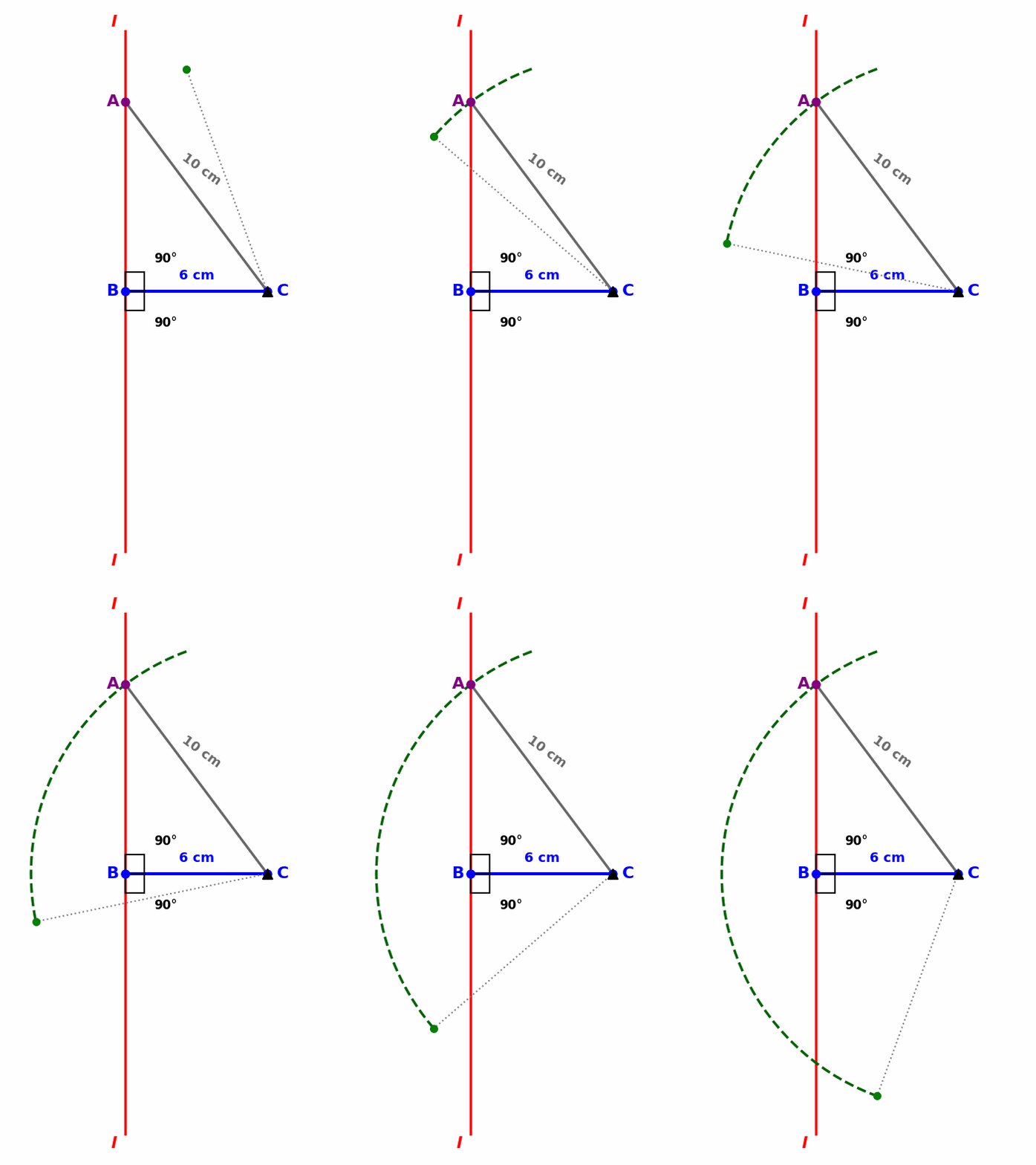
Step 3 (Hypotenuse Arc): Set the compass radius to \(10 \ cm\). Placing the pointer at vertex \(C\), strike an arc cutting the perpendicular line \(l\).
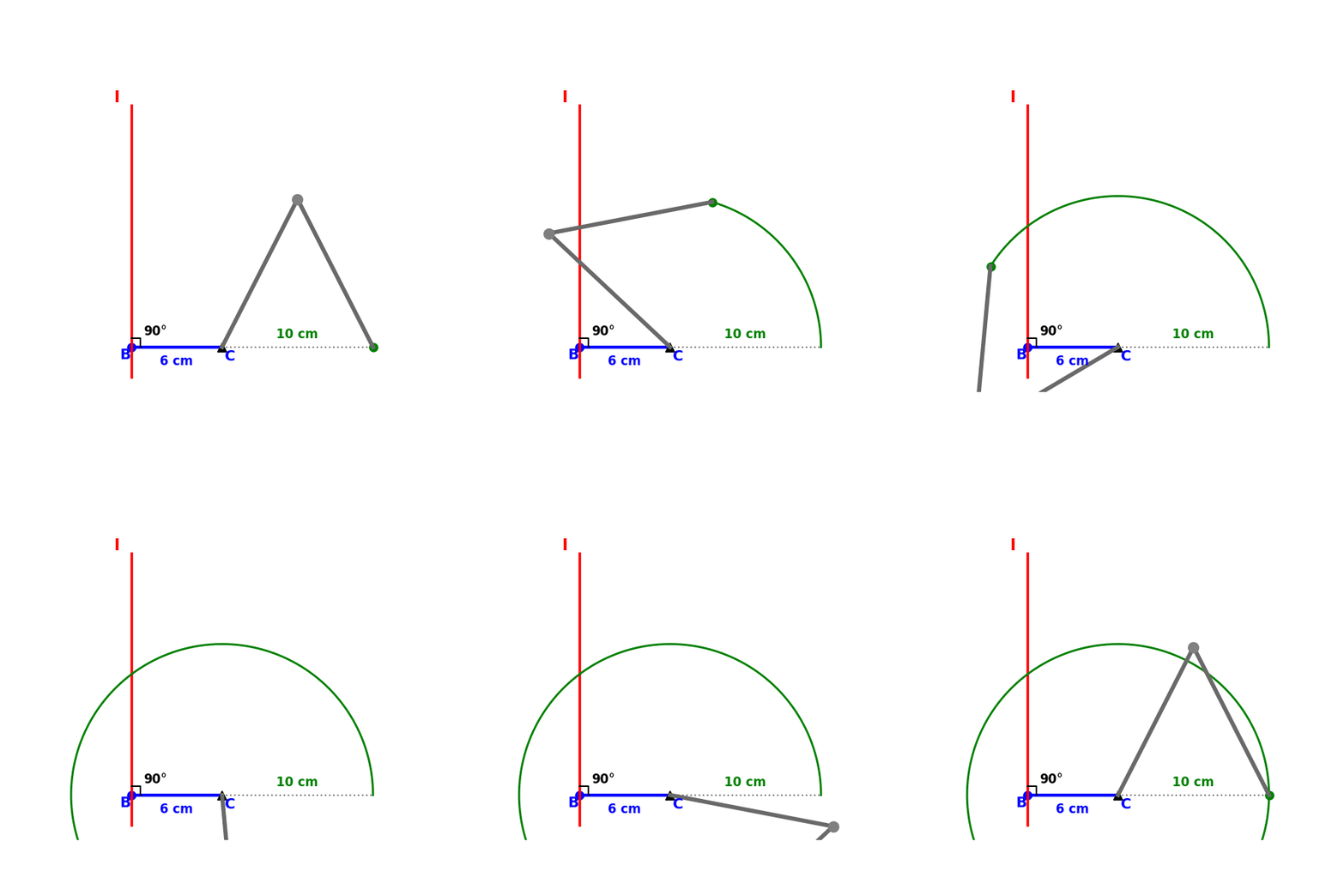
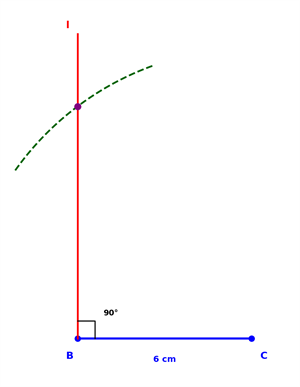
Step 4 (Triangle Completion): Label the point of intersection on line \(l\) as vertex \(A\). Join \(A\) to \(C\). \(\Delta ABC\) is the required right-angled triangle.
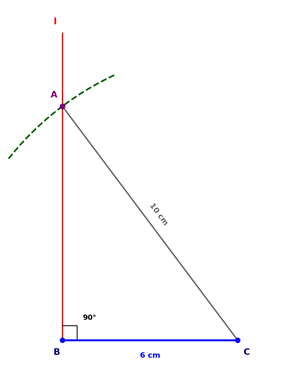
Downward Construction:
1. If perpendicular line \(l\) is extended vertically downwards below baseline \(BC\), the \(10 cm\) arc struck from vertex \(C\) also intersects line \(l\) at a downward point \(D\), as shown below:
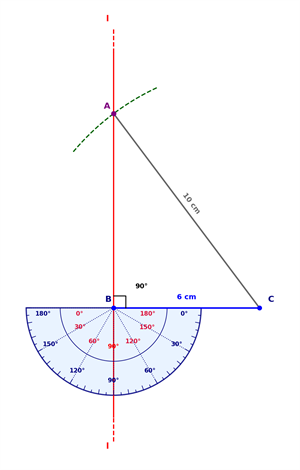
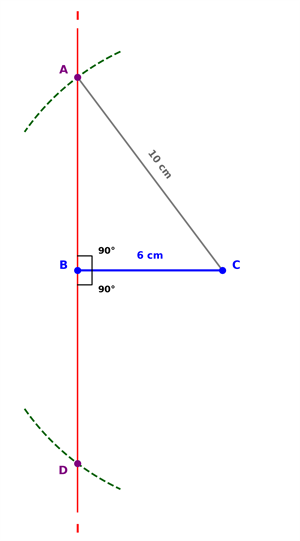
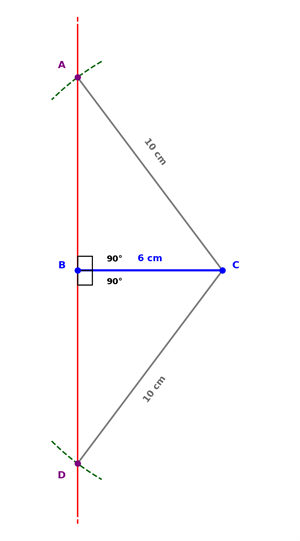
2. Now join \(C\) to \(D\). This forms a lower right-angled triangle \(\Delta DBC\) with base \(BC = 6 \ cm\), right angle \(\angle DBC = 90^\circ\), and hypotenuse \(DC = 10 \ cm\).
Is \(\Delta DBC\) a different triangle in size or shape? (or) Does this create a non-congruent triangle?
No! Baseline \(BC\) acts as a line of symmetry.
Triangle \(\Delta DBC\) is the exact reflection (mirror image) of \(\Delta ABC\) across baseline \(BC\).
Because geometric figures can be rotated or flipped before superimposition, flipping \(\Delta DBC\) vertically over line \(BC\) fits it perfectly over \(\Delta ABC\).
Therefore, \(\Delta ABC \cong \Delta DBC\).
All triangles constructed with these measurements are identical in shape and size, proving that the RHS condition guarantees complete congruence.
Hence, we conclude that \(\Delta DEF \cong \Delta PQR\).
Therefore, the RHS (Right Hypotenuse Side) Congruence Condition is stated as follows:
If the hypotenuse and one side of a right-angled triangle are equal to the hypotenuse and corresponding side of another right-angled triangle, then the two triangles are congruent. This is referred to as the RHS (Right Hypotenuse Side) Congruence Condition.
Example:
Are the following pairs of triangles congruent by the RHS condition?
\(\Delta LMN\) with \(\angle M = 90^\circ\), \(LN = 20 \ cm\), \(MN = 12 \ cm\);
\(\Delta DEF\) with \(\angle E = 90^\circ\), \(DF = 20 \ cm\), \(EF = 12 \ cm\).
Solution
Given:
In \(\triangle LMN\): \(\angle M = 90^\circ\), \(LN = 20 \ cm\), \(MN = 12 \ cm\)
In \(\triangle DEF\): \(\angle E = 90^\circ\), \(DF = 20 \ cm\), \(EF = 12 \ cm\)
In \(\triangle LMN\): \(\angle M = 90^\circ\), \(LN = 20 \ cm\), \(MN = 12 \ cm\)
In \(\triangle DEF\): \(\angle E = 90^\circ\), \(DF = 20 \ cm\), \(EF = 12 \ cm\)
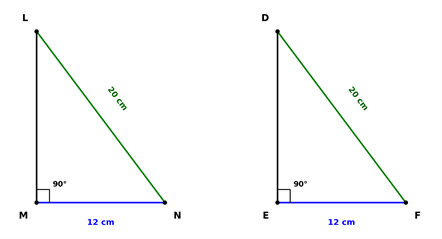
Step 1: Compare the right angles
\(\angle M = \angle E = 90^\circ\)
Therefore, both \(\triangle LMN\) and \(\triangle DEF\) are right-angled triangles.
Step 2: Compare the hypotenuses
In \(\triangle LMN\), the side opposite to the right angle \(\angle M\) is \(LN\).
\(LN = 20 \ cm\) (Given)
In \(\triangle DEF\), the side opposite the right angle \(\angle E\) is \(DF\).
\(DF = 20 \ cm\) (Given)
Therefore, \(LN = DF\)
Step 3: Compare one corresponding side
We are given: \(MN = EF = 12 \ cm\).
Thus, one corresponding side of each right-angled triangle is equal.
Step 4: Identify the congruence condition
We are given: \(MN = EF = 12 \ cm\).
Thus, one corresponding side of each right-angled triangle is equal.
Step 4: Identify the congruence condition
Here,
\(\angle M = \angle E = 90^\circ\) (Right Angle)
\(LN = DF = 20 \ cm\) (Hypotenuse)
\(\angle M = \angle E = 90^\circ\) (Right Angle)
\(LN = DF = 20 \ cm\) (Hypotenuse)
\(MN = EF = 12 \ cm\) (One Corresponding side)
Therefore, by the RHS Congruence Condition, the two triangles are congruent.
Step 5: Understand the order of the letters
The order in the congruence statement is important.
We have the correspondence:
\(M \leftrightarrow E\) (Since \(\angle M = \angle E\))
\(N \leftrightarrow F\) (Since \(MN = EF\) and \(M \leftrightarrow E\))
Therefore, the remaining vertices must correspond:
\(L \leftrightarrow D\)
Therefore, \(\triangle LMN \cong \triangle DEF\).
\(L \leftrightarrow D\)
Therefore, \(\triangle LMN \cong \triangle DEF\).
Hence, the given triangles are congruent by the RHS condition.
Comprehensive Comparison of Triangle Congruence Conditions
| Condition | Full Form | Diagramatic Representation | Required Parts & Position | Guarantees Congruence |
| SSS | Side Side Side | 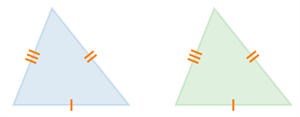 |
3 Pairs of corresponding sides equal | Yes |
| SAS | Side Angle Side | 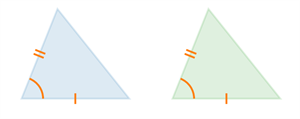 |
2 Sides & 1 Included angle equal | Yes |
| ASA | Angle Side Angle | 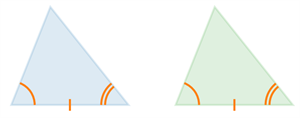 |
2 Angles & 1 Included side equal | Yes |
| AAS | Angle Angle Side | 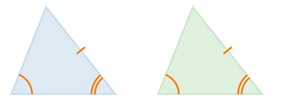 |
2 Angles & 1 Non-Included side equal | Yes (Reduces to ASA via \(180^\circ\) sum) |
| RHS | Right Hypotenuse Side | 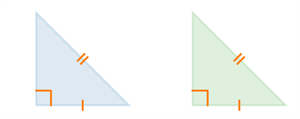 |
Right angle, Hypotenuse & 1 Leg equal | Yes (valid special case of SSA) |
| SSA | Side Side Angle | 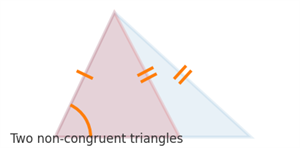 |
2 Sides & 1 Non-Included angle | No (can form 2 triangles) |
| AAA | Angle Angle Angle | 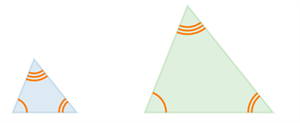 |
3 Pairs of corresponding angles equal | No (Gives same shape, not size) |