

Congruent Triangles in Real Life
Triangles are used everywhere - in buildings, bridges, art and design. In many of these places, we can see congruent triangles (triangles with the same shape and size). Let's look at a few examples.
1. Louvre Pyramid (Paris, France)
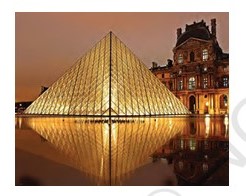
Observation & Structure
The glass pyramid of the Louvre Museum is made up of several triangular glass panels.
The triangular panels are arranged systematically to form the pyramid.
Explanation
- Many triangular panels on the pyramid have the same shape and the same size.
- Some triangles are positioned differently because of the pyramid's structure, but their orientation does not affect congruence.
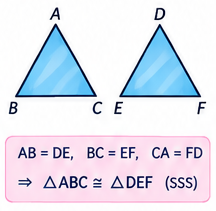
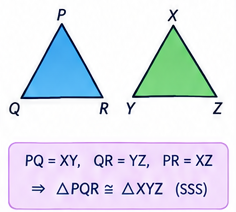
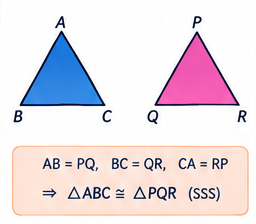
- If two triangular panels have corresponding sides and angles equal, they are congruent.
Mathematical Connection
Engineering / Artistic Benefit
Congruent triangular panels create a strong, symmetrical, and attractive pyramid structure.
2. Egyptian Pyramids (Giza, Egypt)
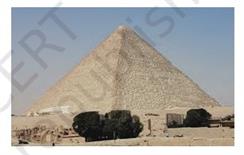
Observation & Structure
The Egyptian pyramid has triangular faces that meet at the top vertex.
The visible side faces have a triangular shape.
Explanation
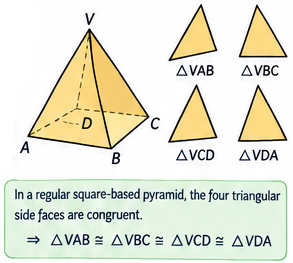
- A regular square-based pyramid has four triangular side faces.
- In an ideal regular pyramid, these four triangular faces are congruent because they have the same dimensions.
- Each triangular face has the same slant height and corresponding base side length.
- The triangles may face different directions, but rotation does not change their size or shape.
Mathematical Connection
Engineering / Artistic Benefit
Congruent triangular faces give a regular pyramid its balanced, symmetrical appearance.
3. Geodesic Dome (Architecture)
Observation & Structure
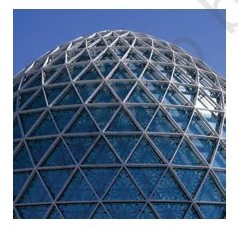
The dome is covered with a network of straight rods that form many small triangles.
Explanation
- The rods divide the curved surface into numerous triangular sections.
- Several of these triangular sections may have the same side lengths and the same shape.
- Such triangles are congruent even though they are located in different parts of the dome.
- Triangular frameworks are useful in construction because triangles provide stability and help distribute forces.
Mathematical Connection
Engineering / Artistic Benefit
Congruent triangles in dome frameworks help create a strong, repeating, and well-organised structure.
4. Rangoli Design (Traditional Art)
Observation & Structure
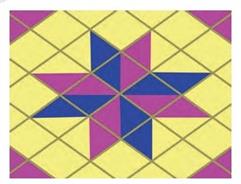
The rangoli contains several coloured triangular regions arranged around a central point. Some triangles are repeated in different positions and orientations.
Explanation
- Several blue and pink triangular regions appear to have the same size and shape.
- Some triangles are rotated or reflected versions of others.
- Rotation and reflection do not change the size or shape of a triangle.
- Therefore, triangles that match exactly after being moved, rotated, or flipped are congruent.
Mathematical Connection
Engineering / Artistic Benefit
Congruent triangles make rangoli designs symmetrical, balanced, and visually attractive.
5. Rabindra Setu (Howrah Bridge, India)

Observation & Structure
The bridge has a framework made of straight steel members. These members form many triangular shapes in the supporting trusses.
Explanation
- The bridge contains repeated triangular sections in its framework.
- Several triangles in corresponding parts of the truss may have the same dimensions.
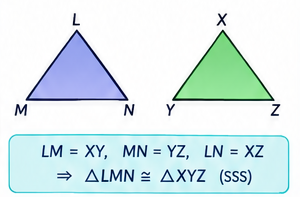
- These triangles can be congruent when their corresponding sides and angles are equal.
- Triangular frameworks are widely used in bridges because triangles maintain their shape and provide structural stability.
Mathematical Connection
Engineering / Artistic Benefit
Repeated triangular frameworks in bridges help provide strength, stability, and an organised design.