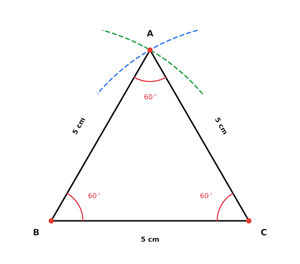
Angles in an Equilateral Triangle
An equilateral triangle is a triangle in which all three sides are equal in length.
Angle property of equilateral triangles:
In an equilateral triangle, all three interior angles are equal, and each angle measures exactly \(60^\circ\).
Proof:
Let \(\Delta PQR\) be an equilateral triangle where all three sides are equal in length, i.e., \(PQ = QR = RP\).
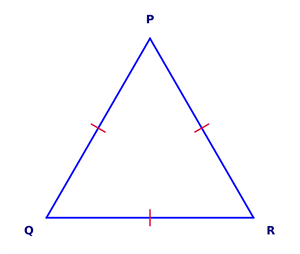
We apply the Isosceles Triangle Theorem (proved in the previous Section using RHS (Right Hypotenuse Side) congruence):
In a triangle, angles opposite to equal sides are equal in measure.
Comparing sides \(PQ\) and \(PR\):
Since \(PQ = PR\), the angles opposite to these sides are equal.
Therefore, \(\angle Q = \angle R\) ....... (1)
Comparing sides \(PQ\) and \(QR\):
Since \(PQ = QR\), the angles opposite to these sides are equal.
Therefore \(\angle P = \angle R\) ....... (2)
From equation \((1)\) and equation \((2)\), \(\angle P = \angle Q = \angle R \)
Hence, all three interior angles of an equilateral triangle are equal to each other.
Angle Measure in an Equilateral Triangle
By the Angle Sum Property of a Triangle,
The sum of all three interior angles in any triangle is always \(180^\circ\).
Therefore, \(\angle P + \angle Q + \angle R = 180^\circ \) ....... (3)
In an equilateral triangle, all three interior angles are equal.
Let \(\angle P = \angle Q = \angle R = x \)
Substituting \(x\) in equation \((3)\).
Therefore, equation \((3)\) becomes \(x + x + x = 180^\circ\)
\(3 \times x = 180^\circ\)
\(x = \frac{180^\circ}{3}\)
\(x = 60^\circ\)
Therefore, \(\angle P = \angle Q = \angle R = 60^\circ\)
Hence, each interior angle of an equilateral triangle measures exactly \(60^\circ\).
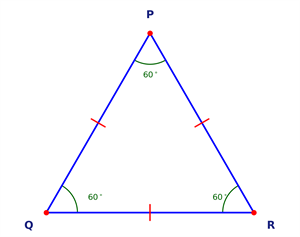
Verify this fact by physical construction using a ruler, compass, and protractor.
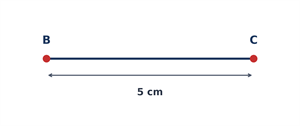
Step 1 (Draw Base Segment): Use a ruler to draw a base line segment \(BC = 5 \ cm\).
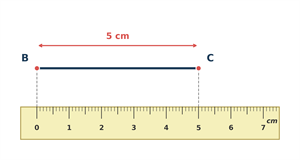
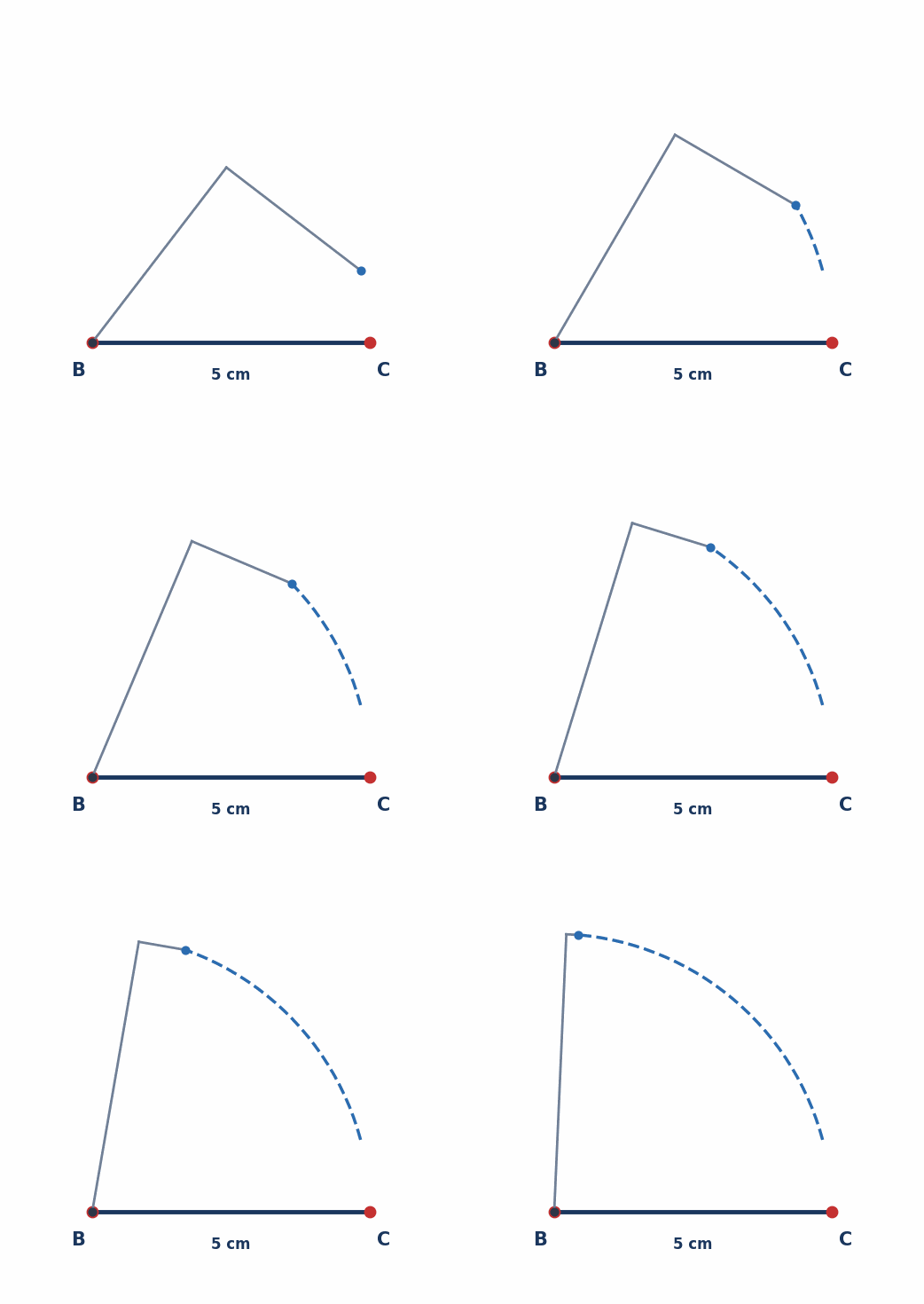
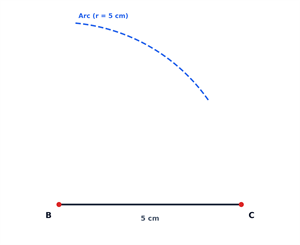
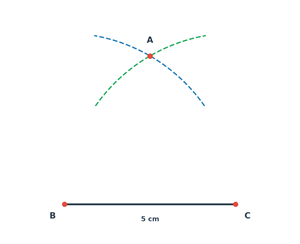
Step 2 (Draw Intersecting Compass Arcs): Set the compass radius equal to the base length \((5 \ cm)\). Place the compass point at \(B\) and draw an arc above line \(BC\).
Without changing the radius, place the compass point at \(C\) and draw a second arc intersecting the first arc at point \(A\).
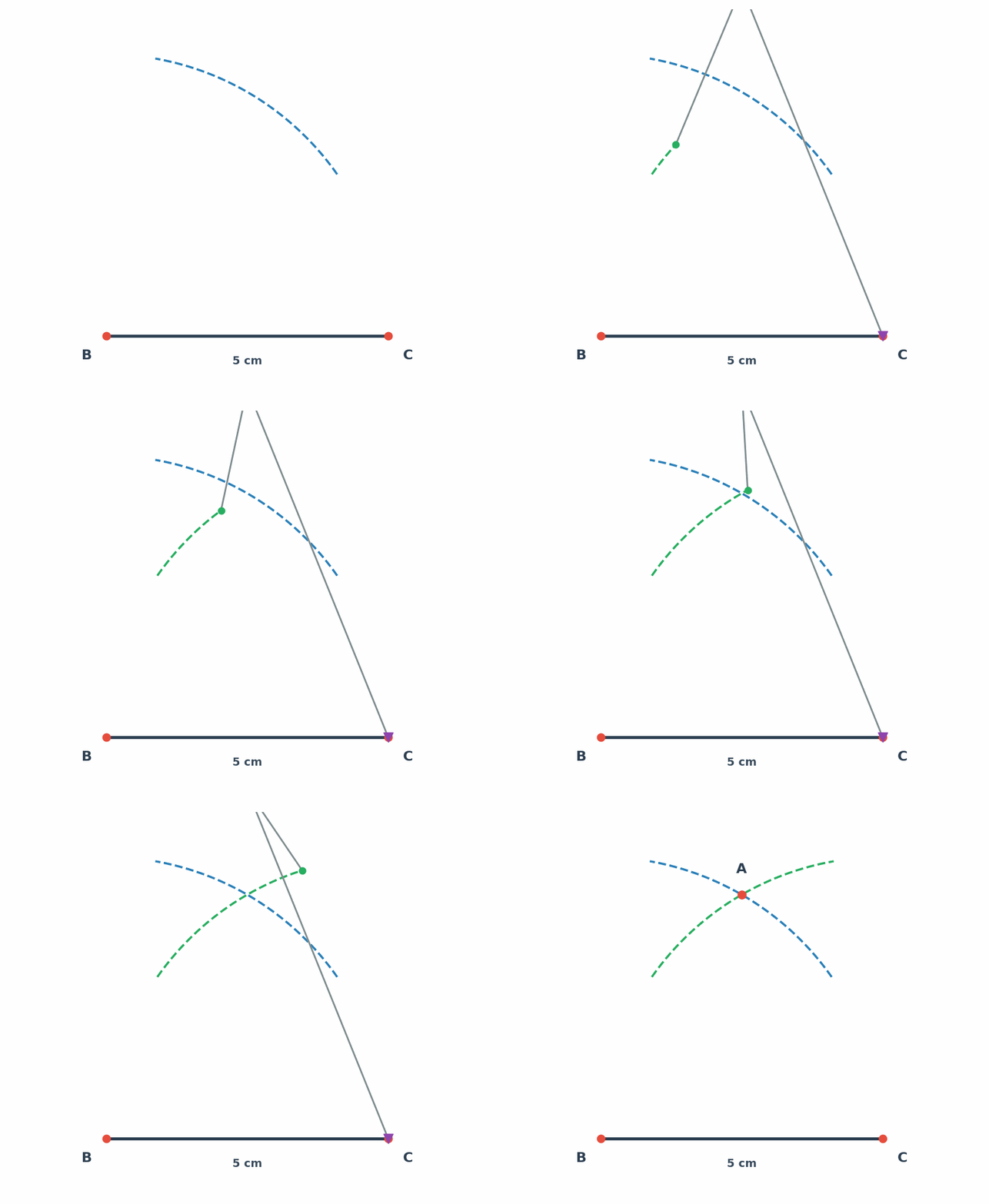
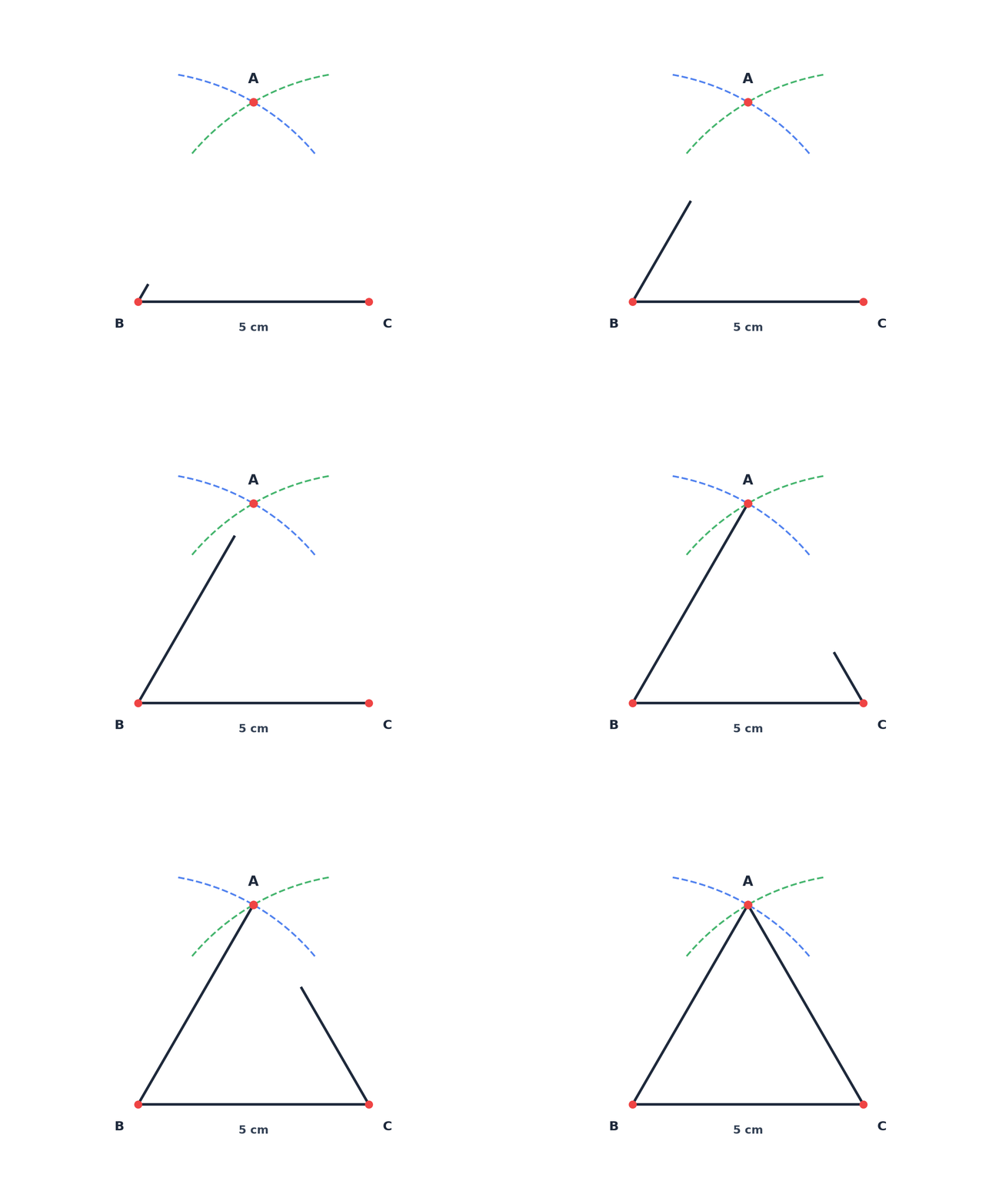
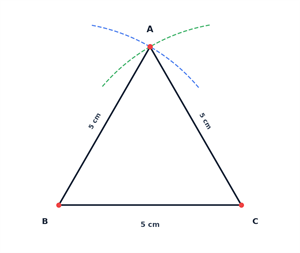
Step 3 (Complete the Triangle): Join line segments \(AB\) and \(AC\) using a straight line. Since both \(AB\) and \(AC\) were drawn with radius \(5 \ cm\), \(AB = BC = CA = 5 \ cm\), forming an equilateral triangle \(\Delta ABC\).
Step 4 (Measure Angles with Protractor): Place a protractor on vertex \(B\) to measure \(\angle B\), on vertex \(C\) to measure \(\angle C\), and on vertex \(A\) to measure \(\angle A\).
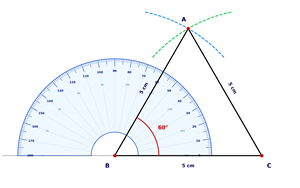
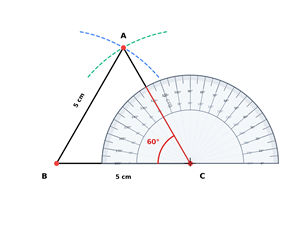
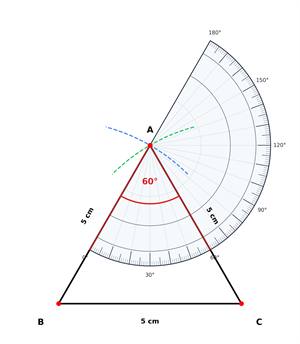
Each measured angle reads exactly \(60^\circ\) on the protractor \(\angle A = 60^\circ, \angle B = 60^\circ, \angle C = 60^\circ\), confirming the mathematical deduction by construction.