

Property of Isosceles triangles
Isosceles triangle: A triangle having two equal sides is called an isosceles triangle.
Theorem : In an isosceles triangle, the angles opposite to equal sides are equal.
Proof:
Let \(\Delta PQR\) be an isosceles triangle where side \(PQ = PR\).
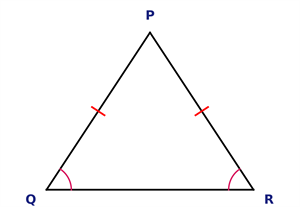
To Prove: \(\angle Q\) = \(\angle R\).
Construction: Draw an altitude \(PS\) from vertex \(P\) perpendicular to base \(QR\) such that \(PS ⊥ QR\) and \(\angle PSQ = \angle PSR = 90^\circ\).
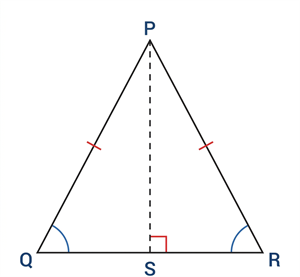
Consider \(\Delta PSQ\) and \(\Delta PSR\)
\(\angle PSQ = \angle PSR = 90^\circ\) (By construction)
\(PQ = PR\) (Given hypotenuses are equal)
\(PS = PS\) (Common side)
Let's recall the concept of RHS (Right Hypotenuse Side) congruence condition.
If the hypotenuse and one side of a right-angled triangle are equal to the hypotenuse and corresponding side of another right-angled triangle, then the two triangles are congruent. This is referred to as the RHS (Right Hypotenuse Side) Congruence Condition.
By the RHS (Right Hypotenuse Side) congruence condition, \(\Delta PSQ \cong \Delta PSR\).
Important!
In congruent triangles, corresponding parts are equal, and we write in short 'CPCT' for corresponding parts of congruent triangles.
Since the triangles are congruent, their corresponding parts are equal by CPCT (Corresponding Parts of Congruent Triangles).
We get \(\angle Q\) = \(\angle R\).
Hence proved.
Example:
Given that \(\Delta PQR\) is isosceles with \(PQ = PR\) and \(\angle P = 70^\circ\). Find \(\angle Q\) and \(\angle R\).
Solution:
Given: \(\Delta PQR\) is isosceles with \(PQ = PR\) and \(\angle P = 70^\circ\).
To find: \(\angle Q\) and \(\angle R\)
Step 1: Apply Isosceles Property
Since \(PQ = PR\), the angles opposite to them are equal.
Therefore \(\angle Q = \angle R\).
Let \(\angle Q = \angle R = x\).
Step 2: Apply Angle Sum Property
The sum of the angles of a triangle is \(180^\circ\).
Therefore, \(\angle P + \angle Q + \angle R = 180^\circ\)
Step 3: Substitute and Solve for \(x\)
\(70^\circ + x + x = 180^\circ\)
\(70^\circ + 2x = 180^\circ\)
\(2x = 180^\circ - 70^\circ\)
\(2x = 110^\circ\)
\(x = \frac{110^\circ}{2}\)
\(x = 55^\circ\)
Therefore, \(\angle Q = \angle R = 55^\circ\).
Hence, \(\angle Q = 55^\circ\) and \(\angle R = 55^\circ\)
Important!
Recall the linear pair property.
When one side of a triangle is extended, the exterior angle formed and the adjacent interior angle form a linear pair.
If an interior angle and its adjacent exterior angle form a linear pair, then:
Interior Angle \(+\) Exterior Angle \(=180^\circ\)