

Two Angles and the Included Side
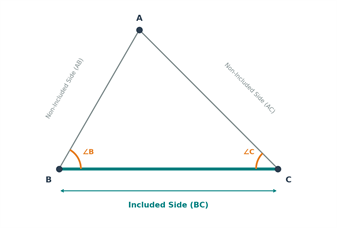
An included side is a side that lies directly between the two specific angles.
Example
- If we select the pair of angles \(\angle B\) and \(\angle C\), the side that directly connects vertex \(B\) to vertex \(C\) is \(BC\). Thus, \(BC\) is the included side between \(\angle B\) and \(\angle C\) as shown in the figure below.
- If we select the pair of angles \(\angle A\) and \(\angle B\), the side connecting vertex \(A\) and vertex \(B\) is \(AB\). Thus, \(AB\) is the included side between \(\angle A\) and \(\angle B\).
- If we select the pair of angles \(\angle A\) and \(\angle C\), the side connecting vertex \(A\) and vertex \(C\) is \(AC\). Thus, \(AC\) is the included side between \(\angle A\) and \(\angle C\).
When we are given two angles and the included side, only one unique triangle can be constructed, which guarantees that all such triangles will be congruent to each other, as stated as follows:
When two angles and the included side of two triangles are equal, the two triangles are congruent. This is referred to as the ASA (Angle Side Angle) congruence condition.
Example
Consider two triangles \(\Delta ABC) and \(\Delta XYZ) as shown in the figure:

From the figure,
In \(\triangle ABC\):
\(BC = 7 \ cm\), \(\angle B = 40^\circ\) and \(\angle C = 30^\circ\)
In \(\triangle XYZ\):
\(YZ = 7 \ cm\), \(\angle Y = 40^\circ\) and \(\angle Z = 20^\circ\)
Step 1: Compare the sides
\(BC = YZ = 7 \ cm\)
Step 2: Compare the angles
\(\angle B = \angle Y = 40^\circ\)
and
\(\angle C = \angle Z = 20^\circ\)
Step 3: Notice where the equal side is located
In \(\Delta ABC\), the side \(BC\) lies between the two angles \(\angle B\) and \(\angle C\).
Therefore \(BC\) is the included side.
Similarly, in \(\Delta XYZ\), the side \(YZ\) lies between the two angles \(\angle Y\) and \(\angle Z)\.
Similarly, in \(\Delta XYZ\), the side \(YZ\) lies between the two angles \(\angle Y\) and \(\angle Z)\.
Therefore \(YZ\) is the included side.
Step 4: Apply the ASA Congruence Condition
Thus,
\(\angle B = \angle Y\)
Thus,
\(\angle B = \angle Y\)
\(BC = YZ\)
\(\angle C = \angle Z\)
Therefore, the two triangles have two equal angles and an equal included side.
Therefore, by the ASA (Angle Side Angle) congruence condition, the two triangles are congruent.
Step 5: Understand the order of the letters
Therefore, by the ASA (Angle Side Angle) congruence condition, the two triangles are congruent.
Step 5: Understand the order of the letters
The order in the congruence statement is important.
We have the correspondence:
\(B \leftrightarrow Y\) (Since \(\angle B = \angle Y\))
\(C \leftrightarrow Z\) (Since \(\angle C = \angle Z\))
Therefore, the remaining vertices must correspond:
\(A \leftrightarrow X\)
Therefore \(\triangle ABC \cong \triangle XYZ\)
\(A \leftrightarrow X\)
Therefore \(\triangle ABC \cong \triangle XYZ\)