

Non-Inculded angle
Every triangle consists of three sides and three angles. Depending on which elements we measure, we can classify angles as either included or non-included.
Non-Included Angle: An angle that does not lie between the two specified adjacent sides. Instead, it is located at one of the other vertices and lies opposite to one of the given sides.
Example
Consider a triangle \(ABC\).
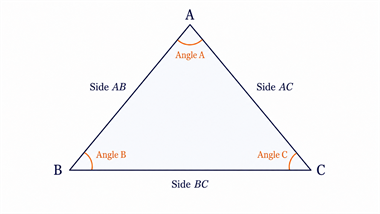
Suppose we are measuring and examining the two sides Side \(AB\) and Side \(AC\):
- The Included Angle is \(\angle A\) (or \(\angle BAC\)), because it is formed where Side \(AB\) and Side \(AC\) meet at vertex \(A\).
- The Non-Included Angles are \(\angle B\) and \(\angle C\). Neither of these angles lies between the two specified sides. Note that \(\angle B\) lies opposite to side \(AC\), and \(\angle C\) lies opposite to side \(AB\).
Measuring Two Sides and a Non-Included Angle:
We know that the SAS (Side Angle Side) condition guarantees triangle congruence. This is because fixing two sides and their included angle establishes a single, unique shape and size.
But what if we measure two sides and a non-included angle? This is the SSA (Side Side Angle) case. Does this guarantee congruence? No. Unlike SSS and SAS, the SSA condition does NOT guarantee congruence. Measuring two sides and a non-included angle can produce two completely different, non-congruent triangles with the same measurements.
Geometric Construction Proof
Let us walk through a step-by-step geometric construction to visualize why this happens using the measurements \(AB = 7 \ cm\), \(BC = 5 \ cm\), and \(\angle A = 35^\circ\).
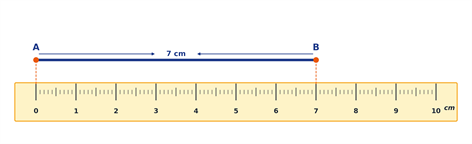
Step 1 (Base Side): Draw a base line segment \(AB\) of length \(7 \ cm\).
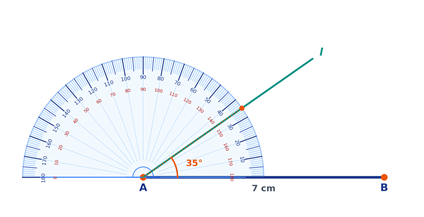
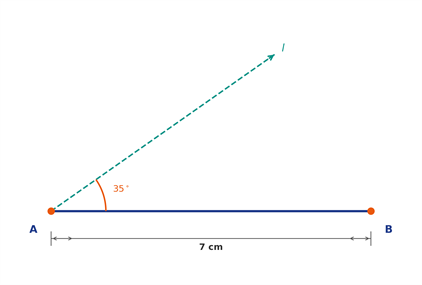
Step 2 (Non-Included Angle): From vertex \(A\), draw a line \(l\) making a fixed angle of \(35^\circ\) with the base \(AB\). This \(35^\circ\) angle is our non-included angle.
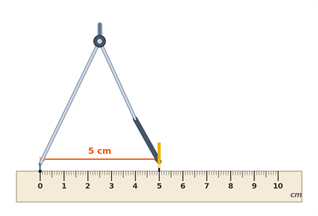
Step 3 (Second Side Arc): Set your compass to a radius of \(5 cm\). Place the needle at vertex \(B\) and draw a sufficiently long circular arc cutting through the line \(l\).
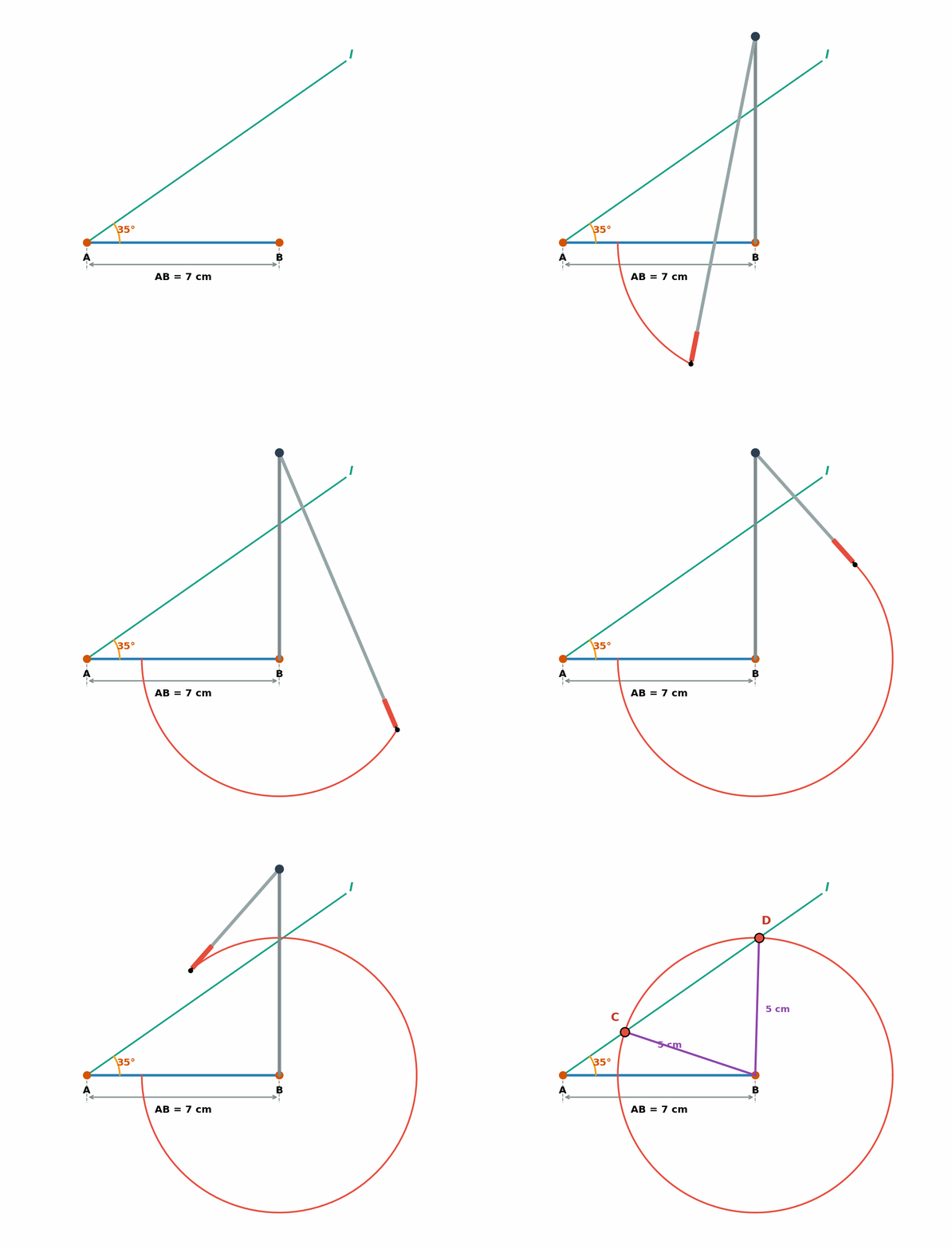
Step 4: Observe the intersection. The arc cuts the line \(l\) at two distinct points, \(C\) and \(D\).
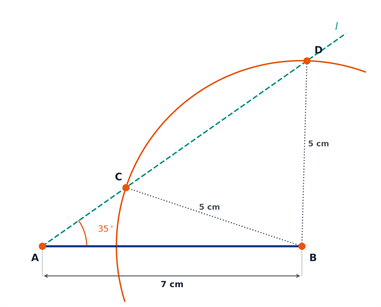
Both points \(C\) and \(D\) lie exactly \(5 \ cm\) away from vertex \(B\). Thus, we can construct two entirely different, non-congruent triangles using the same three measurements:
1. Triangle 1 \(\Delta ABC\): \(AB = 7 \ cm\), \(BC = 5 \ cm\), and \(\angle A = 30^\circ\).
2. Triangle 2 \(\Delta ABD\): \(AB = 7 \ cm\), \(BD = 5 \ cm\), and \(\angle A =30^\circ\).
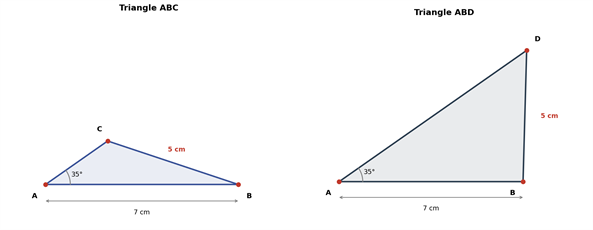
Although they have identical measurements, \(\Delta ABC\) is not congruent to \(\Delta ABD\) because they have different shapes and sizes. Therefore, SSA is not a valid congruence condition.