

Suppose you are given with \(3\) Matchsticks and asking you to form the letter \(C\) using that. It is easy for you to form the letter \(C\) right.
Your work might be like this.

Suppose we want one more \(C\). Then how many sticks you will need?
Yes, We need another \(3\) sticks. In total, we need \( 3 + 3 = 6\) sticks.
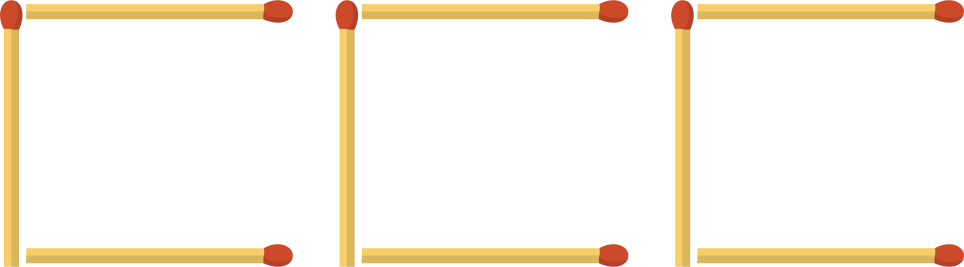
Adding one more letter \(C\) will become:

Here we used \(3+3+3 = 9\) sticks.
Thus, to form one \(C\) we need \(3\) sticks, to form two \(C\)'s we need \(6\) sticks, to form three \(C\)'s we need \(9\) sticks, and so on.
Now tabulate the details and look for the pattern.
| Number of \(C\)'s formed | \(1\) | \(2\) | \(3\) | \(4\) | \(5\) |
| Number of matchsticks needed | \(3\) | \(6\) | \(9\) | \(12\) | … |
Look at the numbers of matchsticks used to form \(C\)'s.
\(3, 6, 9, 12,….\)
In this sequence, the next number should be \(15\).
Because the number of matchsticks needed is three times the number of \(C\)'s formed.
Let us take the general number \(n\) for the number of matchsticks needed.
If one \(C\) is made, then \(n=1\).
If two \(C\)'s are made, then \(n=2\).
If three \(C\)'s are made, then \(n=3\).
Thus, the alphabet \(n\) can be any natural number \(1, 2, 3, 4,...\).
The number of matchsticks required for forming any number of \(C\)'s \(= 3 × n\).
Instead of writing \(3 × n\), we can write \(3n\).
Let us try to get the answer from the above form.
To form one \(C\), \(n=1\) and the number of matchsticks required \(=3×1 =3\).
To form two \(C\), \(n=2\) and the number of matchsticks required \(=3×2 =6\).
To form three \(C\), \(n=3\) and the number of matchsticks required \(=3×3 =9\).
Thus, we got the generalized rule to find the number of matchsticks required to form any number of \(C\)'s.
Is it possible to find the number of matchsticks required to form ten \(C\)'s without drawing its pattern?
Think!
Of course. It is possible.
Just by substituting \(n=10\) in the rule \(3n\), we are able to get the number of matchsticks required to form ten \(C\)'s.
That is, \(3×10 = 30\) matchsticks required.
Now, can you find the number of matchsticks required to form \(100\) \(C\)'s?
Yes, we can get. Substitute \(n = 100\) in the rule \(3n\).
That is, \(3×10 = 30\) matchsticks required.
From the above demonstration, we got the rule to find the number of matchsticks required to make a pattern of \(C\)s.
The rule is:
Number of matchsticks required = 3n
Where \(n\) is the number of \(C\)s in the pattern and \(n\) takes the values from the natural numbers \(1,2,3,4,...\).
Patterns and algebraic expressions:
A pattern is a regular arrangement or sequence of numbers, shapes, or objects in which a rule can be identified.
Patterns show how quantities change and are formed by repeating, increasing, or varying elements in a systematic way. By observing a pattern, we can predict future terms and describe the relationship between different terms.
Patterns can be represented using numbers, figures, or algebraic expressions. Algebraic expressions help us describe patterns in a concise and general form and find values for any position in the pattern.