

Square root:
The square root of a number is a value that, when multiplied by itself, gives the original number.
In general, if \(y=x^2\), then \(x\) is the square root of \(y\). The square root of a number is denoted by \(\sqrt{}\)
Important!
Every perfect square has two integer square roots. One is positive and the other is negative.
For example: \(8\times 8 = 64 \) and \((-8)\times (-8) =64\). So the \(\sqrt{64} = \pm 8\)
Square root by repeated subtraction method:
The square root of a perfect square number can be find by successively subtracting consecutive odd numbers starting from \(1\) until you reach \(0\) as an answer.
The total number of subtraction steps required to reach exactly \(0\) is equal to the square root of that number.
For example: \(16 - 1=15\), \(15-3=12\), \(12-5=7\), \(7-7=0\).
Here are\(4\) steps to attain \(0\).
Therefore, \(\sqrt{16} = 4\)
Important!
A natural number is not a perfect square if it cannot be expressed as a sum of successive odd natural numbers starting from \(1\).
For example: \(12-1=11\), \(11-3=8\), \(8-5=3\), \(3-7=-4\)
It results in a negative value, so it is not a perfect square number.
To check whether the given natural number is a perfect square or not.
Step 1: Write the given natural number as a product of prime factors
Step 2: Now, group the factors in pairs so that both factors in each pair are equal
Step 3: While grouping, no factor is left over, then the given number is a perfect square.
Example:
Check \(36\) is a perfect square.
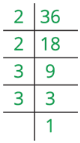
\(36 = 2\times 2\times 3\times 3\)
\(36 = (2\times 2)\times (3\times 3) = 2^2 \times 3^2\)
Here, no factor is left over in grouping.
So, the given number is a perfect square.
Important!
All the numbers are not perfect squares. If any number is not a perfect square, we need to multiply or divide the given number by one of the factor(s) to make it a perfect square.
Square root by prime factorisation method:
A number is a perfect square if its prime factors can be completely divided into two identical, equal groups.
For example : Find the square root of \(324\)
Step 1: Write \(324\) as a product of prime factors.
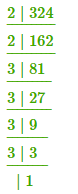
\(324 = 2\times 2\times 3\times 3\times 3\times 3\)
Step 2: Group the prime factors
\(324 = (2\times 2)\times (3\times 3)\times (3\times 3)\)
Step 3: Here, no factor is left over in grouping
So, the given number is a perfect square.
Step 4: Now, take one factor common to each group.
\(\sqrt{324} = 2\times 3\times 3\)
\(\sqrt{324} = 18\).
Therefore, the square root of \(\sqrt{324} = 18\).