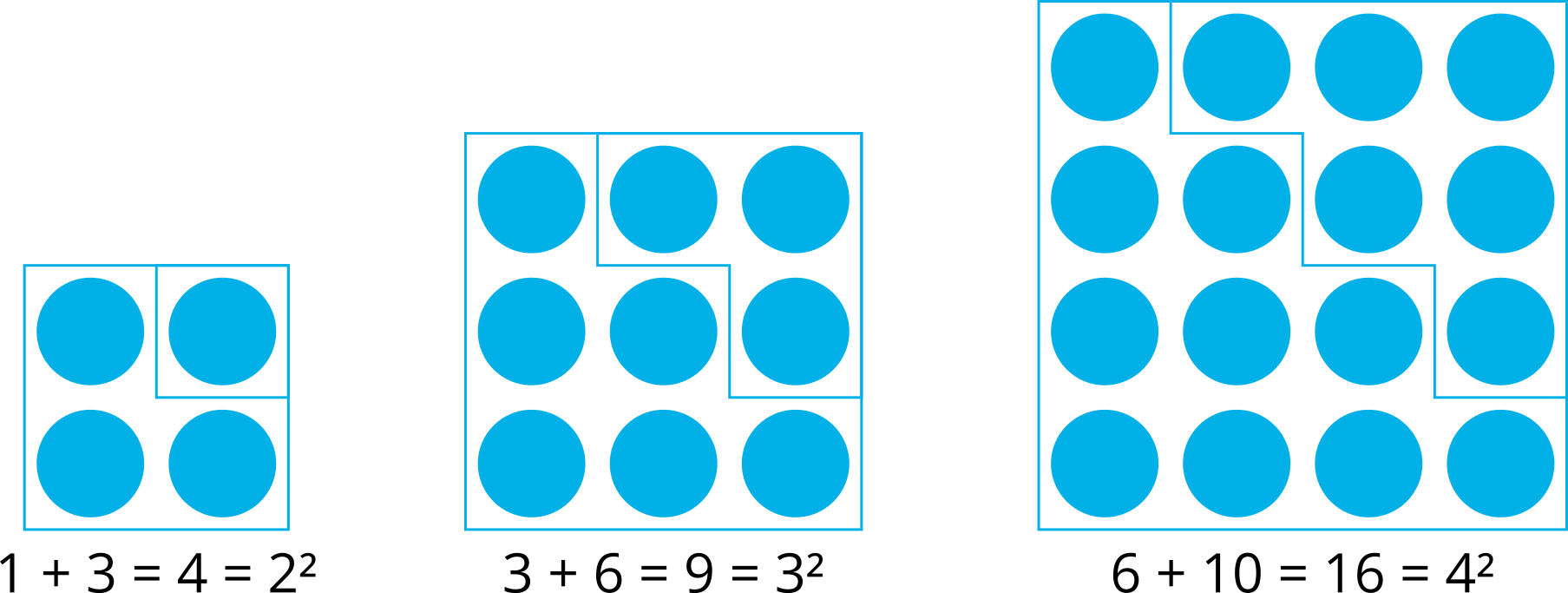
Square number :
A number that can be expressed as the product of a number with itself is called a square number, or simply a square.
In general, for any number \(n\) , we write \(n\times n = n^2\), which is read as \(n\ squared\).
The squares of natural numbers are called perfect squares.
For example, \(36\) is a perfect square becaue it is the product of \(6\) by itself, \(6\times 6 = 36\). However, \(22\) is not a perfect square, it cannot be expressed as the product of two same numbers.
Patterns and properties of perfect squares.
| Number \(n\) (\(1-10\)) | Square Number \(n^2\) | Number \(n\) (\(11-20\) | Square Number \(n^2\) | Number \(n\) (\(21-30\)) | Square Number \(n^2\) |
| \(1\) | \(1^2=1\) | \(11\) | \(11^2=121\) | \(21\) | \(21^2=441\) |
| \(2\) | \(2^2=4\) | \(12\) | \(12^2=144\) | \(22\) | \(22^2=484\) |
| \(3\) | \(3^2=9\) | \(13\) | \(13^2=169\) | \(23\) | \(23^2=529\) |
| \(4\) | \(4^2=16\) | \(14\) | \(14^2=196\) | \(24\) | \(24^2=576\) |
| \(5\) | \(5^2=25\) | \(15\) | \(15^2=225\) | \(25\) | \(25^2=625\) |
| \(6\) | \(6^2=36\) | \(16\) | \(16^2=256\) | \(26\) | \(26^2=676\) |
| \(7\) | \(7^2=49\) | \(17\) | \(17^2=289\) | \(27\) | \(27^2=729\) |
| \(8\) | \(8^2=64\) | \(18\) | \(18^2=324\) | \(28\) | \(28^2=784\) |
| \(9\) | \(9^2=81\) | \(19\) | \(19^2=361\) | \(29\) | \(29^2=841\) |
| \(10\) | \(10^2=100\) | \(20\) | \(20^2=400\) | \(30\) | \(30^2=900\) |
Did you observe the above table? What is the unit digit of the square number?
- All the above numbers are end with \(0\), \(1\), \(4\), \(5\), \(6\) or \(9\). That is, Perfect square numbers always end with these digits only.
- None of them end with \(2\), \(3\), \(7\), or \(8\). That is, Perfect square numbers never end with these digits.
Important!
A number cannot be identified as a perfect square simply by looking at its units digit. For example, \(9\) and \(49\) are perfect squares ending in \(9\), but \(39\) is not a perfect square.
Specific ending patterns:
-
- If a number ends in \(1\) or \(9\), its square will always have \(1\) in its unit place.
- If a number ends in \(2\) or \(8\), its square will always have \(4\) in its unit place.
- If a number ends in \(3\) or \(7\), its square will always have \(9\) in its unit place.
- If a number ends in \(4\) or \(6\), its square will always have \(6\) in its unit place.
- If a number ends in \(5\), its square will always have \(5\) in its unit place.
- If a number ends in one zero, its square will always have two zeros in its unit place. That is, zero in the unit's place gets doubled if it is squared.
- The square of an even number is always even.
- The square of an odd number is always odd.
Perfect Squares and Odd Numbers:
- Every perfect square \(n^2\) is exactly equal to the sum of the first \(n\) consecutive odd numbers starting from \(1\).
For example: \(1^2 = 1\)
\(2^2 = 1+ 3 =4\)
\(3^2 = 1+ 3+ 5 = 9\)
\(4^2 = 1+ 3+ 5+ 7 = 16\)
- If you look at the difference between consecutive perfect squares, you always get a consecutive odd number.
For example: \(4 -1 =3\)
\(9 - 4= 5\)
\(16 - 9 = 7\)
- The \(n^{th}\) odd number is obtained by using \(2n - 1\)
For example: To find \(36^{th}\) odd number, \(\Rightarrow 2(36)-1=71\)
Therefore, the \(36^{th}\) odd number is \(71\).
- There are exactly \(2n\) numbers (non-perfect squares) lying between the squares of two consecutive natural numbers \(n^2\) and \((n+1)^2\)
For example, In between \(6^2\) and \(7^2\), there are \(2\times 6 =12\) numbers.
Perfect Squares and Triangular Numbers:
Triangular Numbers:
A triangular number is a number that can be represented as a triangular arrangement of dots, with each row containing one more dot than the previous one.
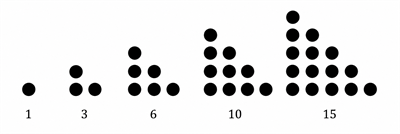
- The sum of any two consecutive triangular numbers always results in a perfect square number.