Cube root
A cube root of a number is a value that gives us the original number when we multiply it by itself three times. The inverse operation of a cube is a cube root. The symbol used to represent the cube root is \(\sqrt[3]{}\). The cube root of \(n\) is denoted by \(\sqrt[3]{n}\) or \(n^{\frac{1}{3}}\).
Example:
Find the cube root of \(64\).
Solution:
\(\sqrt[3]{64} = \sqrt[3]{4 \times 4 \times 4}\) \(= \sqrt[3]{4^3}\) \( = 4\)
Therefore, the cube root of \(64\) is \(4\).
From the observation of the above example, we can conclude that:
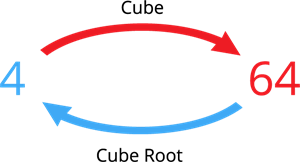
The cube of \(4\) is \(64\).
The cube root of \(64\) is \(4\).
Prime Factorisation method and perfect cube.
Steps to find the cube root of a number through prime factorisation:
Step 1: Find the prime factorisation of the given number.
Step 2: Group the factors in pairs of three numbers (triplets).
Step 3: If no factors remain, the given number is a perfect cube. Otherwise, it is not a perfect cube.
Step 4: Now, take one factor common to each pair and multiply them.
Step 5: The obtained product is a cube root of the given number.
Example:
1. Check \(216\) is a perfect cube and find the cube root.
Solution:
Let us first find the prime factors of \(216\).
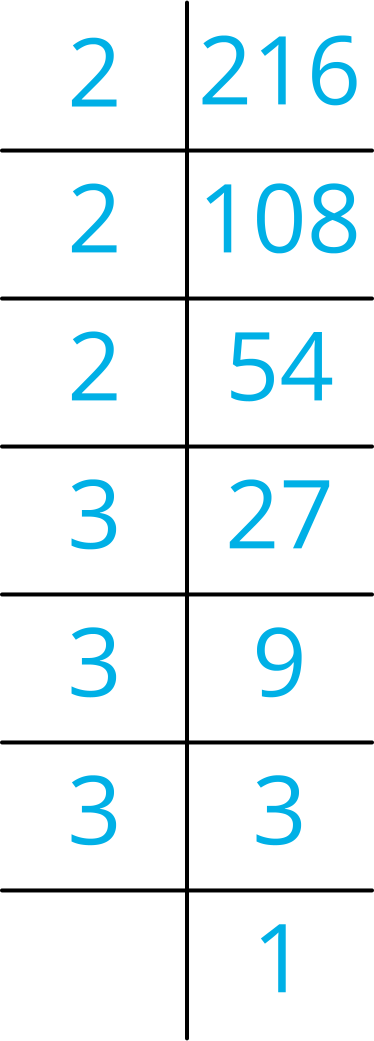
Group the factors in pairs of three numbers.
\(216 = (2 \times 2 \times 2) \times (3 \times 3 \times 3)\)
Here, no factor is left over. Therefore, \(216\) is a perfect cube.
Now, take one common factor from each pair and multiply them.
\(\sqrt[3]{216} = 2 \times 3 = 6\)
Therefore, the cube root of \(216\) is \(6\).
Successive differences in cubes
For perfect cubes, we repeatedly find the differences between consecutive terms until the differences become constant. Taking successive differences of perfect cubes, all differences become equal after three levels.