

Square Numbers:
A square number is a number that can be written as a number multipliedby itself. We write \(n × n\) as \(n²\). It is read as “n squared”.
Example:
- \(4 = 2 × 2\),
- \(6.25 = 2.5 × 2.5\),
- \(16 = 4 × 4\)
Important!
The squares of natural numbers are called perfect squares. For example, \(1, 4, 9, 16, 25, …\) are all perfect squares.
| Number \(n\) (\(1-10\)) | Square Number \(n^2\) | Number \(n\) (\(11-20\) | Square Number \(n^2\) | Number \(n\) (\(1-10\)) | Square Number \(n^2\) |
| \(1\) | \(1^2=1\) | \(11\) | \(11^2=121\) | \(21\) | \(21^2=441\) |
| \(2\) | \(2^2=4\) | \(12\) | \(12^2=144\) | \(22\) | \(22^2=484\) |
| \(3\) | \(3^2=9\) | \(13\) | \(13^2=169\) | \(23\) | \(23^2=529\) |
| \(4\) | \(4^2=16\) | \(14\) | \(14^2=196\) | \(24\) | \(24^2=576\) |
| \(5\) | \(5^2=25\) | \(15\) | \(15^2=225\) | \(25\) | \(25^2=625\) |
| \(6\) | \(6^2=36\) | \(16\) | \(16^2=256\) | \(26\) | \(26^2=676\) |
| \(7\) | \(7^2=49\) | \(17\) | \(17^2=289\) | \(27\) | \(27^2=729\) |
| \(8\) | \(8^2=64\) | \(18\) | \(18^2=324\) | \(28\) | \(28^2=784\) |
| \(9\) | \(9^2=81\) | \(19\) | \(19^2=361\) | \(29\) | \(29^2=841\) |
| \(10\) | \(10^2=100\) | \(20\) | \(20^2=400\) | \(30\) | \(30^2=900\) |
Perfect squares are the squares of natural numbers: \(1, 4, 9, 16, 25, 36, ...\)
Patterns in Perfect Squares
1. Unit Digit of a Square Number:
A square number can end only in \(0, 1, 4, 5, 6\) or \(9\). It cannot end in \(2, 3, 7\) or \(8\).
Let's learn and remember the property in detail.
| Unit digit of a number | Unit digit of the square number |
| \(1\) or \(9\) | \(1\) |
| \(2\) or \(8\) | \(4\) |
| \(3\) or \(7\) | \(9\) |
| \(4\) or \(6\) | \(6\) |
| \(5\) | \(5\) |
| \(0\) | \(0\) |
-
Important!
- \(46\) cannot be a square because it ends in \(6\), but is not formed by a perfect square number. The units digit can only help us identify numbers that are not perfect squares.
- End with zeros: Perfect squares can only have an even number of zeros at the end. For example: \(20^2 = 400\) - two zeros & \(800 = 640000\) - four zeros.
- An even number ends with an even square number. An odd number ends with an odd square number. For example: \(12^2 = 144\) - even & \(21^2 = 441\) - odd.
Perfect squares and Odd Numbers
1. A useful pattern is that the difference between consecutive squares is an odd number. Alternatively, adding consecutive odd numbers starting from \(1\) gives consecutive square numbers. If \(n\) and \(n+1\) are consecutive squares, then \((n+1)^2 - n^2 = 2n+1\), which is odd.
Example:
- \(2^2 -1^1 = 4−1=3\), odd number
- \(3^2-2^2 = 9−4=5\), odd number
2. The sum of first the \(n\) odd numbers is \(n^2\). Alternatively, every square is a sum of successive odd numbers starting from \(1\).
Example:
-
\(1^2 = 1 = 1\)
-
\(2^2 = 4 = 1 + 3\)
-
\(3^2 = 9 = 1 + 3 + 5\)
-
\(4^2 = 16 = 1 + 3 + 5 + 7\)
3. Between the consecutive squares \(n^2\) and \((n+1)^2\), there are \(2n\) non- square numbers.
For example: Let us find the non-square numbers between \(2^2\) and \(3^2\). That is, between \(4\) and \(9\), there are \(2(2) = 4\) non-square numbers \(5, 6, 7\) and \(8\) .
Perfect Square and Triangular Number:
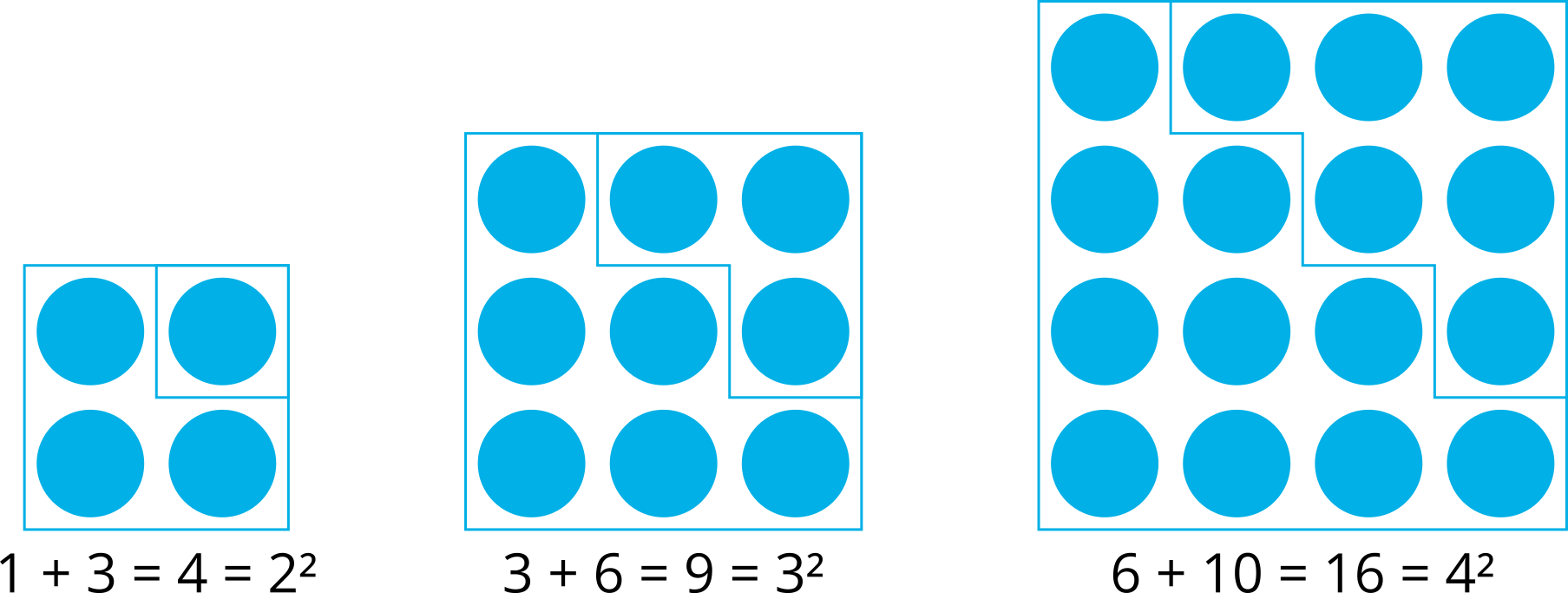
The sum of any two consecutive triangular numbers is always a perfect square.
The triangular numbers are \(1, 3, 6, 10,...\).
- \(1+3 = 4 =2^2\)
- \(3+6 = 9 = 3^2\)
- \(6+10 = 16 = 4^2\)
- \(10+15 = 25 = 5^2\)
Visual representation of perfect square and trianglular number:
Perfect square:
To check whether the given natural number is a perfect square or not, we can follow the below steps:
Step 1. Write the given natural number as a product of prime factors.
Step 2. Now, group the factors in pairs so that both factors in each pair are equal.
Step 3. Now, see whether some factors are leftover or not. If no factor is leftover in grouping, then the given number is a perfect square. Otherwise, it is not a perfect square.
Step 4. Take one factor from each group and multiply them to obtain the number whose square is the given number.
Let's see an example to understand this concept clearly.
Example:
Check whether \(36\) is a perfect square or not. If it is a perfect square, find the number whose square is \(36\).
Solution:
The given number is \(36\).
We have to write \(36\) as a product of prime factors.
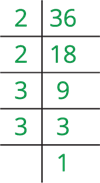
\(36\) \(=\) \(2 \times 2 \times 3 \times 3\)
Now, group the prime factors of \(36\).
\(36 =(2\times 2)\times (3\times 3) = 2^2\times 3^2\)
Here, no factor is leftover in grouping.
So, the given number is a perfect square.
Now, we need to find the number whose square is \(36\).
Take one factor from each group and multiply them to obtain the number whose square is the given number.
\(36 = (2\times 2)\times (3\times 3) = 2\times 3 =6\)
Therefore, \(36\) is the square of the number \(6\).
To obtain a perfect square:
All numbers are not perfect squares. If any number is not a perfect square, we need to multiply or divide the given number by one of the factor(s) to make it a perfect square.
Important!
A perfect number cannot be a perfect square number. Perfect numbers such as \(6\), \(28\), \(496\), \(8128\), ... are not square numbers.
Square root:
The square root of a number is a value that, when multiplied by itself, gives the original number.
In general, if \(y=x^2\), then \(x\) is the square root of \(y\). The square root of a number is denoted by \(\sqrt{}\)
Important!
Every perfect square has two integer square roots. One is positive and the other is negative. In general, \(\sqrt{n^2} =±n\). In this chapter, we will consider the positive square root alone.
For example: \(8\times 8 = 64 \) and \((-8)\times (-8) = 64\). So the \(\sqrt{64} = \pm 8\)
Square root by the repeated subtraction method:
The square root of a perfect square number can be found by successively subtracting consecutive odd numbers starting from \(1\) until you reach \(0\) as an answer.
The total number of subtraction steps required to reach exactly \(0\) is equal to the square root of that number.
Example:
\(16 - 1=15\), \(15-3=12\), \(12-5=7\), \(7-7=0\).
Here \(4\) steps are there to attain \(0\).
Therefore, \(\sqrt{16} = 4\)
Steps to find the square root of a number:
Step 1: Write the given natural number as a product of prime factors.
Step 2: Group the factors in pairs so that both factors in each pair are equal.
Step 3: Now, see whether some factors are left over or not. If no factor is left over in grouping, then the given number is a perfect square. Otherwise, it is not a perfect square.
Step 4: Take one factor from each group and multiply them to obtain the number whose square is the given number.
Let's see an example to understand this concept clearly.
Example:
Find \(\sqrt{324}\).
We need to find the value of \(\sqrt{324}\).
Step 1: Write \(324\) as a product of prime factors.
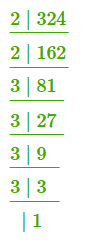
\(324 = 2 \times 2 \times 3 \times 3 \times 3 \times 3\)
Step 2: Group the prime factors.
\(324 = (2 \times 2) \times (3 \times 3) \times (3 \times 3)\)
Step 3: Here, no factor is left over in the grouping.
So, the given number is a perfect square.
Step 4: Now, take one factor common to each group.
\(\sqrt{324}\) \(=\) \(2 \times 3 \times 3\)
\(\sqrt{324}\) \(=\) \(18\)
Therefore, the square root of \(\sqrt{324}\) is \(18\).
Closest Square Numbers:
A perfect square has a whole number as its square root. When a number is not a perfect square, its square root can be estimated using a nearby perfect square.
Step to find the closest square number:
Step 1: Identify the two consecutive perfect squares between which the given number lies.
Step 2: Find their square roots.
Step 3: The square root of the given number lies between these two whole numbers.
Step 4: Determine which perfect square is closer to the given number to get a better estimate.
Let's see an example to understand this concept clearly.
Example:
Find the closest square value of \(250\).
Step 1: We know that \(100 < 250 < 400\) and \(\sqrt{100} = 10\) and \(\sqrt{400} = 20\).
So, \(10 < \sqrt{250} < 20\).
But we are still not very close to the number whose square is \(250\).
Step 2: To find the square root of the number.
We know that \(15^2 = 225\) and \(16^2 = 256\)
Step 3: The square root of the given number lies between these two whole numbers.
Therefore, \(15 < \sqrt{250} < 16\).
Step 4: To determine the closest square number.
Since \(256\) is much closer to \(250\) than \(225\).
Therefore, \(\sqrt{250}\) is approximately equal to \(16\).