Cube Number
When a number is multiplied by itself three times, the result is called a cube number (or perfect cube).
In general, for any number \(n\), we write the cube \(n\times n\times n\) as \(n^3\).
Example:
Let us find the cube number of \(3\).
Here \(a = 3\)
\(a^3 = 3^3\)
\(=3\times 3\times 3 = 27\)
Therefore, \(27\) is the cube number of \(3\).
The following table consists of cube numbers of the first twenty numbers.
| Number | Cube Number | Number | Cube Number |
| \(1\) | \(1^3 =1\) | \(11\) | \(11^3 = 1331\) |
| \(2\) | \(2^3 = 8\) | \(12\) | \(12^3 = 1728\) |
| \(3\) | \(3^3 = 27\) | \(13\) | \(13^3 = 2197\) |
| \(4\) | \(4^3 = 64\) | \(14\) | \(14^3 = 2744\) |
| \(5\) | \(5^3 = 125\) | \(15\) | \(15^3 = 3375\) |
| \(6\) | \(6^3 = 216\) | \(16\) | \(16^3 = 4096\) |
| \(7\) | \(7^3 = 343\) | \(17\) | \(17^3 = 4913\) |
| \(8\) | \(8^3 = 512\) | \(18\) | \(18^3 = 5832\) |
| \(9\) | \(9^3 = 729\) | \(19\) | \(19^3 = 6859\) |
| \(10\) | \(10^3 = 1000\) | \(20\) | \(20^3 = 8000\) |
Properties of cube numbers:
1. Unit digits of cubes
| Unit digit of \(n\) | Unit digit of \(n^3\) |
| \(0\) | \(0\) |
| \(1\) | \(1\) |
| \(2\) | \(8\) |
| \(3\) | \(7\) |
| \(4\) | \(4\) |
| \(5\) | \(5\) |
| \(6\) | \(6\) |
| \(7\) | \(3\) |
| \(8\) | \(2\) |
| \(9\) | \(9\) |
2. The cube of a positive number is always positive.
Example:
\(4^3 = 4\times 4\times 4 = 64\)
3. The cube of a negative number is always negative.
Example:
\((-4)^3 = (-4)\times (-4) \times (-4) = -64\)
4. The cube of every even number is even.
Example:
\(2^3 = 8\), \(4^3 = 64\), \(6^3 = 216\),...
Here, \(8\), \(64\) and \(216\) are all even numbers.
5. The cube of every odd number is odd.
Example:
\(1^3 = 1\), \(3^3 = 27\), \(5^3 = 125\)
Here, \(1\), \(27\) and \(125\) are all odd numbers.
6. When cubing a fraction number, cube both the numerator and the denominator separately.
Example:
\(\left(\frac{4}{5}\right)^3 = \frac{4}{5} \times\frac{4}{5} \times \frac{4}{5} = \frac{64}{125}\)
7. When cubing a decimal number, the number of decimal places in the answer will be three times the number of decimal places in the original number.
Example:
\((13.08)^3 = 13.08\times 13.08\times 13.08 = 2237.810112\)
8. A perfect cube does not end with two zeros; the number of zeros at the end of \(n^3\) is always a multiple of \(3\).
Example:
\(10^3 = 1000\), \(20^3 = 8000\), \(500^3 = 125000000\).
Perfect Cubes and Consecutive Odd Numbers:
1. Every perfect cube \(n^3\) can be expressed as the sum of exactly \(n\) consecutive odd numbers, where the first odd number is \(n(n-1)+1\)
\(1 = 1 = 1^3\)
\(3 + 5 = 8 = 2^3\)
\(7 + 9 + 11 = 27 = 3^3\)
\(13 + 15 + 17 + 19 = 64 = 4^3\)
\(21 + 23 + 25 + 27 + 29 = 125 = 5^3\)
\(31 + 33 + 35 + 37 + 39 + 41 = 216 = 6^3\)
Example:
If \(n=3\)
The sequence starts at \(3(3 -1) + 1 = 7\)
And consists of \(3\) consecutive odd numbers starting from \(7\)
Thus, \(3^3 = 7 + 9 + 11 = 27\)
Important!
To express the cube of any number \(n\) you must add exactly \(n\) consecutive odd numbers together.
The sequence of odd numbers does not reset; it continues exactly where the previous cube's sequences left off.
2. The difference between the cubes of two consecutive natural numbers, \(n\) and \(n+1\) is given by
\((n+1)^3 - n^3 = 1 + (n + 1) \times 3n\)
Example:
Find the difference between \(64^3\) and \(65^3\)
Here, \(n = 64\)
\((64 +1)^3 - 64^3 = 1 + (64 + 1)\times 3(64)\)
\(65^3 - 64^3 = 1+65 \times 64\times 3\)
\(= 1 +12480\)
\(65^3 - 64^3 = 12481\)
The inverse operation of a cube is a cube root. The symbol used to represent the cube root is \(\sqrt[3]{}\).
A cube root is a unique value that gives us the original number when we multiply it by itself three times.
The cube root of \(n\) is denoted by \(\sqrt[3]{n}\) or \(n^{\frac{1}{3}}\).
Example:
Find the cube root of \(64\).
Solution:
\(\sqrt[3]{64} = \sqrt[3]{4 \times 4 \times 4}\) \(= \sqrt[3]{4^3}\) \( = 4\)
Therefore, the cube root of \(64\) is \(4\).
From the observation of the above example, we can conclude that:
The cube of \(4\) is \(64\).
The cube root of \(64\) is \(4\).
Prime Factorisation method and perfect cube.
Steps to find the cube root of a number through prime factorisation:
Step 1: Find the prime factorisation of the given number.
Step 2: Group the factors in pairs of three numbers (triplets).
Step 3: If there are no factors left over, then the given number is a perfect cube. Otherwise, it is not a perfect cube.
Step 4: Now, take one factor common to each pair and multiply them.
Step 5: The obtained product is a cube root of a given number.
Example:
1. Find the value of \(\sqrt[3]{3375}\).
Solution:
Let us first find the prime factor of \(3375\).
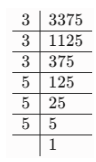
Group the factors in pairs of three numbers.
\(3375 = (5 \times 5 \times 5) \times (3 \times 3 \times 3)\)
Here, no factor is left over. Therefore, \(3375\) is a perfect cube.
Now, take one common factor from each pair and multiply them.
\(\sqrt[3]{3375} = 5 \times 3 = 15\)
Therefore, the value of \(\sqrt[3]{3375} = 15\).
Properties of cube root:
1. Each prime factor of a number appears exactly \(3\) times in the prime factorisation of its cube. So, for a number to be a perfect cube, each prime in its factorisation must appear a multiple of \(3\) times.
Example:
Is \(216\) a perfect cube?
Let us find the prime factors of \(216\)
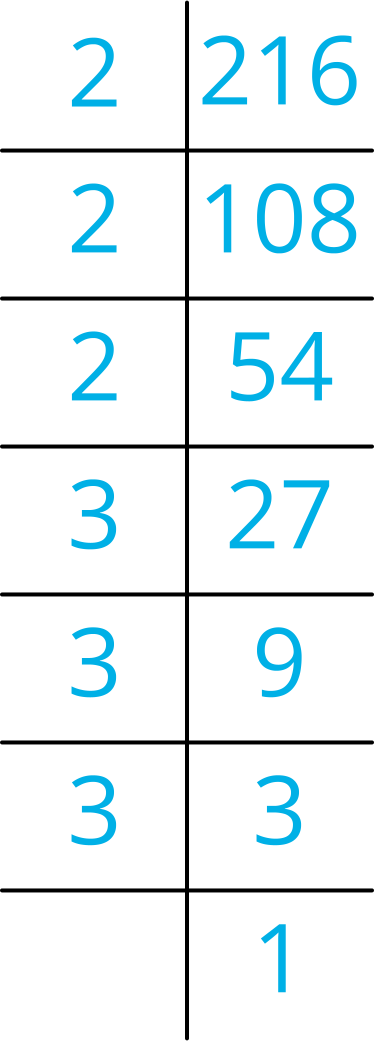
\(216 = 3\times 3\times 3\times 2\times 2\times 2\)
\(216 = (3\times 3\times 3)\times (2\times 2\times 2)\)
Therefore, the prime factors of \(216\) form a triplet; there is no factor left over.
So, \(216\) is a perfect cube.
2. Taking successive differences of perfect cubes, all differences become equal after three levels.