

Number systems having landmark numbers in which the
(a) First landmark number is \(1\), and
(b) Every next landmark number is obtained by multiplying the current landmark number by some fixed number \(n\) is said to be \(\text{base-n}\) number system.
A base - \(10\) number system is also called a \(\text{decimal number system}\)
The Evolution of Number Systems
The Egyptian System: The "Landmark" Approach
The Egyptians (3000 BCE) used a Base-\(10\) system, but they didn't have place value. Instead, they used "landmark numbers."
How it worked: They had unique symbols for \(1, 10, 100, 1000,\) and so on.

The Method: To write a number, you simply repeated the symbols.
For example, \(324\) required three symbols for \(100\), two for \(10\), and four for \(1\).
Limitation: As numbers got larger, you needed an "unending sequence" of new symbols.
Place Value Representation:
The Mesopotamian Number System
It is a \(\text{base - 60 system}\). It is also called as \(\text{sexagesimal system}\).
It is influenced by \(\text{Babylonian number system}\)
Example:
\(\text{1 hour = 60 minutes}\)
\(\text{1 minute = 60 seconds}\)
Symbols:
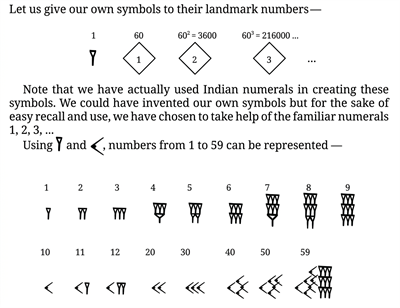
Example:
\( 640 = (10) \times 60 + 40\)
\(=\) \(10 \times\)  \(+ 4 \times\)
\(+ 4 \times\) 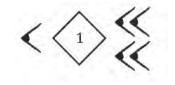
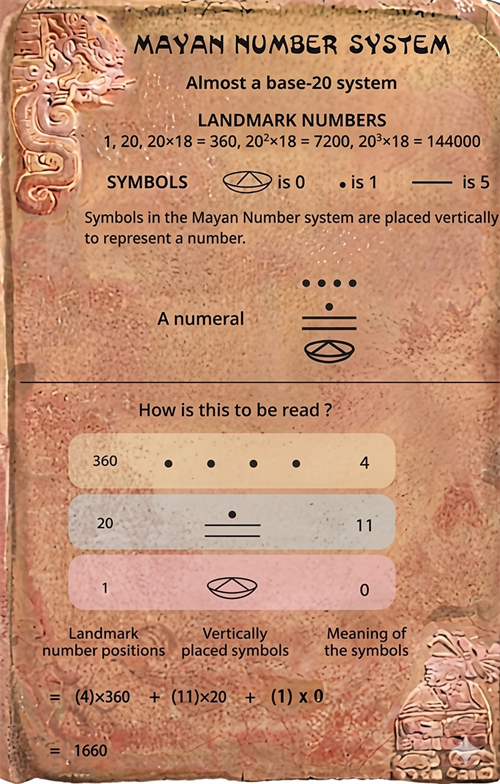
Mayan Number System
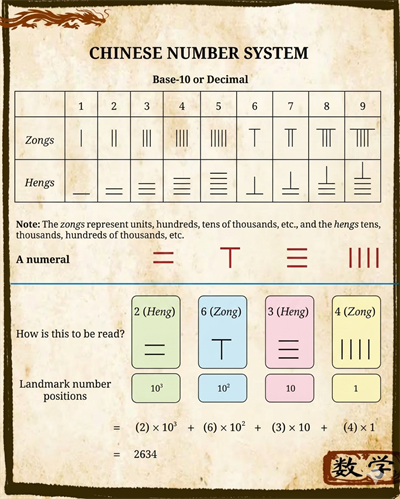
Chinese Number System:
The Hindu Number System:
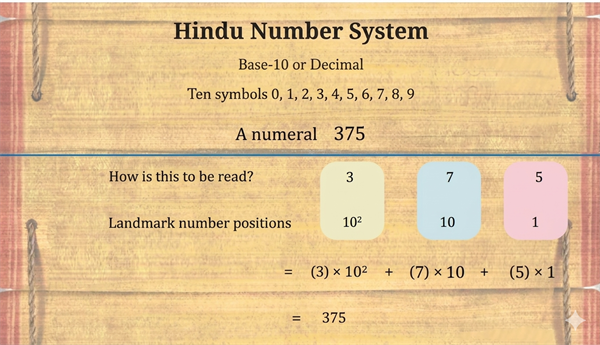
Since, we have already discussed about Egyptian number system and Mayan number system in the previous sessions,
We will see the remaining systems in this session.