

Thousands of years ago, people needed numbers to:
- Count animals and food.
- Trade goods.
- Record taxes.
- Measure land.
- Keep track of days, months and seasons.
Since modern digits \((0–9)\) did not exist, every civilisation developed its own unique way of writing numbers.
Different civilisations created different systems based on their daily needs.
Some systems used
- pictures,
- symbols,
- lines,
- dots,
- bars,
- or special characters.
Among them, three important systems are
- Egyptian Number System
- Mayan Number System
- Roman
- Number System
1. Egyptian Number System:
In this system, we see the use of landmark numbers to group and represent a given number. However, what makes this system special is its sequence of landmark numbers.
Each landmark number is \(10\) times the previous one. Since \(1\) is the first landmark number, they are all powers of \(10\). The following are the symbols given to these numbers —

Example:
Represent \(324\) in Egyptian numerals.
Solution:
\(324 = 100+100+100+20+4\)
Thus we get, \(324\) \(=\) 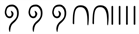
- Variation on Egyptian number system and notation of base:
We get a new number system where each landmark number is 5 times the previous one. Since 1 is the first landmark number, they are all powers of 5.

Example:
Represent \(143\) in this new number system
Solution:
\(143=125+5+5+5+1+1+1\)
\(143\) = 
Number systems having landmark numbers in which the
(a) First landmark number is \(1\), and
(b) Every next landmark number is obtained by multiplying the current landmark number by some fixed number \(n\), which is said to be \(\text{base-n}\) number system.
The Egyptian number system is base-\(10\), and the number system we created is base-\(5\). A base - \(10\) number system is also called a decimal number system.
2. Mayan number system:
The ancient Maya of Central America were brilliant mathematicians and astronomers. They developed an incredibly advanced numbering system to track time, manage trade, and calculate complex astronomical cycles.
Why almost a base-\(20\) number system?:
- Unlike our modern base-\(10\) system, the Mayans counted using both \(10\) fingers and \(10\) toes; because of this, their landmark number became \(20\).
- While a pure base-\(20\) system would scale up by multiplying by \(20\) each time \((1, 1\times 20 = 20, 20 \times 20 = 400, ...\)), but the Mayans have changed their rule at the third level. Their landmark numbers was \(1, 20, 20\times 18 = 360, 20^2 \times 18 = 7200, 20^3\times 18 = 144000,...\).
- Since the Mayan number system does not follow the base-\(20\) pattern completely, it is known as an almost base-\(20\) number system.
Three Simple Symbols (Numbers \(1\) to \(19\)):
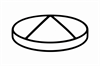
They could write any number up to \(19\) using combinations of just two primary shapes along with a special shell shape for zero.
- A dot represented \(1\)

- A horizontal Bar represented \(5\)
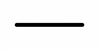
- A shell shape for \(0\)
Vertical Place-Value System:
The Mayans wrote their numbers vertically from bottom to top. The bottom row represented \(1s\), the row above represented \(20s\), the next row represented \(360s\), and the rows above represented larger place values.
Example:
Represent the number \(65\) in the Mayan number system.
\(65 = 3\times 20 + 5\times 1\)
To represent \(3\times 20 \), we draw three dots.
To represent \(5\times 1\), we draw one horizontal bar.
So, \(65\) can be expressed as  in the Mayan number system.
in the Mayan number system.3. Roman number system:
The Roman number system introduces new symbols to represent larger numbers. Let us call all these numbers that have a new basic symbol landmark numbers. Here are some landmark numbers in the Roman system and their corresponding numerals.

Example:
\(27 = 10 + 10 + 5 + 5 + 1 =\) \(\text{XXVII}\)
\(2367 = 1000+1000+100+100+100+50+10+5+1+1 =\) \(\text{MMCCCLXVII}\)