

Reema discovers a mysterious document covered in wedge-shaped symbols. These are ancient Mesopotamian numbers, used over \(4,000\) years ago in a region spanning modern-day Iraq and its neighbours. This discovery leads us to a fundamental realisation: humans have always needed to count—whether to track food, manage livestock, trade goods, or predict lunar cycles and seasons.
Through this chapter, we can explore the profound evolution of number systems.
Mathematics is more than just calculations; it is a human story of curiosity, necessity, and the gradual refinement of "ingenious methods" that allow us to describe the world.
As Pierre-Simon Laplace (1749–1827) once noted:

“The ingenious method of expressing every possible number using a set of ten symbols (each symbol having a place value and an absolute value) emerged in India. The idea seems so simple nowadays that its significance and profound importance are no longer appreciated. Its simplicity lies in the way it facilitated calculations and placed arithmetic foremost among useful inventions.”
The Journey of Indian Numerals
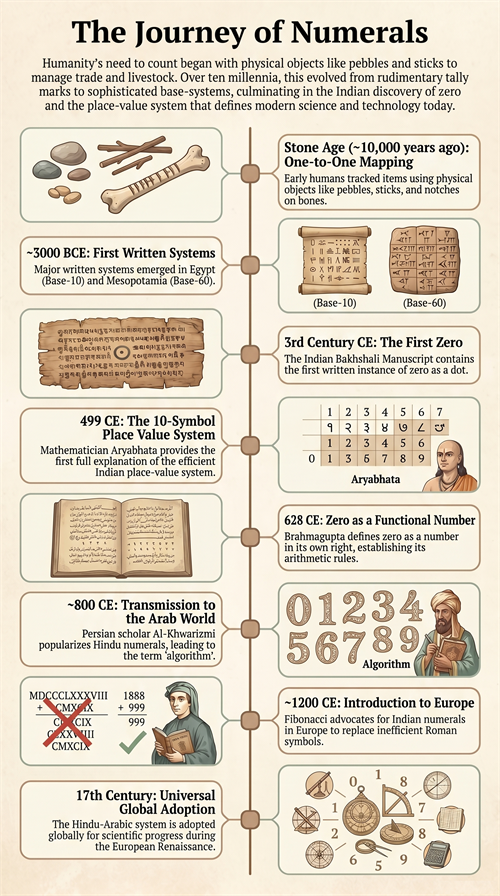
The digits we use today (\(0–9\)) are not "Arabic" in origin, but a \(2,000\)-year-old legacy from India.
Important!
Terminology Confusion:
Arabic Numerals - The name Europeans gave to our system because they learned it from Arab scholars.
Arabic Numerals - The name Europeans gave to our system because they learned it from Arab scholars.
Hindu Numerals - The name Arab scholars (like Al-Khwārizmī) used to credit the Indian origin.
Hindu-Arabic Numerals - The modern transitional term acknowledging both the origin and the transmission.
It is critical to remember that in this context, the word "Hindu" refers to a geography and a people, not a religion.
Mechanism of Counting:
Three historical methods.
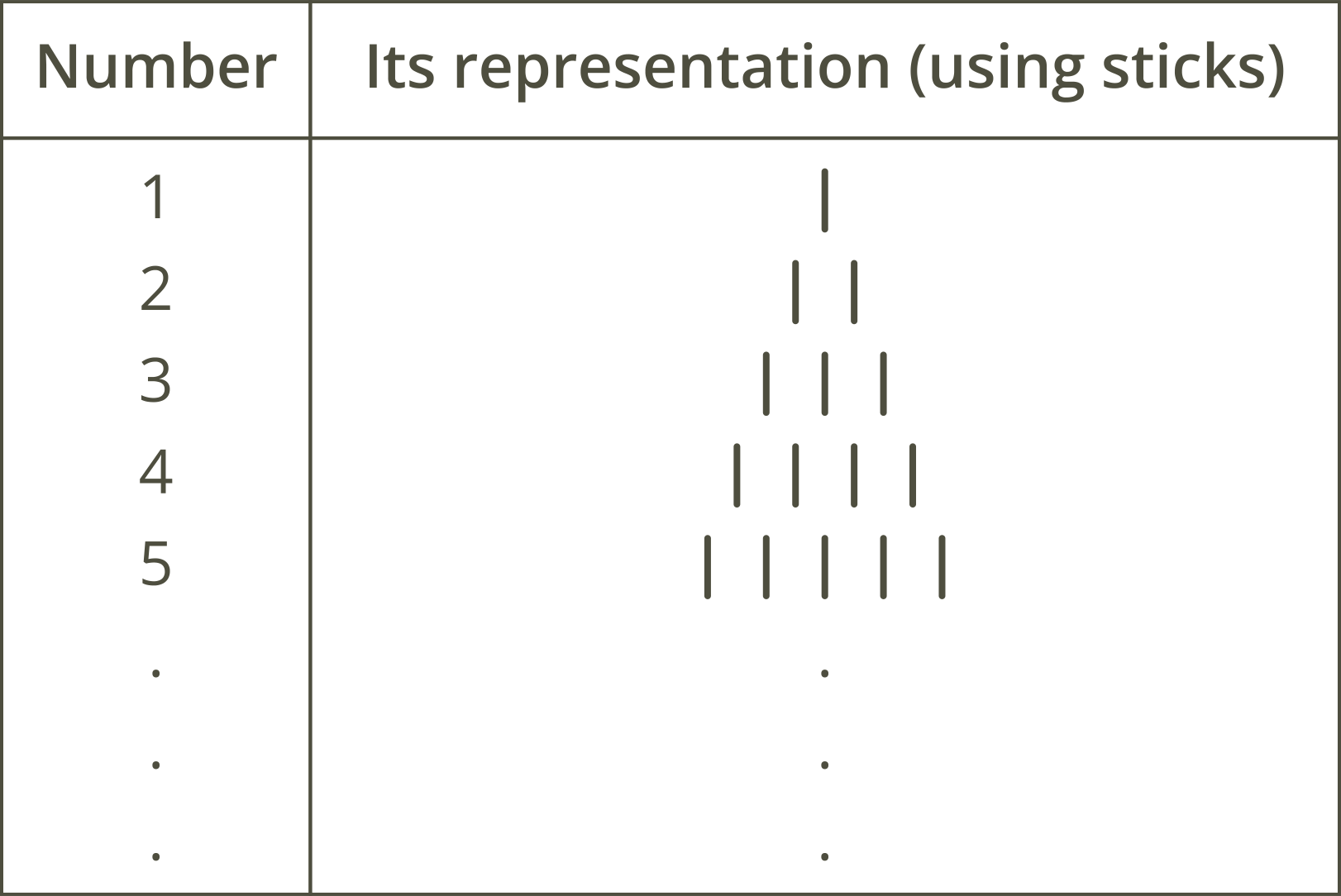
1. Physical Objects Method: Pebbles/sticks.
Practical but cumbersome for large counts. For every cow that goes to graze, you keep one stick. If you have a stick left over when they return, a cow is missing. You don't need the word "seven" to know you have seven cows; you just need seven sticks.
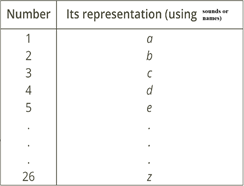
2. Sounds/Names (Letters of the Alphabet)
Using the alphabet (\(a=1\), \(b=2\)). Limited by the number of letters (e.g., \(26\))
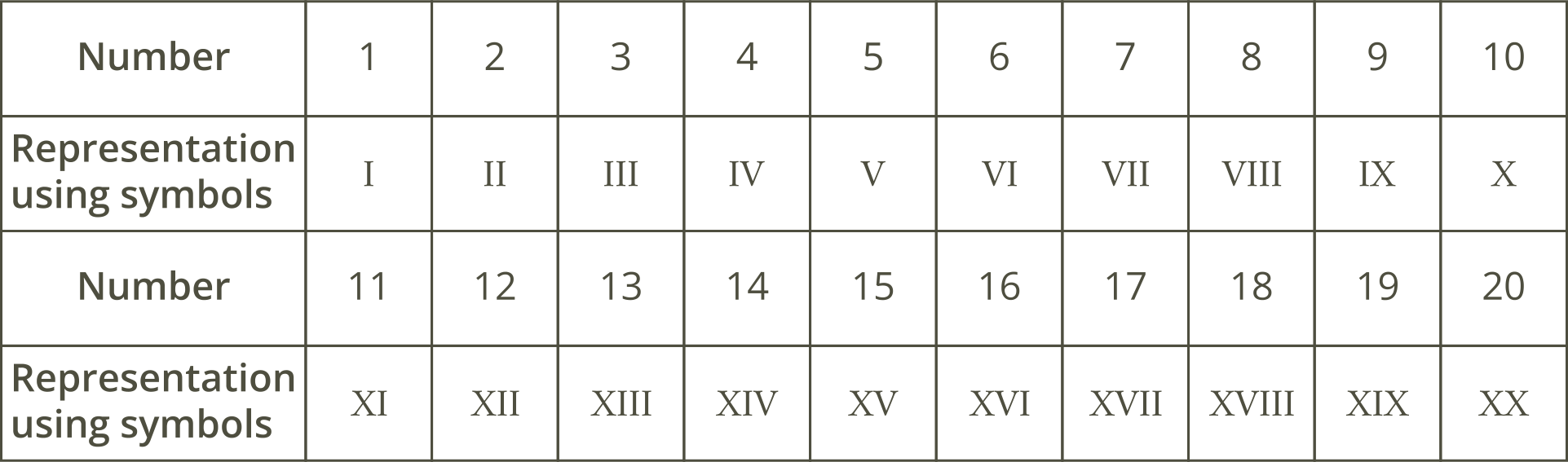
3. Written Symbols
Efficient but requires learning rules (e.g. Roman Numerals)
One-to-One Mapping: Pairing each object (like a cow) with exactly one unique counter (like a stick). This is the foundation of counting.
Example:
Imagine a shepherd has sheep. For every sheep, he keeps one pebble.
| Sheep | Pebble |
|---|---|
| 🐑 | ● |
| 🐑 | ● |
| 🐑 | ● |
Each sheep is matched with exactly one pebble.
This is called one-to-one mapping.
Scenario: If \(12\) sheep leave and only \(11\) return, one pebble remains unmatched.
The shepherd immediately knows one sheep is missing.