

1. Physical Markers for Counting:
There are two major ways followed:
- Body Parts
- Tally Marks on Bone
- Lebombo Bone
- Ishango Bone
1. Use of Body parts:
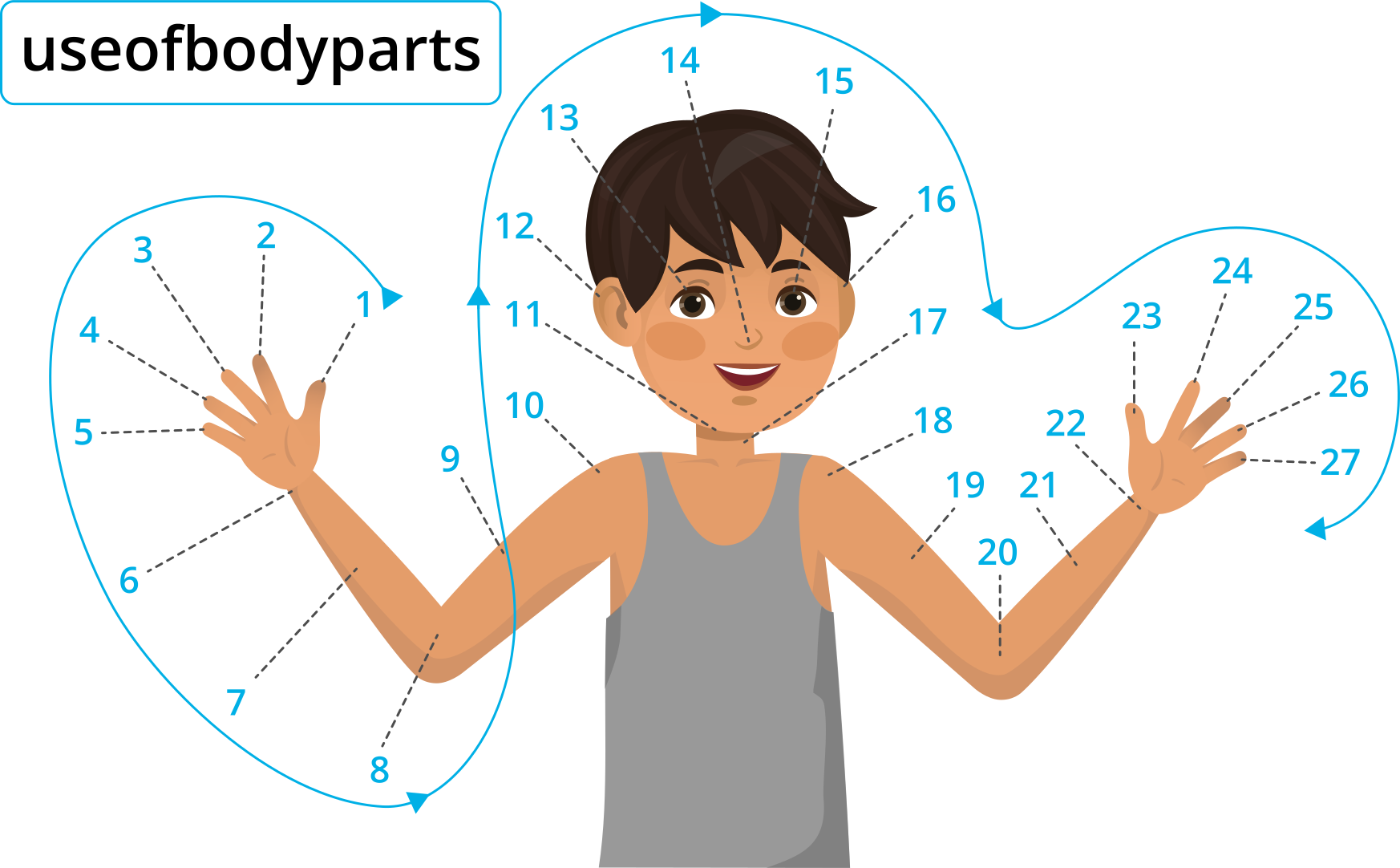
A Group of people in Papua New Guinea used and still use their body parts as a standard sequence/number system.
2. Tally marks:
One of the oldest methods of number representation is by making notches—marks cut on a surface such as a bone or the wall of a cave.
These marks are also called tally marks. tally marks.
In this method, a mark is made for each object that is being counted. So the final collection of marks represents the total number of objects.
- Lebombo Bone (South Africa): \(~44,000\) years old. Features \(29\) notches; potentially a lunar calendar.
- Ishango Bone (DR Congo): \(20,000–35,000\) years old. Features notches in columns, potentially representing a more complex tracking system.
Tally marks represent the first time humans moved "data" from their brains onto a permanent surface. This allowed information to be stored across generations, which is the foundation of all recorded history.
2. Counting in Twos:
Gulmulgal System:
The Gumulgal people (Australia) developed a system where all numbers are built from just two base names: urapon (\(1\)) and ukasar (\(2\)).
-
\(3 =\) ukasar-urapon (\(2+1\))
-
\(4 =\) ukasar-ukasar (\(2+2\))
-
\(5 =\) ukasar-ukasar-urapon (\(2+2+1\))
-
\(6 =\) ukasar-ukasar-ukasar (\(2+2+2\))
-
Any number \(> 6 =\) ras (meaning "many")
Important!
Surprisingly, this same logic appeared independently in other cultures:
-
Bakairi (South America): tokale (\(1\)), ahage (\(2\)). Number \(3\) is ahage tokale or ahawao.
-
Bushmen (South Africa): xa (\(1\)), t'oa (\(2\)). Number \(4\) is t'oa-t'oa.
3. Perception and the Power of \(5\):
Humans have a biological limit of perception. Most people can only recognise up to \(5\) objects at a glance without consciously counting them. This limit prompted humans to stop using simple tallies and start grouping. By replacing a group of \(5\) marks with a new symbol, counting became faster and more accurate.
4. Roman Numerals:
The Roman system is efficient because it uses "Landmark Numbers"—specific symbols for key group sizes.
\(I = 1\) | \(V = 5\) | \(X = 10\) | \(L = 50\) | \(C = 100\) | \(D = 500\) | \(M = 1000\)
The Rules of the Road
-
Additive: Symbols placed after a larger symbol are added (\(VI = 5 + 1 = 6\)).
-
Subtractive: A smaller symbol before a larger one is subtracted (\(IV = 4, XL = 40\)).
-
\(2000 (MM) + 300 (CCC) + 50 (L) + 10 (X) + 5 (V) + 2 (II) = MMCCCLXVII\)
Example:
1. \(29 = 10 + 10 + (10-1) = XXlX\)
2. \(3478 = 1000+1000+1000+100+100+100+100+50+10+10+5+1+1+1 = MMMCDLXXVIII\)
Let us decode this:
\(3000 = MMM\)
\(400 = CD\) \(500-100 = 400\)
\(70 = LXX\)
\(8 = VIII\)
Arithmetic Efficiency of Roman Numbers
While the Roman numeral system is effective for writing numbers, it is ineffective for mathematical operations. There is no place value, and multiplication/division is nearly impossible to do directly with the symbols. In the Middle Ages, people had to use an abacus (a physical tool) and relied on specially trained experts to perform basic arithmetic. It was beautiful and well-structured, but it couldn't scale to meet the needs of modern science, which is why the Indian system eventually replaced it globally.