Parallelogram:
A parallelogram is a quadrilateral (four-sided figure) in which the opposite sides are parallel.
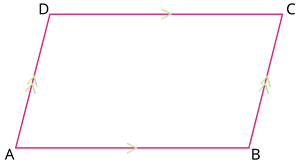
In the figure, the side \(AB\) is parallel to \(CD\), and \(AD\) is parallel to \(BC\).
Important!
• The opposite sides are congruent.
• The two diagonals bisect each other.
• The opposite angles are congruent.
• The consecutive angles are supplementary.
Area of the parallelogram:
The area of any parallelogram is calculated using the formula \(A = b \times h\) square units.
Where \(h\) represents the height of the parallelogram and \(b\) represents the base of the parallelogram.
Example:
If the height and the base of the parallelogram are \(12\) \(cm\) and \(6\) \(cm\), then find its area.
Solution:
Given \(h\) \(=\) \(12\) \(cm\) and \(b\) \(=\) \(6\) \(cm\).
Area of the parallelogram, \(A\) \(=\) \(b \times h\)
\(=\) \(12 \times 6\)
\(=\) \(72\) \(cm^2\)
Ways to construct a parallelogram:
A parallelogram can be constructed if one of the following four measurements are given.
(i) Two adjacent sides and one angle.
(ii) Two adjacent sides and one diagonal.
(iii) Two diagonals and one included angle.
(iv) One side, one diagonal and one angle.
(i) Two adjacent sides and one angle.
Working rule to construct a parallelogram:
Let us discuss the working rule to construct a parallelogram when the measure of two adjacent sides and an angle of a parallelogram are given.
Example:
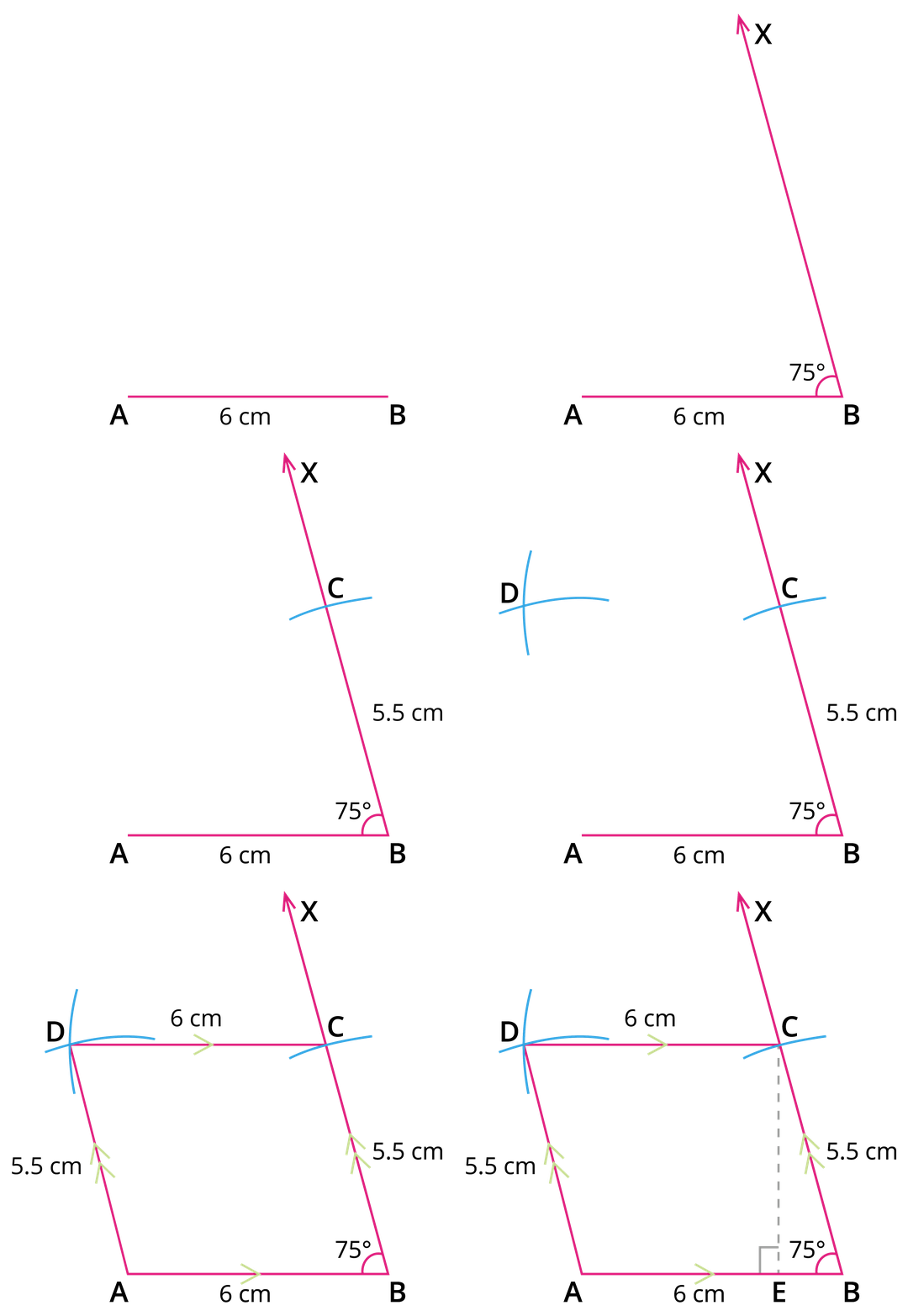
Construct a parallelogram \(ABCD\) with \(AB\) \(=\) \(6\) \(cm\), \(BC\) \(=\) \(5.5\) \(cm\) and \(\angle ABC\) \(=\) \(75^{\circ}\).
Construction:
Step 1: Draw a line segment \(AB\) \(=\) \(6\) \(cm\).
Step 2: With \(B\) as centre, mark an angle \(75^{\circ}\) using the protractor and mark it as \(X\). Join \(BX\).
Step 3: With \(B\) as centre, draw an arc of radius \(5.5\) \(cm\) intersecting \(BX\) at \(C\).
Step 4: With \(C\) and \(A\) as centres, draw two arcs of radii \(6\) \(cm\) and \(5.5\) \(cm\) respectively such that they intersect each other at \(D\).
Step 5: Join \(CD\) and \(AD\).
Step 6: \(ABCD\) is the required parallelogram. The measure of \(CE\) gives the height of the parallelogram \(ABCD\).
(ii) Two adjacent sides and one diagonal.
Working rule to construct a parallelogram:
Let us discuss the working rule to construct a parallelogram when the measures of two adjacent sides and a diagonal of a parallelogram are given.
Example:
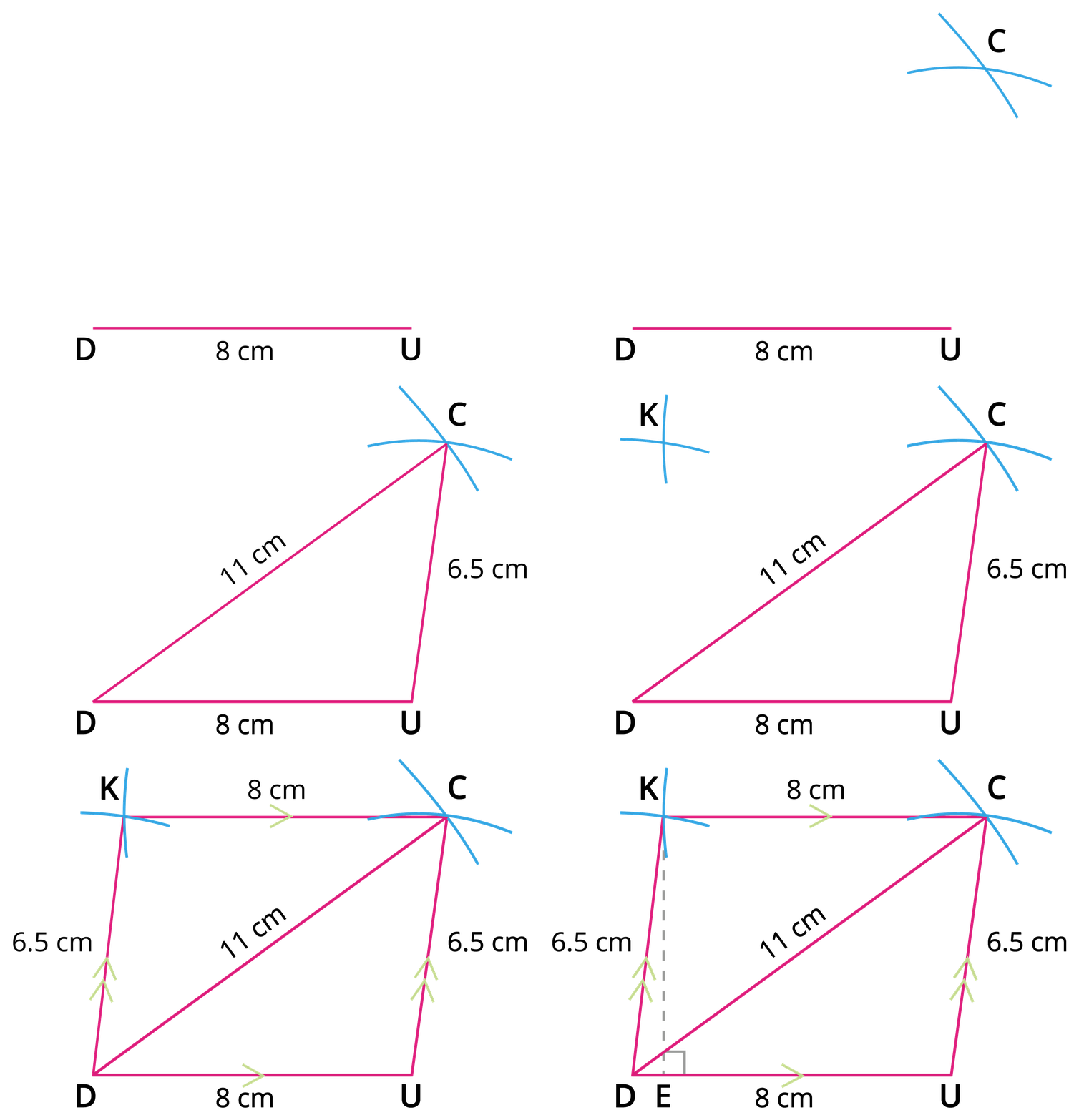
Construct a parallelogram \(DUCK\) with \(DU\) \(=\) \(8\) \(cm\), \(UC\) \(=\) \(6.5\) \(cm\) and \(DC\) \(=\) \(11\) \(cm\).
Construction:
Step 1: Draw a line segment \(DU\) \(=\) \(8\) \(cm\).
Step 2: With \(D\) and \(U\) as centres, draw two arcs of radii \(11\) \(cm\) and \(6.5\) \(cm\) respectively such that they intersect each other at \(C\).
Step 3: Join \(DC\) and \(UC\).
Step 4: With \(C\) and \(D\) as centres, draw two arcs of radii \(8\) \(cm\) and \(6.5\) \(cm\) respectively such that they intersect each other at \(K\).
Step 5: Join \(DK\) and \(CK\).
Step 6: \(DUCK\) is the required parallelogram. The measure of \(KE\) gives the height of the parallelogram \(DUCK\).
(iii) Two diagonals and one included angle:
Working rule to construct a parallelogram:
Let us discuss the working rule to construct a parallelogram when the measure of two diagonals and one included angle of a parallelogram are given.
Example:
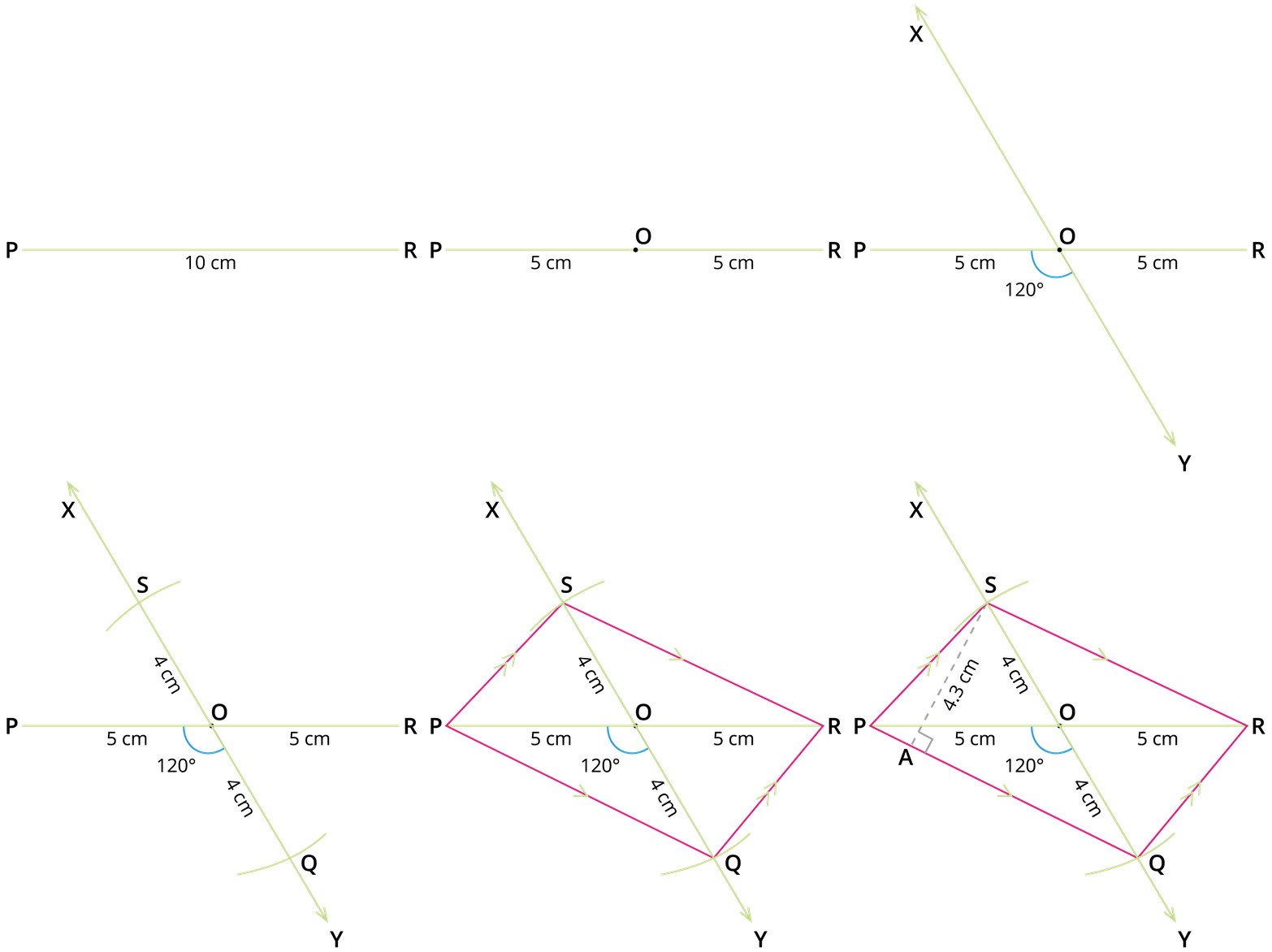
Construct a parallelogram \(PQRS\) with \(PR\) \(=\) \(10\) \(cm\), \(QS\) \(=\) \(8\) \(cm\) and \(\angle POQ\) \(=\) \(120^{\circ}\). Also, find its area.
Construction:
Step 1: Draw a line segment \(PR\) \(=\) \(10\) \(cm\).
Step 2: Mark the midpoint of the line segment \(PR\) as \(O\).
Step 3: Draw a line \(XY\) through \(O\) such that \(\angle POQ\) \(=\) \(120^{\circ}\).
Step 4: With \(O\) as centre, draw two arcs each of radii \(4\) \(cm\) on either side of \(PR\) intersecting \(XY\) at \(Q\) and \(S\).
Step 5: Join \(PQ\), \(QR\), \(RS\) and \(SP\).
Step 6: \(PQRS\) is the required parallelogram. The measure of \(SA\) gives the height of the parallelogram \(PQRS\).
(iv) One side, one diagonal and one angle:
Working rule to construct a parallelogram:
Let us discuss the working rule to construct a parallelogram when the measure of one side, one angle and one diagonal of a parallelogram are given.
Example:
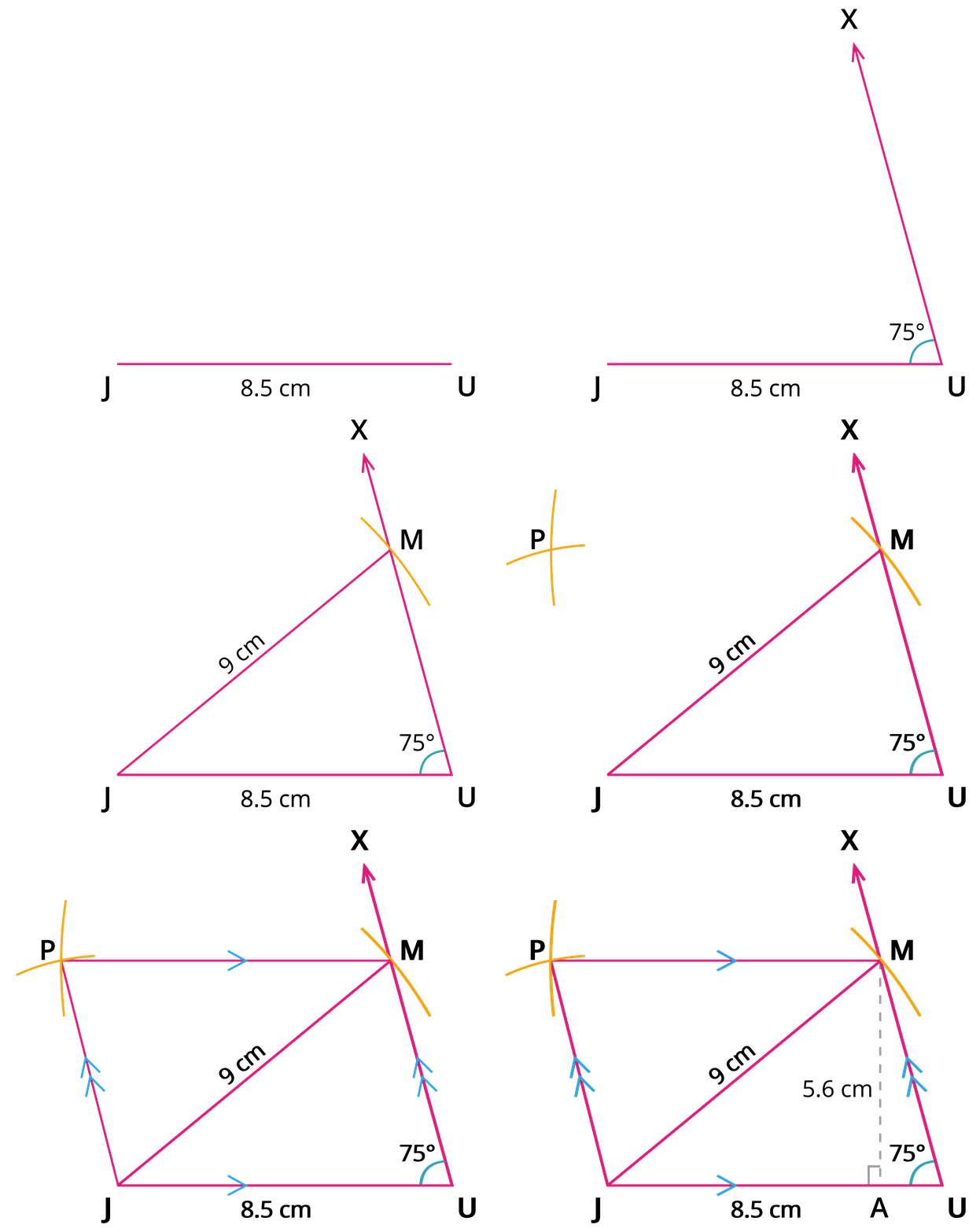
Construct a parallelogram \(JUMP\) with \(JU\) \(=\) \(8.5\) \(cm\), \(JM\) \(=\) \(9\) \(cm\) and \(\angle JUM\) \(=\) \(75^{\circ}\). Also, find its area.
Construction:
Step 1: Draw a line segment \(JU\) \(=\) \(8.5\) \(cm\).
Step 2: With \(U\) as centre, mark an angle \(75^{\circ}\) using a protractor and mark it as \(X\). Join \(QX\).
Step 3: With \(J\) as centre, draw an arc of radius \(9\) \(cm\) intersecting \(QX\) at \(M\). Join \(JU\).
Step 4: Measure \(UM\), and with \(J\) as centre, draw an arc of radius that is equal to the measure of \(UM\).
Step 5: With \(M\) as centre, draw an arc of radius \(8.5\) \(cm\) intersecting the previous arc at \(P\).
Step 6: Join \(MP\) and \(MJ\).
Step 7: \(JUMP\) is the required parallelogram. The measure of \(MA\) gives the height of the parallelogram \(JUMP\).