Deduction 1 - Diagonals of a Rectangle are Equal
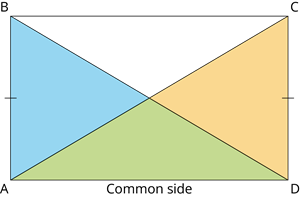
Consider triangles \(△ADC\) and \(△DAB\) in the rectangle \(ABCD\).
| Statement | Reason |
| \(AB = CD\) |
The opposite sides of a rectangle are equal
|
| \(∠BAD = ∠CDA = 90°\) | All angles of a rectangle are \(90°\) |
| \(AD = AD\) | Common side for both triangles. By SAS \(△ADC ≅ △DAB\) |
| Thus, \(AC = BD\) | The corresponding parts of congruent triangles |
Therefore, the diagonals of the rectangle \(AC\) and \(BD\) are equal.
Deduction 2 - Diagonals Bisect Each Other
In the rectangle \(ABCD\), the diagonals \(AC\) and \(BD\) meet at \(O\).
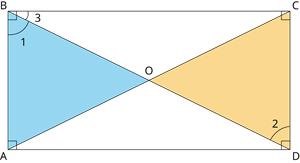
Let us consider triangles \(△AOB\) and \(△COD\).
We are going to prove \(△AOB\) is congruent to \(△COD\) and hence conclude diagonals bisects each other.
| Statement | Reason |
| \(\angle AOB = \angle COD\) | Vertically opposite angles |
| \(∠3 + ∠1 = 90°\) | Since \(\angle B = 90°\) |
|
\(∠3 + ∠2 + 90° = 180°\)
\(∠3 + ∠2 = 90°\)
|
By angle sum property of a triangle \(△BCD\) |
| \(∠1 = ∠2\) | By AAS: \(△AOB ≅ △COD\) |
| \(OA = OC\) and \(OB = OD\) | Corresponding parts of congruent triangles |
| \(O\) is midpoint of both diagonals | Since \(OA = OC\) and \(OB = OD\) |
Thus, the diagonals of a rectangle always intersect at their midpoints.
When the diagonals cross at their midpoints, we say that the diagonals bisect
each other. Bisecting a quantity means dividing it into two equal parts.
each other. Bisecting a quantity means dividing it into two equal parts.
Deduction 3 - The angle between the diagonals does not affect the formation of a rectangle.

In a rectangle \(ABCD\), if one of the angles between the diagonals \(\angle AOB\) as \(x\).
| Statement | Reason |
| \(\angle COD =x\) | Vertically opposite angles |
| \(\angle AOD = \angle BOC = 180-x\) | Linear pairs |
|
\(\triangle AOD\),
\(b+b+180-x = 180\)
\(2b = x\) \(b=\frac{x}{2}\) |
Angle sum property of a triangle |
| \(a = 90 - \frac{x}{2}\) | All interior angle are \(90 ^\circ\) |

Thus, the four angles between the diagonals to be \(x\), \(x\), \(180 – x\), and \(180 – x\). And the remaining interior angles would be \(90-\frac{x}{2}\) and \(\frac{x}{2}\).
The diagonals of a rectangle can meet at different angles.
The angle between them is not important.
What is important is that the diagonals are equal and meet at their common midpoint.
These two conditions are enough to form a rectangle.
The angle between them is not important.
What is important is that the diagonals are equal and meet at their common midpoint.
These two conditions are enough to form a rectangle.
Important!
Equal diagonals \(+\) common midpoint \(=\) Rectangle.
Deduction 4 - A quadrilateral with all the angles equal to \(90°\) is a rectangle.
Proof:
Consider the quadrilateral \(ABCD\) with interior angle \(90^\circ\).
By Deducation 2, \(\angle 1 = \angle 2\)
By AAS, \(\triangle BAD \cong \triangle DCB\)
Therefore, \(AD = CB\), and \(DC = BA\), since these are corresponding sides of congruent triangles.
Properties of a Rectangle
A rectangle has the following properties.
| Number | Property | Description |
|---|---|---|
| Property 1 | Angles | All are \(90°\) |
| Property 2 | Opposite sides | Equal |
| Property 3 | Opposite sides | Parallel |
| Property 4 | Diagonals | Equal |
| Property 5 | Diagonals | Bisect each other |