

Look around you! Many objects in daily life such as a book, window, television screen, or floor tile have four sides.
Shapes like these are examples of quadrilaterals. A quadrilateral is a closed figure made up of four line segments.
The word quadrilateral comes from two Latin words:
- Quadri means four
- Latus means side
Therefore,
A quadrilateral is a polygon having four sides, four vertices, and four angles.
Example:
- Rectangle
- Square
- Parallelogram
- Rhombus
- Trapezium
- Kite
Features of a Quadrilateral
Every quadrilateral has
| Feature | Number |
|---|---|
| Sides | \(4\) |
| Vertices | \(4\) |
| Angles | \(4\) |
| Diagonals | \(2\) |
A diagonal is a line segment joining two opposite vertices.
Rectangle
A rectangle is a special type of quadrilateral.
Definition
A rectangle is a quadrilateral in which
- all four angles are right angles (\(90°\))
- opposite sides are equal.
Carpenter's Problem
Imagine a carpenter wants to make a rectangular wooden frame. He has one wooden strip of length \(6\) \(cm\).
Another strip is placed across it.
The two strips become the diagonals of the rectangle.
The important questions are:
- What should be the length of the second strip?
- Where should they intersect?
- At what angle should they meet?
Using geometric reasoning, we find that
- both diagonals must be equal.
- the diagonals must bisect each other.
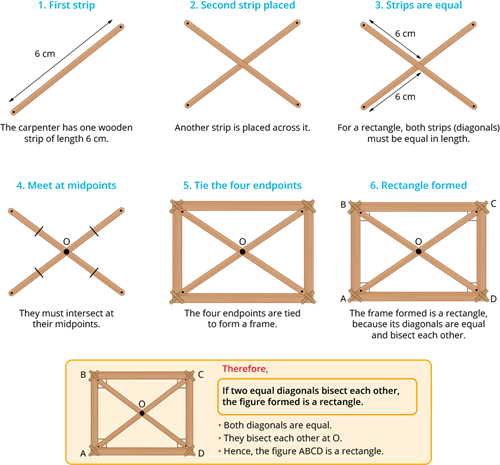
Therefore,
If two equal diagonals bisect each other, the figure formed is a rectangle.
Alternate Definition for Rectangle:
A rectangle is a quadrilateral whose diagonals
- are equal
- bisect each other.
Important!
Both definitions describe the same shape.
The Process of Finding Properties:
In geometry, we can learn about shapes in two ways:
- By Observation
- By Deduction
Observation helps us notice a pattern, while deduction helps us prove that the pattern is always true.
Observation vs Deduction
| Observation | Deduction |
|---|---|
| Observation means looking carefully at a figure, drawing it, or measuring its parts. | Deduction means using known facts and logical reasoning to prove a property. |
| It helps us notice a pattern. | It helps us explain why the pattern is always true. |
| It leads to a conjecture. | It leads to a proved conclusion or property. |
| The result may not always be true for every figure. | The result is true for every figure of that type if the deduction is correct. |
| Example:
A student draws four different rectangles and measures their diagonals.
In each rectangle, the diagonals are equal.
The student observes a pattern and makes the following conjecture:
Conjecture: The diagonals of a rectangle are equal.
|
Example:
In the Carpenter's Problem,
|