

We have already learnt that a rectangle is a special quadrilateral whose opposite sides are parallel.
But is every quadrilateral with parallel opposite sides a rectangle?
No.
If a quadrilateral has opposite sides parallel but its angles are not necessarily \(90^\circ\), it is called a parallelogram.
Parallelogram:
A parallelogram is a quadrilateral in which both pairs of opposite sides are parallel.
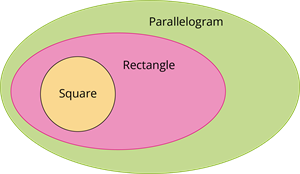
We know that a rectangle has opposite sides parallel. Therefore, it satisfies the definition of a parallelogram. Further, since all the angles of a rectangle are (\(90^\circ\)), a rectangle is a special type of parallelogram.
Thus, the Venn diagram is as follows.
Deduction 6: Opposite angles of a Parallelogram are equal.
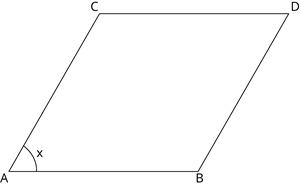
Let \(∠A = x°\) in parallelogram \(ABCD\).
| Statement | Reason |
|
\(AB ∥ CD\) and \(AD\) is a transversal,
\(∠A + ∠D = 180°\)
\(∠D = 180° − x°\)
|
sum of the internal angles on the same side of a transversal is \(180°\). |
|
\(AD ∥ BC\), \(AB\) is a transversal,
\(∠A + ∠B = 180°\) \(∠B = 180° − x°\)
|
sum of the internal angles on the same side of a transversal is \(180°\). |
| This implies, \(∠D = ∠B = 180° − x°\) | Same measure |
|
\(AB ∥ DC\), \(BC\) is a transversal,
\(∠B + ∠C = 180°\),
\(∠C = 180° − ∠B = 180° − (180° − x°) = x°\)
Thus, \(∠A = ∠C = x°\)
|
sum of the internal angles on the same side of a transversal is \(180°\). |
Therefore, \(∠A = ∠C\) and \( ∠B = ∠D\).
Deduction 7: Opposite Sides of a Parallelogram are equal.
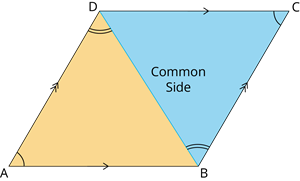
Consider the triangles \(\triangle ABD\) and \(\triangle CDB\) in the parallelogram \(ABCD\).
| Statement | Reason |
| \(\angle DCB = \angle Bd\) | Opposite angles of a parallelogram are equal. |
| \(\angle ADB =\angle CBD\) | \(AD||BC\), \(BD\) is a transversal and since alternate angles are equal. |
| \(\triangle ABD \cong \triangle CDB\) | \(AAS\) condition |
| \(AD = CB\) and \(AB=CD\) | corresponding sides are equal |
Thus, the opposite sides of a parallelogram are equal.
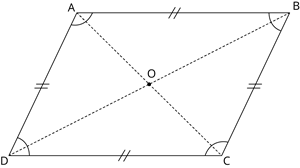
Deduction 8: Diagonals of a Parallelogram bisect each other.
Consider \(ABCD\) is a parallelogram.
The diagonals \(AC\) and \(BD\) intersect at \(O\).
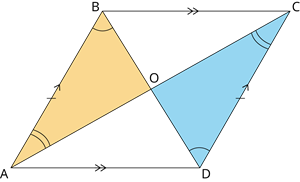
| Statement | Reason |
| \(\triangle AOB\) \(\triangle DOC\), \(AB = DC\) | Opposite sides of parallelogram |
| \(\angle OBA = \angle ODC\) | Alternate angles, \(AB || DC\) |
| \(\angle OAB = \angle OCD\) | Alternate angles |
| \(\triangle BOA \cong \triangle DOC\) | \(ASA\) condition |
| \(OA = OC\) and \(OB=OD\) | Congruent triangles |
| \(O\) bisects both diagonals | \(OA = OC\) and \(OB=OD\) |
Thus, the diagonals of the parallelogram bisect each other.
Important!
In a parallelogram if one angle is \(x^\circ\), then the angles are \(x^\circ\), \((180^\circ−x^\circ) \), \(x^\circ\), and \((180^\circ−x^\circ)\).
Rhombus
A rhombus is a special parallelogram.
Every rhombus is a parallelogram, but every parallelogram is not a rhombus
A rhombus is a quadrilateral in which all four sides are equal.
Now we are going to define a rhombus as a quadrilateral is a parallelogram with all the sides are in equal measures.
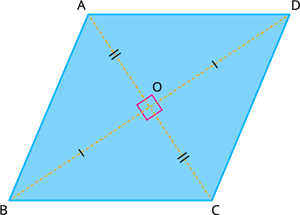
Thus, if \(ABCD\) is a rhombus then \(AB=BC=CD=AD\), \(AB||CD\) and \(BC||AD\).
Deduction 9: In a Rhombus, Opposite Angles are Equal.
Consider a rhombus \(GAME\).
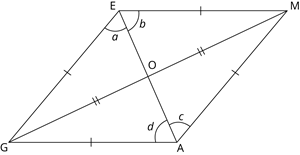
| Statement | Reason |
| In (∆GAE\), \(a = d\) | \(GE = GA\) |
| In \(∆MAE\), \(b = c\) | \(ME = MA\) |
| \(∆GAE ≅ ∆MAE\) and \(a = b\), \(c = d\) | By \(SAS\) |
| \(∠G = ∠M\) | They are corresponding parts of congruent triangles) |
In a rhombus opposite angles are equal to each other.
A square is a special type of rectangle because each of its four angles is (\(90^\circ\)).
Since its opposite sides are parallel, it is also a parallelogram. In addition, all four sides of a square are equal in length, making it a rhombus as well. Hence, a square combines the properties of a rectangle, a parallelogram, and a rhombus.
Therefore, the relationship among these quadrilaterals can be represented using the following Venn diagram.
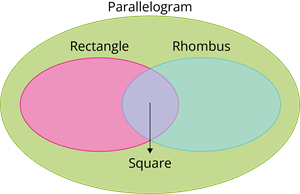
Deduction 10: Diagonals of a Rhombus are perpendicular bisector of each other.
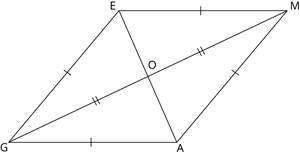
Consider the rhombus \(GAME\), diagonals meet at \(O\). In \(△GEO\) and \(△MEO\).
| Statement | Reason |
| \(GE = ME\) | All sides of rhombus are equal |
| \(OE = OE\) | common side |
| \(GO = MO\) | Diagonals bisect each other in rhombus |
| \(△GEO ≅ △MEO\) | By \(SSS\) |
| \(∠GOE = ∠MOE = \frac{180}{2} =90^\circ\) | \(∠GOE + ∠MOE = 180°\) (linear pair) |
| diagonals are perpendicular bisector of each other |
Thus, the diagonals of the rhombus are perpendicular bisector of each other.
| Property | Parallelogram | Rhombus |
|---|---|---|
| Definition | A quadrilateral with both pairs of opposite sides parallel. | A special parallelogram in which all four sides are equal. |
| Sides | Opposite sides are equal. | All four sides are equal. |
| Parallel Sides | Opposite sides are parallel. | Opposite sides are parallel. |
| Opposite Angles | Opposite angles are equal. | Opposite angles are equal. |
| Adjacent Angles | Adjacent angles add up to \(180^\circ\). | Adjacent angles add up to \(180^\circ\). |
| Diagonals | Diagonals bisect each other. | Diagonals bisect each other. |
| Length of Diagonals | Diagonals are not always equal. | Diagonals are not always equal. |
| Angle Between Diagonals | Diagonals do not necessarily meet at \(90^\circ\). | Diagonals always intersect at \(90^\circ\). |
| Diagonals and Angles | Diagonals do not necessarily bisect the angles. | Each diagonal bisects the opposite angles. |