

Construction of a parallelogram
Let us learn how to construct a parallelogram when two adjacent sides and an angle between them are provided.
Example:
Construct a parallelogram \(ABCD\) with \(AB = 6 \ cm\), \(BC = 5.5 \ cm\) and \(\angle ABC = 75^{\circ}\).
Rough figure:

Construction:
Step 1: Draw a line segment \(AB = 6 \ cm\).

Step 2: With \(B\) as centre, mark an angle \(75^{\circ}\) using the protractor and mark it as \(X\). Join \(BX\).

Step 3: With \(B\) as centre, draw an arc of radius \(5.5 \ cm\) intersecting \(BX\) at \(C\).
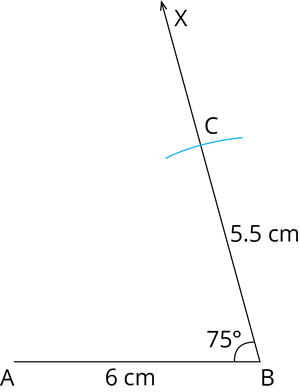
Step 4: With \(C\) and \(A\) as centres, draw two arcs of radii \(6 \ cm\) and \(5.5 \ cm\), respectively such that they intersect each other at \(D\).
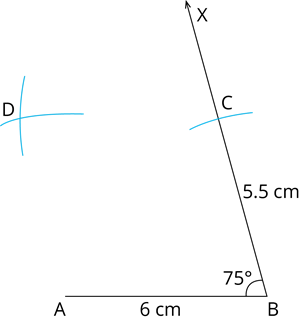
Step 5: Join \(AD\) and \(CD\).
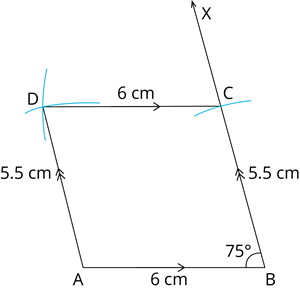
Thus, \(ABCD\) is the required parallelogram.
Construction of a rhombus
Let us learn how to construct a rhombus using diagonal properties. (i.e) construction of a rhombus given two diagonals.
Example:
Construct a rhombus \(ABCD\) with diagonals \(8 \ cm\) and \(9 \ cm\).
Rough diagram:
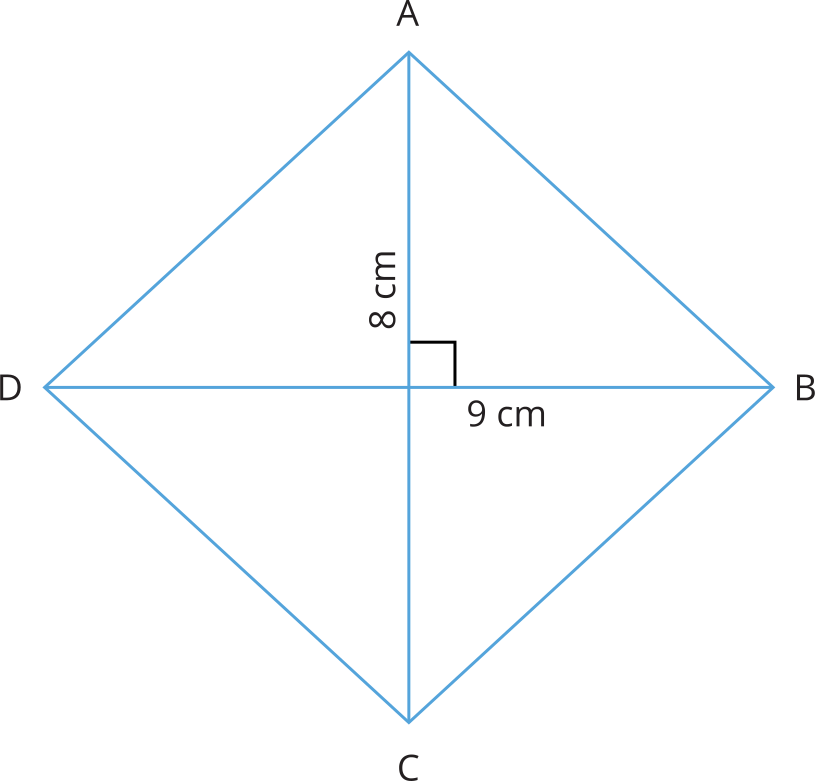
In a rhombus, we know that the diagonals bisect each other.
\(BO = OD = \frac{9}{2} = 4.5 \ cm\)
\(AO = OC = \frac{8}{2} = 4 \ cm\)
Construction:
Step 1: Draw a line segment of length \(DB = 9 \ cm\).

Step 2: Mark a point \(O\) of line segment \(BD\) such that \(DO = OB = 4.5 \ cm\). At point \(O\), draw a perpendicular bisector using a protractor.
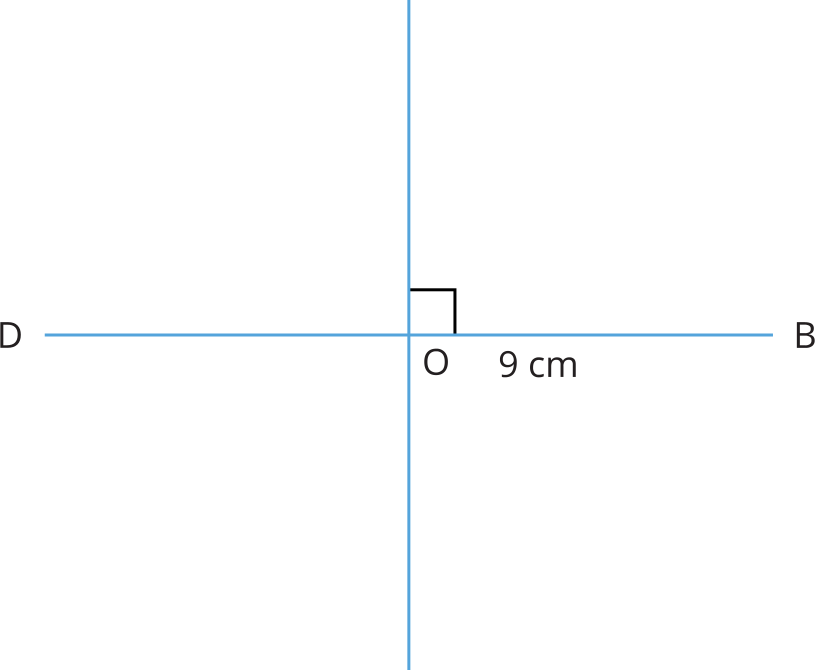
Step 3: With \(O\) as centre and \(4 \ cm\) as radius, draw two arcs on the perpendicular line and mark the intersections as \(A\) and \(C\), respectively.
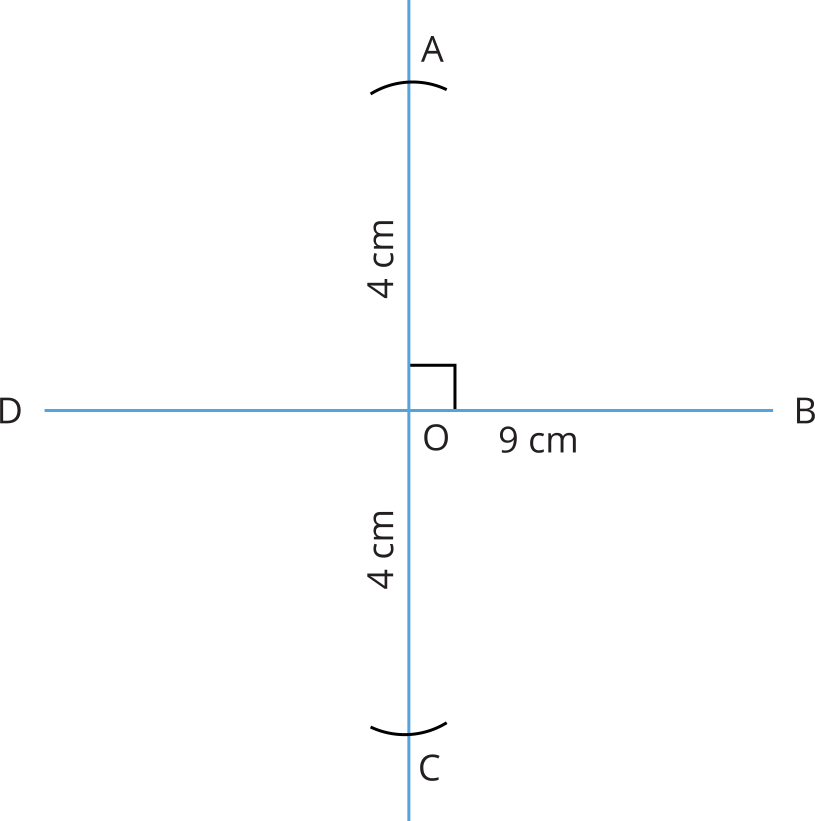
Step 4: Join \(AD\), \(DC\), \(CB\) and \(BA\).
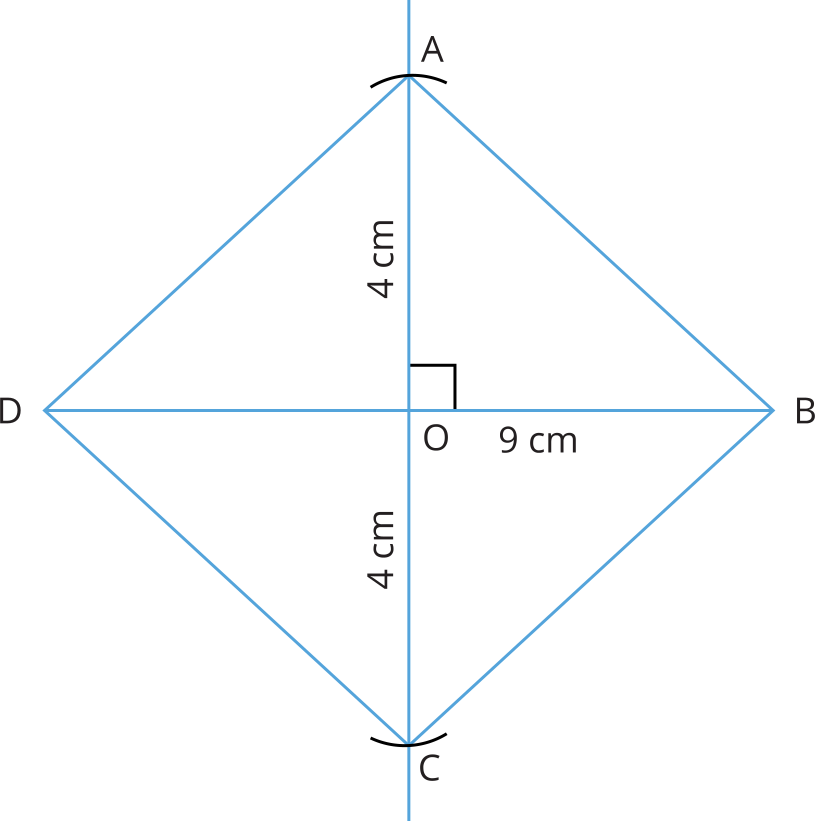
Thus, \(ABCD\) is the required rhombus.