

Arc of a circle:
The portion between any two points on the circumference of a circle is called an arc.
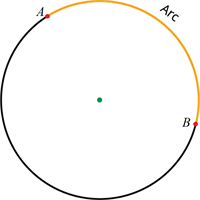
Here, the shorter arc(yellow) is called the minor arc and the longer arc(black) is called the major arc.
Important!
- The arc connecting the two points on the circle along the circle's edge are called end points.
-
If the ends of the arc coincides with the ends of the diameter in such a case each arc is called a semicircle.
-
The area enclosed by a semicircle and the diameter of a circle is called the semicircular region.
Segment of a circle:
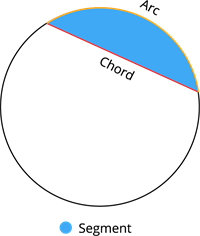
The region enclosed by the chord and the arc is called the segment of the circle.
Important!
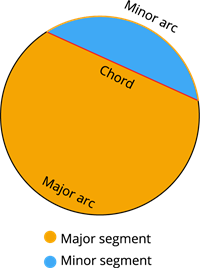
The region enclosed by the chord and the minor arc is called the minor segment, and the region enclosed by the chord and the major arc is called the major segment.
Angles Subtended by an Arc:
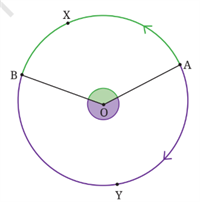
The angle subtended by the arc \(AB\) at the centre is the measure of the \(\angle AOB\), as we sweep along the arc.
- Here the arc through \(X\) subtends an \(\angle AOB\) is the angle subtended by the minor arc.
- And, the arc through \(Y\) subtends an \(\angle AOB\) is the angle subtended by the major arc.
Important!
The angle subtended by the major arc at the centre of the circle is also called a reflex angle and is greater than \(180^{\circ}\).
Theorem on angles subtended by an arc:
The angle subtended by an arc at the centre of the circle is double the angle subtended by the arc at any point on the circle outside the arc.
Explanation:
The theorem states that the angle subtended by the arc \(AFB\) of the circle at the centre \(C\) is twice the angle subtended by the point \(D\) at any remaining part of the circle. (i.e.) \(\angle ACB = 2 \angle ADB\).
Proof:
Given, \(AFB\) is an arc on the circle.
\(∠ACB\) is the angle subtended by arc \(AFB\) at centre \(C\).
\(D\) is a point on the circle outside arc \(AFB\).
To prove:
\(\angle ACB = 2 \angle ADB\)
Proof:
Case (i): \(CD\) extended meets the arc \(AFB\)
We will assume for now that \(D\) is such that \(CD\) when extended cuts the circle at some point \(E\) on arc \(AFB\), as shown in the below figure.
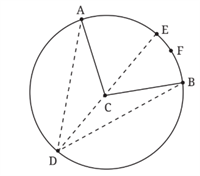
Join \(CD\) and extend \(CD\) to cut the circle at a point \(E\) on arc \(AFB\).
Now, consider the isosceles \(∆DCB\).
Here \(CB = CD\) [Radii of the circle].
And, \(∠CBD = ∠CDB\) ......(1) [Angles opposite to equal side are equal]
\(∠BCE\) is the exterior angle of \(∆BCD\).
By theorem, the exterior angle is equal to the sum of the interior oppposite angles.
So, \(∠BCE = ∠CBD + ∠CDB\)
So, \(∠BCE = ∠CBD + ∠CDB\)
\(= 2 ∠BDC\) ......(2) [From (1)]
Similarly, consider the isosceles \(∆ADC\)
\(CA = CD\) [Radii of the circle].
And, \(∠CAD = ∠CDA\) ......(3) [Angles opposite to equal side are equal]
\(∠ACE\) is the exterior angle of \(∆ADC\).
By the theorem, the exterior angle is equal to the sum of the interior opposite angles.
\(∠ACE = ∠CAD + ∠CDA\)
\(∠ACE = ∠CAD + ∠CDA\)
\(= 2 ∠CDA\) ......(4) [From (3)]
Now \(∠BCA = ∠BCE + ∠ECA\)
And, \(∠BDA = ∠BDE + ∠EDA\)
Hence \(∠BCA = 2 (∠BDC + ∠CDA)\) [From (3) and (4)]
\(= 2 ∠BDA\)
So, \(∠BCA = 2∠BDA\)
Hence, proved.
Case (ii): \(CD\) extended meets the circle outside the arc \(AFB\)
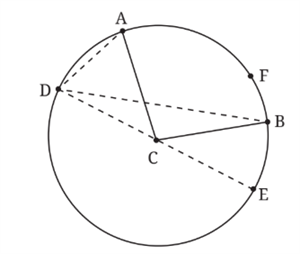
Join \(CD\) and extend \(CD\) to cut the circle at a point \(E\) outside the arc \(AFB\).
Now, consider the isosceles \(∆ACD\).
Here \(CA = CD\) [Radii of the circle].
And, \(∠ADC = ∠CAD\) ......(5) [Angles opposite to equal side are equal]
\(∠ACE\) is the exterior angle of \(∆ACD\).
By exterior angle theorem, \(∠ACE = ∠ADC + ∠CAD\)
\(= 2 ∠ADC\) ......(6) [From (5)]
Similarly consider the isosceles \(∆BCD\).
Here \(CD = CB\) [Radii of the circle].
And, \(∠CBD = ∠CDB\) ......(7) [Angles opposite to equal side are equal]
\(∠BCE\) is the exterior angle of \(∆ACD\).
By exterior angle theorem, \(∠BCE = ∠BDC + ∠CBD\)
\(= 2 ∠BDC\) ......(8) [From (7)]
Also, \(∠ACB = ∠ACE – ∠BCE\).
\(∠ACB = 2 ∠ADC - 2 ∠BDC\) [From (6) and (8)]
\(∠ACB = 2 (∠ADC - ∠BDC)\)
But \(∠ADB = ∠ADC – ∠BDC\)
This implies, \(∠ACB = 2 ∠ADB\).
Hence, proved.
Example:
Find the unknown angle \(x\) in the given figure if the angle subtended by the arc \(QR\) at the centre \(O\) is \(160^{\circ}\).
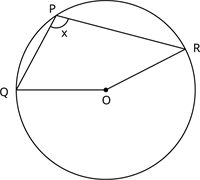
Solution:
By the theorem, \(\angle QOR = 2\angle QPR\).
This implies, \(\angle QPR = \frac{1}{2} \times \angle QOR\)
\(x = \frac{160^{\circ}}{2}\)
\(=\) \(80^{\circ}\)
Therefore, the unknown angle \(x\) is \(80^{\circ}\).
Special cases of angle at the centre and the circumference:
Conjecture \(1\)
Illustration:
Consider a circle with centre \(O\) and a diameter \(QR\).
Place a points \(P\) on the circumference of the circle.
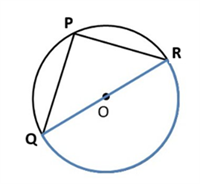
It is known that the angle measure of a diameter in a circle is \(180^{\circ}\).
This implies, the arc \(QR\) subtends an \(\angle QOR = 180^{\circ}\) at the centre \(O\)[the arc we take is not containing \(P\)] and \(\angle QPR\) at the circumference of the circle.
According to the theorem, the angle subtended by an arc of the circle at the centre is double the angle subtended by it at any point on the remaining part of the circle.
So, \(\angle QOR = 2\angle QPR\).
This implies, \(\angle QPR = \frac{1}{2} \times \angle QOR\)
\(= \frac{180^{\circ}}{2}\)
\(=\) \(90^{\circ}\)
Based on this result, we arrive at a conjecture which states:
The angle subtended by a diameter at any point on the circle is \(90°\).
Explanation:
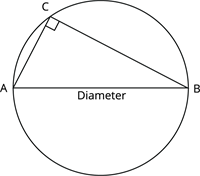
The conjecture is that any angle inscribed in the semi-circle is always \(90^{\circ}\). In other words, the angle subtended by the diameter is always \(90^{\circ}\).
Example:
Find the measure of the angle subtended by the longest chord of the circle at any point on the circumference.
Solution:
The longest chord of the circle is the diameter of the circle.
Also, the angle subtended by the diameter of the circle at any point on the circumference is the same as the angle inscribed in a semi-circle.
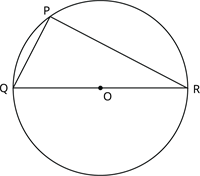
Let \(QR\) be the diameter and \(P\) be any point on the circumference.
It is known that an angle inscribed in a semi-circle is a right angle.
This implies, \(\angle QPR = 90^{\circ}\).
Therefore, the measure of the angle subtended by the longest chord of the circle at any point on the circumference is \(90^{\circ}\).
Conjecture \(2\)
Illustration:
Consider a circle with centre \(O\) and chord \(PQ\).
Let \(R\) and \(S\) be any two points on the circumference of the circle lying on the same segment of the circle.
Join the endpoints of the chord \(PQ\) with the centre \(O\).
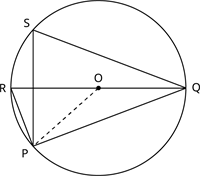
We know that, according to the theorem, the angle subtended by an arc of the circle at the centre is double the angle subtended by it at any point on the remaining part of the circle.
This implies, \(\frac{1}{2} \angle POQ\) \(=\) \(\angle PRQ\) \(……\) \(\text{equation }(1)\)
Similarly, \(\frac{1}{2} \angle POQ\) \(=\) \(\angle PSQ\) \(……\) \(\text{equation }(2)\)
From equation \((1)\) and \((2)\), we have:
\(\angle PRQ\) \(=\) \(\angle PSQ\)
Based on this result, the following theorem is obtained.
Theorem: Angles in the same segment of a circle are equal.
Explanation:
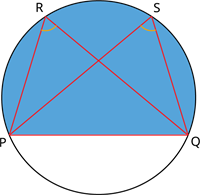
The theorem states that angles in the same segment of the circle are equal. In the given circle, the angles \(\angle PRQ\) and \(\angle PSQ\) are equal as they lie on the same segment (i.e.) \(\angle PRQ = \angle PSQ\).
Example:
Find the unknown angles \(x\) and \(y\) in the given figure, where \(O\) is the centre of the circle.
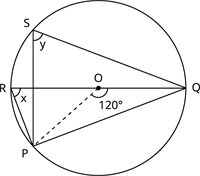
Solution:
According to the theorem, the angle subtended by an arc of the circle at the centre is double the angle subtended by it at any point on the remaining part of the circle.
This implies:
\(\angle PRQ\) \(=\) \(\frac{1}{2} \angle POQ\)
\(x\) \(=\) \(\frac{1}{2} \times 120^{\circ}\)
\(=\) \(60^{\circ}\)
Also, by the theorem, angles in the same segment of a circle are equal.
Hence, \(\angle PRQ\) \(=\) \(\angle PSQ\).
So, \(x\) \(=\) \(y\).
Therefore, \(y\) \(=\) \(60^{\circ}\).