

Statement:
The chord nearer to the centre is longer than the chord which is farther from the centre.
Theorem:
Let \(AB\) and \(DE\) be two chords of a circle with centre \(C\). Suppose \(AB > DE\). Then the distance from \(C\) to \(AB\) is less than the distance from \(C\) to \(DE\).
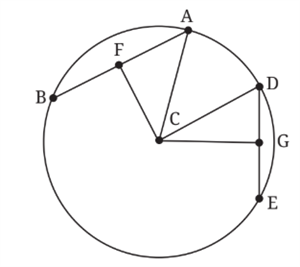
Explanation:
Given:
Two unequal chords \(AB\) and \(DE\), where \(AB\) \(>\) \(DE\).
To prove:
The perpendicular distance from \(C\) to \(AB\) is lesser than the perpendicular distance from \(C\) to \(ED\).
That is, \(CF < CG\), where \(F\) and \(G\) are the midpoints of the chords \(AB\) and \(DE\), respectively.
Proof:
In figure, \(AC\) and \(CD\) are radii of the circle. So, they are equal.
That is, \(AC = CD\) ......(1)
Since, \(CF \perp AB\), \(\angle CFA = 90^{\circ}\).
Similarly, \(CG \perp DE\), \(\angle CGD = 90^{\circ}\).
Consider the right angled triangle \(CFA\).
By the Baudhayana - Pythagoras Theorem, we have:
\(AC^2 = CF^2 + AF^2\) ......(2)
Consider the right angled triangle \(CGD\).
By the Baudhayana - Pythagoras Theorem, we have:
\(CD^2 = CG^2 + GD^2\) ......(3)
Using equation (2) and (3) in (1), we have:
\(CF^2 + AF^2 = CG^2 + GD^2\)
Using equation (2) and (3) in (1), we have:
\(CF^2 + AF^2 = CG^2 + GD^2\)
We know that, \(F\) and \(G\) are the midpoints of \(AB\) and \(DE\) repectively.
Also, given, \(AB\) \(>\) \(DE\).
Also, given, \(AB\) \(>\) \(DE\).
This implies, \(AF > GD\).
Since \(AF^2 > GD^2\), we have \(CF^2 < CG^2\).
\(\Rightarrow\) \(CF < CG\)
Therefore, perpendicular distance from \(C\) to \(AB\) is lesser than the perpendicular distance from \(C\) to \(ED\).