

Cyclic Quadrilateral:
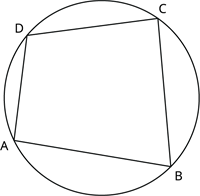
A four-sided figure inscribed in a circle such that all its vertices lie on the circumference of the circle is said to be a cyclic quadrilateral.
Important!
- A quadrilateral are also called a \(4\)-gon.
- The angle subtended by the major arc at the centre \(O\) is called the reflex angle.
Theorem on a cyclic quadrilateral:
The sum of two opposite angles of a cyclic quadrilateral is \(180^{\circ}\).
Explanation:
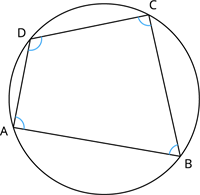
The theorem states that the sum of the interior opposite angles of a cyclic quadrilateral is \(180^{\circ}\).
That is, \(\angle A + \angle C = 180^{\circ}\).
And \(\angle B + \angle D = 180^{\circ}\).
Proof of the theorem:
Given:
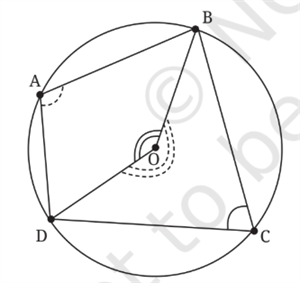
\(A\), \(B\), \(C\), \(D\) are the vertices of a cyclic quadrilateral.
This means that there is a circle passing through the points \(A\), \(B\), \(C\) and \(D\).
Let \(O\) be the circle of the cyclic quadrilateral.
To prove:
\(∠BAD + ∠BCD = 180°\)
Proof:
Consider the arc \(BCD\).
The point \(A\) is on the circle and it lies outside the arc \(BCD\).
By the theorem:
The angle subtended by an arc at the centre of the circle is double the angle subtended by the arc at any point on the circle outside the arc.
So, \(∠BAD\) is half the angle that arc \(BCD\) subtends at the centre \(O\).
Here, we move from \(OB\) to \(OD\) along \(C\), this is the reflex angle \(BOD\) (dotted).
The angle subtended by the major arc \(BCD\) is given by:
\(∠BAD = \frac{1}{2} \times \text{reflex} \angle BOD\) ......(1)
Similarly, \(∠BCD\) is half the angle subtended by the arc \(BAD\) at \(O\)
.
This is the angle denoted by the double arc \(BOD\).
This is the angle denoted by the double arc \(BOD\).
Since \(C\) is on arc \(BCD\), we need to move from \(OB\) to \(OD\) through \(A\).
The angle subtended by the minor arc \(BCD\) is given by:
So, \(∠BCD = \frac{1}{2} \times ∠BOD\) ......(2)
Adding equation (1) and (2), we get:
\(∠BAD + ∠BCD = \frac{1}{2} \left(\text{reflex} \angle BOD + \angle BOD \right)\)
\(∠BAD + ∠BCD = \frac{1}{2} \left(\text{complete angle at the centre} O\right)\)
We know that, the complete rotation at the centre \(O\) is \(360°\).
So, \(∠BAD + ∠BCD = \frac{1}{2} \times 360°\)
\(\Rightarrow ∠BAD + ∠BCD = 180°\)
So, the opposite angles of a cyclic quadrilateral add up to \(180°\).
Example:
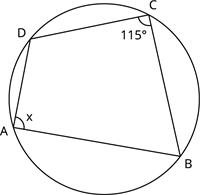
Find the unknown angle \(x\) in the given figure.
Solution:
By the theorem, opposite angles of a cyclic quadrilateral are supplementary.
This implies:
\(\angle A + \angle C = 180^{\circ}\)
\(x + 115^{\circ} = 180^{\circ}\)
\(x = 180^{\circ} - 115^{\circ}\)
\(x = 65^{\circ}\)
Converse of Theorem: If two opposite angles of a quadrilateral add up to \(180°\), then the vertices of the quadrilateral lie on a circle, i.e., they are concyclic.
Explanation:
The theorem states that if the sum of the interior opposite angles of any quadrilateral is \(180^{\circ}\), then that quadrilateral is said to be cyclic.
Proof of the theorem:
Given:
\(ABCD\) is a \(4\)-gon.
\(∠BAD + ∠BCD = 180°\)
\(∠ABC + ∠CDA =180°\)
To prove:
The quadrilateral \(ABCD\) is cyclic.
Proof:
Suppose \(ABCD\) is not cyclic.
Since \(A\), \(D\), \(C\) are not collinear, there is a circle passing through the three points.
Assume that circle does not pass through the point \(C\).
Case (i): \(C\) lies outside the circle.
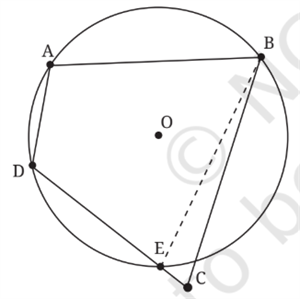
If \(C\) is outside the circle, then \(CD\) intersects the circle at the point \(E\) as shown in the figure above.
By theorem, \(∠BAD + ∠BED = 180°\).
So, \(∠BED = 180° - ∠BAD\) ......(1)
\(∠BAD + ∠BCD = 180°\) [Given]
So, \(∠BCD = 180° - ∠BAD\) ......(2)
From (1) and (2), we have \(∠BCD = ∠BED\).
Here, \(∠BED\) is an exterior angle of the \(\triangle BEC\), so \(∠BED < ∠BCE\).
This implies, \(∠BAD < ∠BCE\)
Which is not possible.
So, the point \(C\) must not lie outside the circle.
Case (ii): \(C\) lies inside the circle.
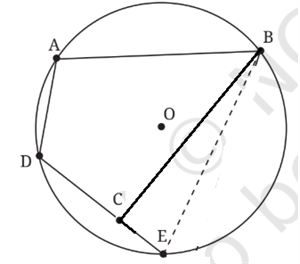
If \(C\) is inside the circle, extend \(CD\) to meet the circle at \(E\) as shown in the above figure.
By theorem, \(∠BAD + ∠BED = 180°\).
So, \(∠BED = 180° - ∠BAD\) ......(1)
\(∠BAD + ∠BCD = 180°\) [Given]
So, \(∠BCD = 180° - ∠BAD\) ......(2)
From (1) and (2), we have \(∠BCD = ∠BED\).
Here, \(∠BCE\) is an exterior angle of the \(\angle BEC\), so \(∠BED < ∠BCD\).
This implies, \(∠BAD < ∠BCD\)
Which is not possible.
So, the point \(C\) must not lie inside the circle.
From the above two cases it is clear that \(C\) must lie on the circle passing through \(A\), \(B\) and \(D\).
This implies, the points \(A\), \(B\), \(C\) and \(D\) are concyclic.
Hence, proved.
Example:
Prove that a square inscribed in a circle is cyclic.
Proof:
Let \(ABCD\) be the square inscribed in a circle.

It is known that every angle of a square is \(90^{\circ}\).
Here \(\angle A + \angle C = 90^{\circ} + 90^{\circ}\)
Implies, \(\angle A + \angle C\) \(=\) \(180^{\circ}\)
Similarly, \(\angle B + \angle D = 90^{\circ} + 90^{\circ}\)
Implies, \(\angle B + \angle D\) \(=\) \(180^{\circ}\)
According to the theorem, the pair of opposite angles of the square is supplementary.
Hence the square inscribed in a circle is cyclic.
Important!
The exterior angle of a cyclic quadrilateral at a vertex is equal to the interior opposite angle.