

Theorem:
If a line segment joining two points subtends equal angles at two other points lying on the same side of the line containing the line segment, the four points lie on a circle (i.e. they are concyclic).
Explanation:
The theorem states that if the line segment \(AB\) subtends equal angles at the points \(C\) and \(D\) on the same side of the line containing the segment \(AB\) then the four points \(A\), \(B\), \(C\) and \(D\) lie on the circle.
Proof of the theorem:
Consider segment \(AB\).
Points \(C\) and \(D\) lie on the same side of \(AB\) but points \(C\) and \(D\) are not on the line \(AB\); and \(∠ACB = ∠ADB\).
To prove:
\(A\), \(B\), \(C\), \(D\) lie on the same circle.
Proof:
The points \(A\), \(B\), \(C\) are noncollinear points.
By the theorem:
There is a unique circle passing through three non-collinear points.
We need to show that the point \(D\) also lies on the circle.
Let us draw a circle through the points \(A\), \(B\) and \(C\).
Suppose that \(D\) does not lie on the circle.
Join \(AD\).
Case (i): \(D\) lies outside the circle.
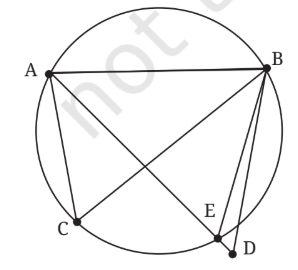
If \(D\) is outside the circle, then \(AD\) intersects the circle at the point \(E\) as shown in the figure above.
Now \(C\) and \(E\) are on the same segment of the arc formed by chord \(AB\).
So, \(∠ACB = ∠AEB\) ......(1)
Here, \(∠AEB\) is an exterior angle of the \(∆BED\), so \(∠AEB > ∠ADB\) ......(2)
From (1) and (2), we have: \(∠ACB > ∠ADB\)
But, \(∠ACB = ∠ADB\) [given].
Which is not possible.
So, the point \(D\) must not lie outside the circle.
Case (ii): \(D\) lies inside the circle.
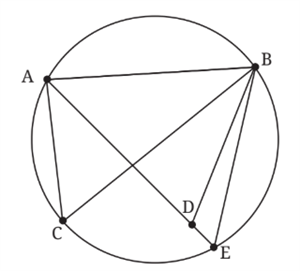
If \(D\) is inside the circle, extend \(AD\) to meet the circle at \(E\) as shown in the above figure.
Now \(C\) and \(E\) are on the same segment of the arc formed by chord \(AB\).
So, \(∠ACB = ∠AEB\) ......(3)
Here \(∠ADB\) is an exterior angle of \(\Delta BED\), so \(∠AEB > ∠ADB\) ......(4)
From (3) and (4), we have: \(∠ACB > ∠ADB\)
But, \(∠ACB = ∠ADB\) [given].
Which is absurd.
So, the point \(D\) must not lie inside the circle.
From the above two cases it is clear that \(D\) must lie on the circle passing through \(A\), \(B\) and \(C\).
This implies, the points \(A\), \(B\), \(C\) and \(D\) are concyclic.
Hence, proved.