

Circle
A Circle is a closed two-dimensional figure with no corners and edges consisting of all the points at an equidistance from a fixed point in a plane.
Parts of a Circle
Centre:
The fixed point in which the circle is described is called the centre of the circle.

Radius:
The equidistant from the centre to any point on the circle is its radius.
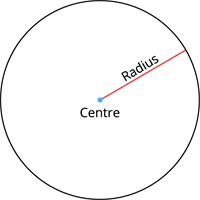
Important!
The line segment joining any point on the circle with its centre is the radius of the circle.
Chord:
The intersecting line having its endpoints on the circle is called a chord of the circle.

Diameter:
The chord of a circle passing through the centre is called the diameter of the circle.
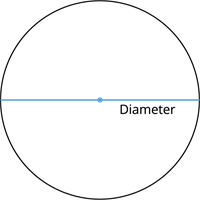
Important!
Properties of the diameter:
- It is the line segment that bisects the circle.
- It is the largest chord in the circle.
- It is the line of symmetry for the circle.
- It is twice the length of the radius.
Circumference:
The boundary line of the circle is called its circumference.
Position of a point with respect to a circle
Consider any point on the circle in a plane, then:
-
If the distance between the centre and the point is equal to the radius of the circle, then the point lies on the circle.
-
If the distance between the centre and the point is less than the radius of the circle, then the point lies inside the circle.
-
If the distance between the centre and the point is greater than the radius of the circle, then the point lies outside the circle.
Therefore, the circle divides the plane into three distinct region in which it lies.
Important!
The centre of the circle always lie in the interior of the circle.
Symmetries of a Circle:
A circle has the maximum number of symmetries among all plane figures.
The circle exhibits both the rotaional symmetry and reflection symmetry.
Rotaional symmetry: A circle looks exactly the same when rotated through any angle about its centre. Hence, it has infinite rotational symmetry.
Reflection symmetry: A circle can be divided into two identical halves by any line passing through its centre. Each half is the mirror image of the other.
Lines of symmetry: A circle has infinitely many lines of symmetry because every diameter of the circle acts as a line of reflection symmetry.
Circle through a point
Given a point \(O\), it is always possible to draw infinitely many circles through the given point.
In other words, an infinite number of circles can be drawn through a given point.
Illustration:
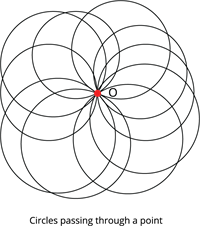
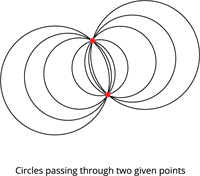
Circle through two points
Given any two points, it is always possible to draw infinitely many circles through the given points.
In other words, an infinite number of circles can be drawn, passing through a pair of points.
Illustration:
Circle through three points
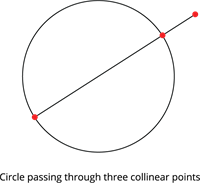
Case 1: Collinear points
If the three points are collinear, then it is impossible to draw a circle using all three points.
Any set of points are said to be collinear if all the points lie on the same line.
Illustration:
Case 2: Non-collinear points
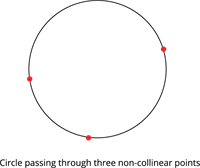
If the three points are non-collinear, then it is possible to draw only one circle using all the three points.
Any set of points are said to be non-collinear if all the points do not lie on the same line.
Illustration:
Theorem on circle passing through three points:
Statement:
There is a unique circle passing through three non-collinear points.
Proof of the theorem:
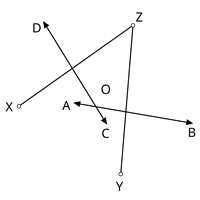
Consider three non-collinear points \(X\), \(Y\) and \(Z\).
Draw two line segments joining the points \(XZ\) and \(YZ\).
Now draw two perpendicular bisectors \(CD\) and \(AB\) of the lines \(XZ\) and \(YZ\) respectively such that they intersect at the point \(O\).
It is known that, every point on the perpendicular bisector of a line segment is equidistant from its end points.
Here the point \(O\) lies on the perpendicular bisector \(CD\) of a line segment \(XZ\). Hence \(O\) is equidistant from \(X\) and \(Z\).
Thus, \(OX\) \(=\) \(OZ\).
Similarly, the point \(O\) lies on the perpendicular bisector \(AB\) of a line segment \(YZ\). Hence \(O\) is equidistant from \(Y\) and \(Z\).
Thus, \(OY\) \(=\) \(OZ\).
\(\Rightarrow\) \(OX\) \(=\) \(OY\) \(=\) \(OZ\).
This implies that the points \(X\), \(Y\) and \(Z\) are at equidistance from the point \(O\).
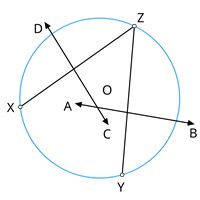
So, any circle drawn with centre \(O\) passing through one of the points \(X\), \(Y\) and \(Z\) passes through other two points also.
Therefore, only one circle is drawn through the three points \(X\), \(Y\) and \(Z\) as shown below.
Important!
By the theorem, the unique circle passing through the three vertices of any triangle is called the circumcircle of that triangle. And its corresponding centre is called the circumcentre and radius is called the circumradius of the triangle.
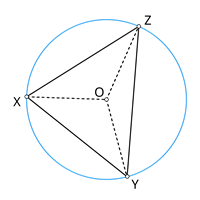
In the figure, \(XYZ\) is a triangle.
The circle through the vertices \(X\), \(Y\) and \(Z\) is the circumcircle of the triangle.
\(O\) is the circumcentre and \(OX = OY = OZ\) is the circumradius.