

When two chords intersect, each of them is divided into two line segments. Prove that if the intersecting chords are of equal length, then the line segments of one chord are equal to the corresponding line segments of the other chord.
Explanation:
Let \(PQ\) and \(RS\) are two equal chords of a circle meeting at point \(E\).
Now, Draw \(OM⊥ PQ\), \(ON⊥ RS\) and join \(OE\), where \(O\) is the centre of circle.
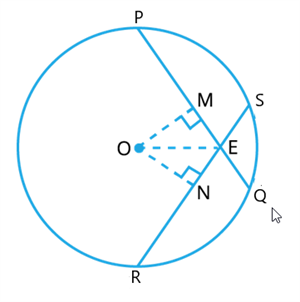
In \(△OME\) and \(△ONE\),
\(OM = \) []
\(OE = \) [common side]
Also, \(∠OME=∠ONE=\)\(^°\)
Therefore, \(△OME≅△ONE\) []
Now, \(EM=\) [CPCT] .....(1)
Also, \(PQ = RS\).
On dividing both sides by \(2\),
\(\frac{PQ}{2}=\frac{RS}{2}\)
Therefore, \(PM=\) .....(2) [Perpendicular drawn from the centre of a circle to a chord, bisects it]
Now, adding (1) and (2) we get,
\(EM + PM = EN + RN\)
Therefore, \(PE=\) .....(3)
Now, \(PQ =RS \).
On subtracting \(PE\) from both the sides,
\(PQ − PE = RS− PE\)
\(QE = RS − RE\) [from (3)]
That is, \(QE =\)
Hence, proved.