

Deduce that the perpendicular bisector of a chord passes through the centre of the circle.
Proof:
Consider a circle with centre \(O\) and a chord \(AB\).
Let \(OC\) be the perpendicular bisector from the centre of a circle \(O\) meeting the chord \(AB\) at the midpoint \(C\).
Join the points \(OA\) and \(OB\).
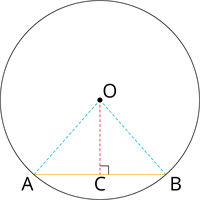
Consider the \(\Delta OAC\) and \(\Delta OBC\).
Here, \(OA\) \(=\) [].
Also, \(C\) is the midpoint of the chord, \(CA =\) .
And, the side \(OC\) is to the triangle \(OCA\) and \(OCB\).
Therefore, \(\Delta OAC\) \(≅\) \(\Delta OBC\) [].
This implies, \(\angle OCA = \angle OCB\). []
It is observed that \(\angle OCA\) and \(\angle OCB\) are .
So, \(\angle OCA\) \(+\) \(\angle OCB\) \(=\) \(^{\circ}\)
This implies, \(\angle OCA = \angle OCB =\) \(^{\circ}\).
We say that , \(OC\) \(AB\).
Here, the line through \(C\) perpendicular to the chord \(AB\) contains the centre \(O\).
Therefore, perpendicular bisector of a chord passes through the centre of the circle.