


If the bisectors of the opposite angles of a cyclic quadrilateral
\(ABCD\) meet the circle again at points
\(X\) and
\(
Y\).Establish that
\(XY\) is a diameter of the circle.
Explanation:
Now, Join \(YD\) and \(YC\).
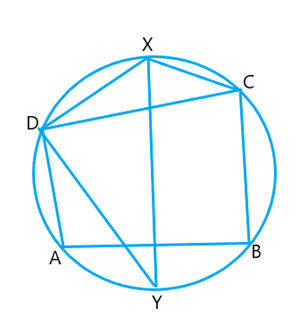
Here, \(ABCD\) is a cyclic quadrilateral.
The bisectors of opposite angles of the cyclic quadrilateral, \(∠A\) and \(∠C\), intersect the circle circumscribing at the points \(X\) and \(Y\) respectively.
Now, the opposite angles of a cyclic quadrilateral are supplementary.
That is, \(∠B + ∠D = \)\(^°\)
\(\frac{1}{2}∠B+\frac{1}{2}∠D=\frac{1}{2} \times \)\(^°\)
\(=\)\(^°\)
That is,\(\angle XDY=\)\(∠CDX + \)\(= 90^°\)
But \(∠CBY =\) []
Therefore, \(∠CDX + ∠CDY = \)\(^°\)
\(∠\)\(= 90^°\)
Thus, \(∠XDY\) is in semicircle. [The diameter of the circle subtends a right angle at the circumference]
Therefore, \(XY\) is diameter of the circle.
Hence, proved.