


Take a triangle \(ABC\), mark the midpoints \(D\), \(E\) and \(F\) on its sides \(AB\), \(BC\) and \(CA\). Prove that connecting these mid-points produces \(four\) congruent triangles inside the original triangle.
Proof:
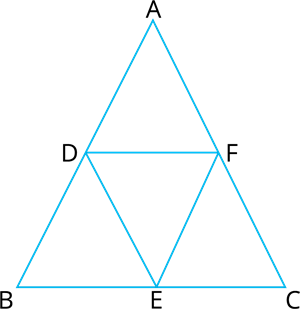
In \(△ ABC\), \(D, E, F\) are the mid-points of the sides \(AB, BC\) and \(CA\) respectively.
Then, \(AD = \) \(=\frac{1}{2} AB\),
\(BE = EC =\frac{1}{2} BC\) and
\(AF =\) \(= \frac{1}{2} AC\)
Then, using the mid-point theorem,
\(EF∥AB\) and \(EF=\frac{1}{2}\)\(=AD = BD \) --------\((1)\)
\(ED∥AC\) and \(ED=\frac{1}{2}\)\(=AF=CF\) and ----------\((2)\)
\(DF∥BC\) and \(DF=\frac{1}{2}\)\(=BE=CE\) -----------\((3)\)
In \(△ ADF\) and \(△ EFD\),
\(AD = EF\) [from \((1)\)]
\(AF = DE\) [from \((2)\)]
\(DF = DF\) (common)
Therefore, \(△ADF≅△EFD\) []
Similrly,\(△DEF≅△EDB\) and
\(△DEF≅△CFE\)
So, \(△ ABC\) is divided into four congruent triangles.
Hence, proved.